
Glossary
249 quantum computing terms from the Quantum Bits books, each with a short definition. 40 have a comic you can read free here; for the rest, each term links to the books that cover it.
Terms without a free comic list the books that cover them. 💬 marks a book with a comic on the term; the others define it in their glossary.
Acceptance Testing
Contractually agreed tests, with thresholds and duration, run on site after installation to confirm a system meets its specification before final payment.
Algorithm
A step-by-step procedure for solving a problem or performing a computation.
Amplitude
One of the numbers that describe a qubit's state, one per possible outcome. Amplitudes can cancel or reinforce like waves; the probability of an outcome comes from the square of its amplitude's size.
Analog Quantum Simulation
Tuning a quantum system's natural behavior so that it imitates another system of interest, instead of running a general program of gates.
Ancilla Qubit
A helper qubit used to detect errors without disturbing the data qubits it monitors.
Ansatz
A parameterized starting circuit whose variables are tuned to approximate the solution to a quantum problem.
Atom
The basic unit of a chemical element, consisting of a nucleus surrounded by electrons.
Atom-loss Detection
In neutral-atom processors, checking whether an atom has been lost from its trap, a common error, so the affected qubit can be flagged as an erasure and handled by error correction.
Atomic Clock
A clock that keeps time by counting the frequency of a transition between atomic energy levels; atomic clocks underpin GPS and official timekeeping.
Avoiding Lock-in
Keeping quantum code portable by using open, widely supported tools and formats and isolating hardware-specific code, so systems can be added or replaced.
Belief Propagation Decoder
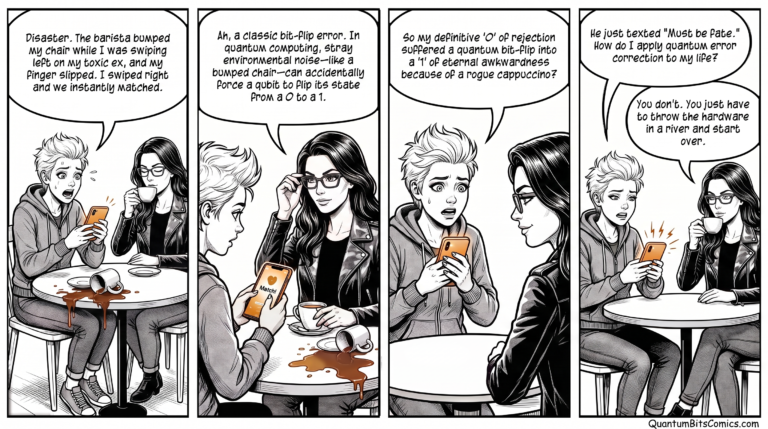
A decoder that passes probabilistic messages between qubit and check nodes to estimate where errors are; for qLDPC codes it is usually paired with a second stage such as ordered-statistics decoding.
Bell Inequality
A mathematical test that distinguishes quantum correlations from any possible classical explanation.
Bell State
A maximally entangled two-qubit state in which measurement outcomes are perfectly correlated in a way that cannot be explained classically.
Bell Test
An experiment comparing correlations measured in different ways against the limit any local hidden-variable explanation allows; entangled qubits exceed it.
Below Threshold and Break-Even
Two separate milestones: “below threshold” means larger codes suppress logical errors further, and “break-even” means a logical qubit outperforms the best physical qubit it is built from.
Benchmarking
Standardized tests that evaluate a quantum processor’s performance in terms of noise, speed, accuracy, and task-specific capability.
Benchmark the Workflow, Not the QPU
Measuring a hybrid quantum-classical job from submission to usable result, including queueing, compilation, data movement and classical processing, rather than timing only the quantum processor; energy per validated result needs the same full boundary.
Binary
A number system using only 0 and 1, the language of classical computers.
Bit
The smallest unit of classical information, always either 0 or 1.
Bivariate Bicycle Codes
A compact family of qLDPC codes that protect several logical qubits with far fewer physical qubits than the surface code, at the cost of some longer-range connectivity.
Blind Quantum Computing
A protocol allowing a user to run computations on a remote quantum computer without revealing the program or data.
Bloch Sphere
A geometric representation of a single qubit's state: pure states are points on the surface of a unit sphere, and noisy (mixed) states lie inside it.
Bosonic Code
A code that stores a qubit in the many levels of one oscillator, such as a microwave cavity; cat and GKP codes are examples.
Boson Sampling
A specialized photonic task designed to demonstrate quantum computational advantage without a universal quantum computer.
Build vs Buy vs Cloud Quantum
How a center obtains quantum computing. The familiar options, build, buy or cloud, bundle separate decisions: where the hardware sits, who owns and operates it, and what kind of access users get.
Buy Direct or Through an Integrator?
The procurement choice between buying a quantum system from its hardware maker or through a systems integrator or HPC solutions provider, which shapes support, integration, upgrades and contract accountability.

Calibration
The process of tuning a quantum processor’s electrical or optical control signals to maximize gate accuracy.
October 4, 2026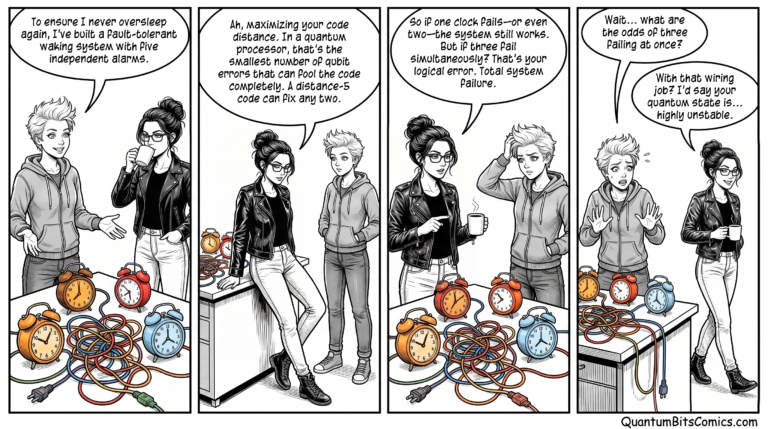
Code Distance
The smallest number of physical errors that can cause an undetected logical error; a distance-d code corrects any (d−1)/2 errors, rounded down.
October 18, 2026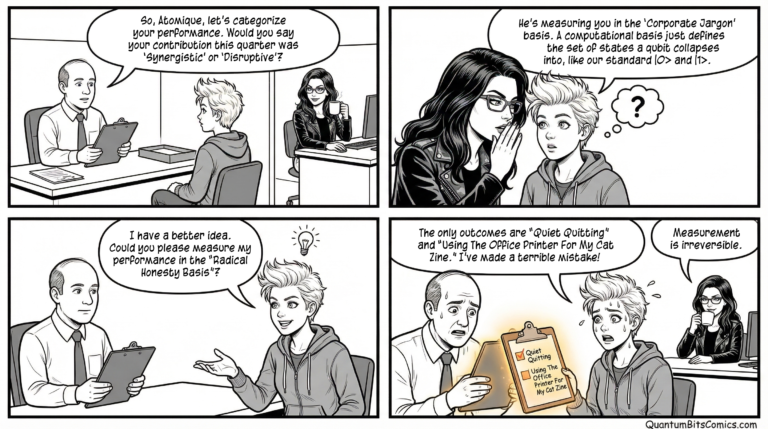
Computational Basis
The standard basis states for a qubit, usually labeled |0⟩ and |1⟩, in which measurements are typically expressed.
October 25, 2026
Controlled Not Gate
A two-qubit gate that flips the target qubit only when the control qubit is in the |1⟩ state.
July 26, 2026Cat Qubits
Qubits encoded in superpositions of coherent states of an oscillator that strongly suppress bit-flip errors, leaving mainly phase flips for an outer code to correct.
Circuit Depth
The number of sequential gate layers in a quantum circuit, determining how long the computation takes.
Classical Computer
A conventional computer that processes information using bits in definite 0 or 1 states.
Classical Computing Runs the Error Correction
The role of classical processors in decoding error signals from an error-corrected quantum computer fast enough to keep up. Time-critical decoding runs on FPGAs, custom chips or closely connected GPUs and CPUs that meet the system's latency and throughput needs; simulation, analysis and other less time-sensitive work can use shared HPC resources.
Clifford Gates
A family of quantum gates whose circuits can be simulated efficiently on a classical computer; universal computing needs at least one non-Clifford gate as well.
Close or Far
Whether classical processing must sit beside a quantum computer, which depends on the loop: batch work tolerates distance, iterative loops depend on where the optimizer runs, and real-time control needs dedicated hardware at the system.
Cloud FinOps and the Quantum Bill
Controlling the cost of pay-per-shot or per-task quantum cloud use, where every iteration of a hybrid loop is billed: emulator testing, shot and spending limits, budget alerts.
Code Switching
Converting encoded information between two different error-correcting codes to access gates that are easy in one code but not the other.
Coherence
The property that allows a qubit to maintain a well-defined superposition over time.
Coherent Errors
Systematic errors, such as a consistent over- or under-rotation, that can build up from gate to gate faster than random errors.
Color Codes
A family of codes on tiled lattices, with checks around each tile, that allow many logical gates to be performed transversally at the cost of larger checks than the surface code.
Concatenated Codes
Error correction built in nested layers, encoding qubits into a code and then encoding those again; below the threshold, protection compounds with each level.
Correlated Errors
Errors that hit several qubits at once from a single cause, such as a cosmic ray or a control glitch, making them harder for error correction to handle.
Correlation
A statistical relationship between two variables where knowing one gives information about the other.
Crosstalk
Unwanted interference between neighboring qubits when operating on one affects another.
Cryogenic Cooling
The use of extreme refrigeration, often below 20 millikelvin, to reduce thermal noise in quantum processors.
CSS Code
A code built from two classical codes, with separate checks for bit flips and phase flips; Steane, surface, color and bivariate bicycle codes are all CSS codes.
Decoder Latency
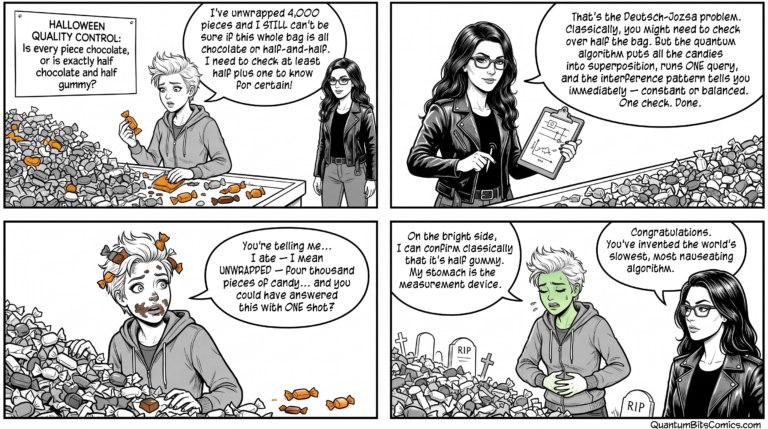
The delay between a round of checks and the decoder's answer about it, as distinct from throughput, keeping up with the stream.
Decoding
The classical step that interprets the history of syndrome measurements to infer the most likely errors, so they can be corrected or tracked.
Decoherence
The loss of a qubit's quantum information through unwanted interaction with its environment.
Decoherence Time (T1/T2)
The characteristic times over which a qubit loses energy to its environment (T1) and loses phase coherence (T2).
Detection Event
A check whose result changes from one round to the next: the basic clue a decoder works from.
Diamond Vacancy Centers
Atomic-scale defects in diamond whose electron spins serve as qubits operable at room temperature.
Dilution Refrigerator
A cryogenic system that cools superconducting quantum chips to millikelvin temperatures.
DiVincenzo Criteria
Five requirements a physical system must satisfy to function as a scalable quantum computer.
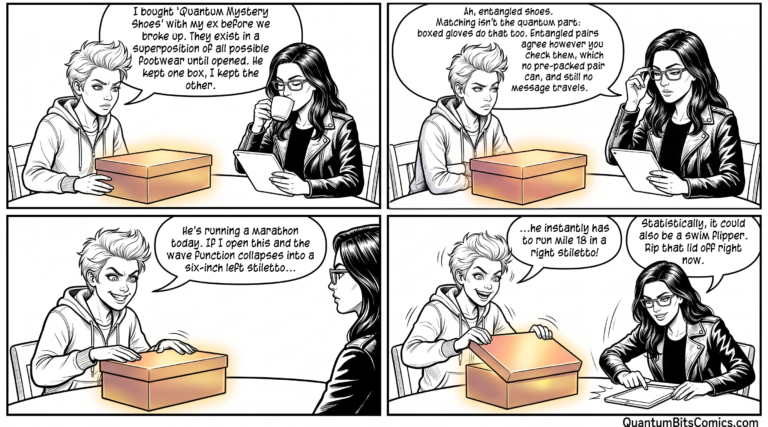
Entanglement
A uniquely quantum relationship between particles in which their states cannot be fully described independently, even when the particles are far apart.
April 19, 2026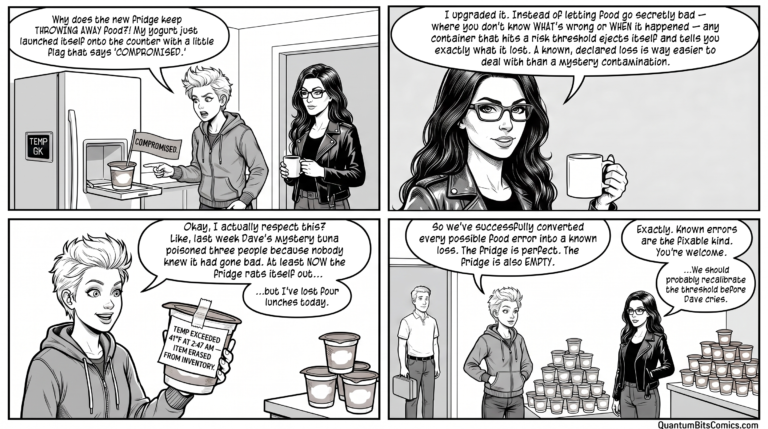
Erasure Conversion
Turning hard-to-locate errors into “erasures,” errors whose location is known, which are much easier to correct.
October 11, 2026Early Fault Tolerance
The near-term regime that uses limited error correction to run longer computations than raw hardware allows, before full large-scale fault tolerance is available.
Eastin-Knill Theorem
The result that no code able to detect an arbitrary single-qubit error can perform a universal set of gates transversally.
Eigenstate
A quantum state that produces a definite, predictable outcome when a particular property is measured.
Eigenvalue
The specific value obtained when a quantum observable is measured on one of its eigenstates.
Eigenvalue and Eigenstate
Electron
A subatomic particle carrying negative charge, whose quantum properties are used in several qubit designs.
Emulator
Classical software that imitates a quantum computer, used to develop and test programs; exact emulation is practical only for small numbers of qubits.
Emulators on Your GPUs
Classical software that simulates small quantum programs, used to develop and debug code; an exact state-vector simulation needs twice the memory for every added qubit.
Entanglement Swapping
A protocol that creates entanglement between two particles that have never interacted, by performing a joint measurement on intermediary particles.
Erasure
An error whose location is known, such as a lost atom or photon; much easier to correct than a hidden error.
Erasure Qubits (dual-rail)
Qubits encoded across two modes, such as two optical paths or two microwave cavities, so that the dominant error, loss, reveals its own location as an erasure.
Error Rate
The probability that a quantum gate or measurement produces an incorrect result.
Error Threshold
The physical error rate, counting gates, measurements and idling together, below which making a code larger lowers the logical error rate; its value depends on the code, the noise and the decoder.
Exponential
Growth in which a quantity increases by a constant multiplicative factor over equal steps, often making problems rapidly hard to solve classically.
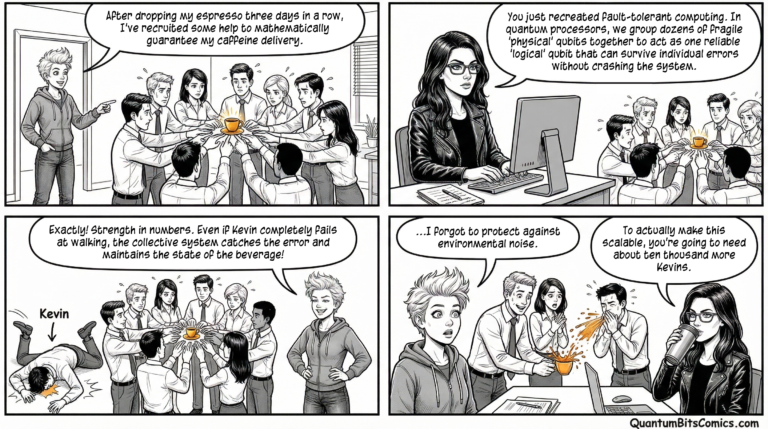
Fault-Tolerant Syndrome Extraction
Running error checks with circuits designed so that a single fault during checking cannot spread into an uncorrectable error.
Feed Forward
Measuring some qubits mid-computation and using those results, in real time, to choose the operations applied to the remaining qubits.
Flag Qubit
An extra ancilla that flips when a fault during a check could spread to several data qubits, warning the decoder.
Floquet Codes
Codes defined by a repeating schedule of simple measurements rather than a fixed set of checks.
Fluxonium
A superconducting qubit design that uses a superinductor to achieve longer coherence times than the transmon.
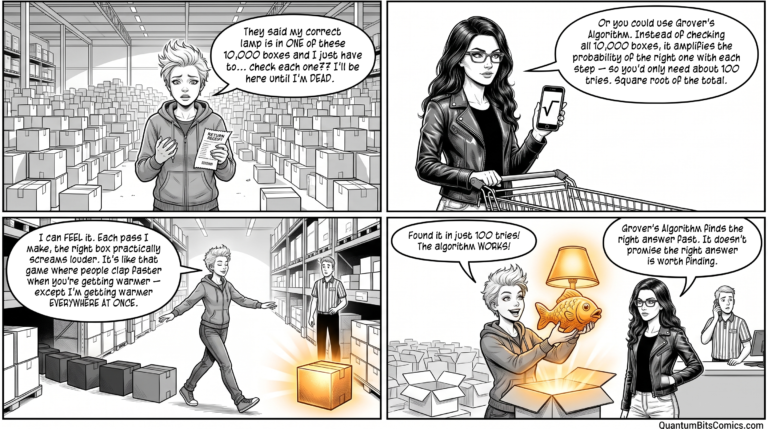
Gate-Model Computing
Running a quantum program as a sequence of operations (gates) on qubits, the quantum counterpart of a classical instruction stream. Also called digital quantum computing.
Gate Fidelity
A measure of how closely a physical quantum gate matches its ideal mathematical operation.
Gate Synthesis
Approximating a gate the hardware cannot perform directly, such as an arbitrary rotation, with a sequence of available gates like Clifford and T gates.
Gate Teleportation
Performing a gate by consuming a prepared resource state, then measuring and applying a correction chosen by the outcome; how magic states deliver T gates.
GKP Codes
Gottesman-Kitaev-Preskill codes: bosonic codes, stored in a single oscillator, that encode a qubit in its continuous states and correct small shifts in position and momentum.
Gottesman-Knill Theorem
The result that circuits of Clifford gates alone, starting from simple states and ending in standard measurements, can be simulated efficiently on a classical computer.
Ground State
The lowest-energy configuration of a quantum system, often the target of quantum simulation algorithms.
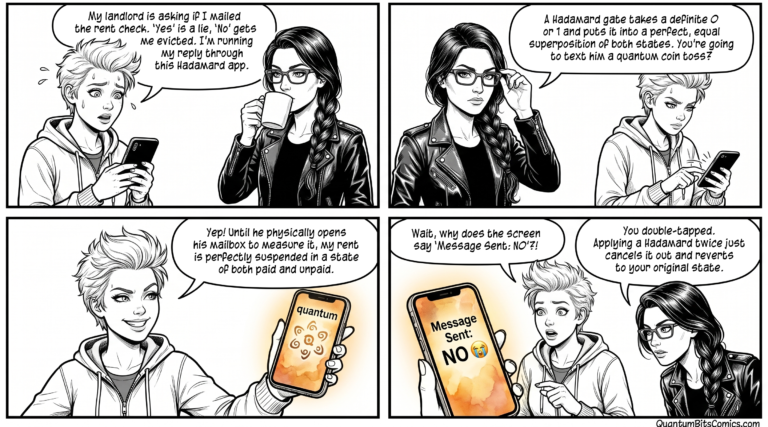
Hadamard Gate
A single-qubit gate that maps basis states into equal superpositions, making it central to many quantum algorithms.
May 10, 2026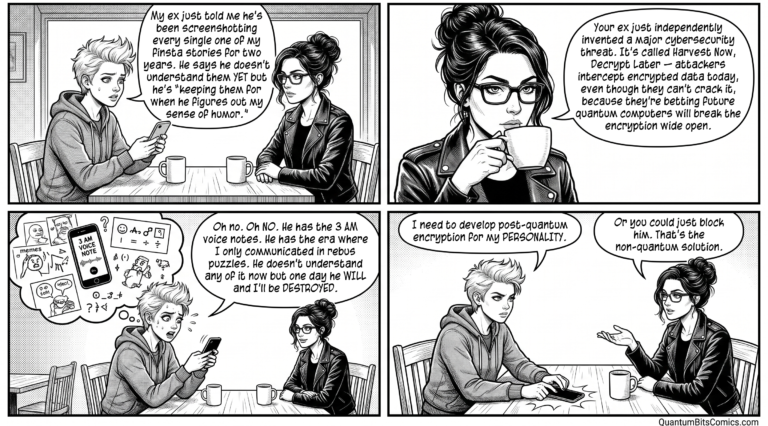
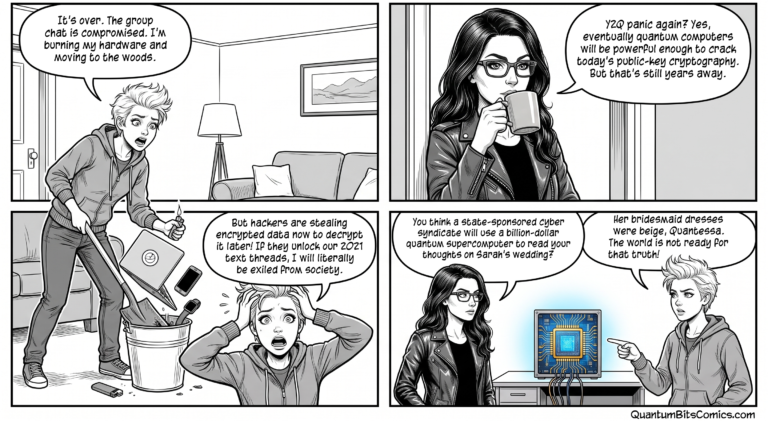
Harvest Now Decrypt Later
Most internet security today rests on a single mathematical assumption: that factoring large numbers is prohibitively difficult.
November 8, 2026Hamiltonian
The mathematical operator that describes the total energy and time evolution of a quantum system.
Heisenberg Uncertainty Principle
The principle that certain pairs of observables, such as position and momentum, cannot both be specified with arbitrary precision at the same time.
Hybrid Algorithms
Computational strategies that divide work between a quantum processor and a classical computer.
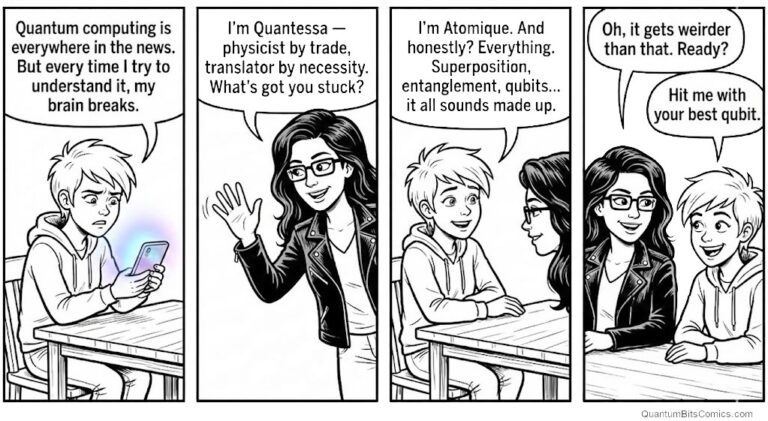
Interference
The way quantum amplitudes add or cancel, which algorithms use to reinforce correct answers and suppress wrong ones.
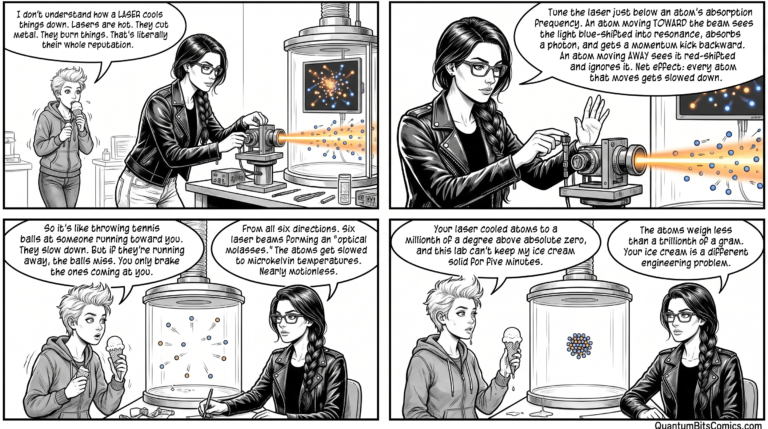
Laser
A device that emits a precisely controlled beam of light, used to trap and manipulate atoms in quantum computers.
Lattice Surgery
A technique for entangling and operating on surface-code logical qubits by temporarily merging and splitting their code patches.
Leakage Errors
Errors in which a qubit escapes its two working states, 0 and 1, into some other physical state, requiring special techniques to detect and remove.
Logical Clock Speed
How many error-corrected logical operations a quantum computer completes per second, set by its QEC cycle time, the number of check rounds each operation needs, and decoding speed.
Logical Error Rate
The chance that errors slip past the code and corrupt the logical qubit, usually quoted per round of checks or per logical operation; below threshold it falls exponentially with code distance.
Logical Qubit
A unit of quantum information protected from errors by encoding it across multiple physical qubits.
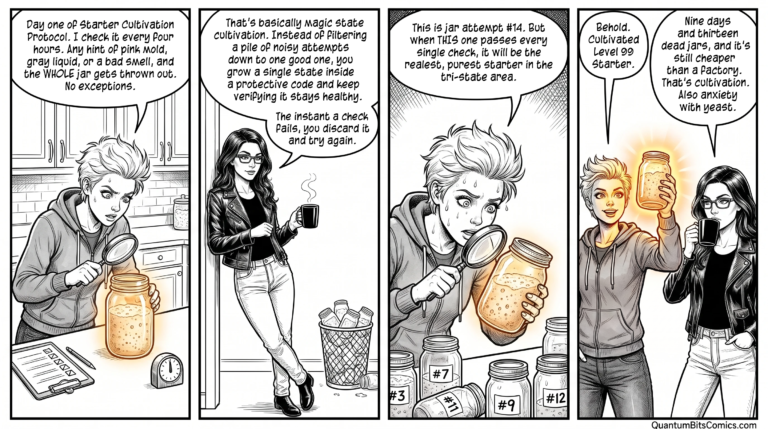
Magic-State Factory
A region of a fault-tolerant machine that only produces magic states, by distillation or cultivation, for the rest of the computer.
Magic State Distillation
Turning many noisy magic states into fewer, higher-fidelity ones with an error-detecting code and postselection; the classic source of states for T gates.
Magic States
Special resource states that are consumed, through gate teleportation, to perform non-Clifford gates such as the T gate in an error-corrected computer.
Measurement-Based Quantum Computing
Computing by measuring the qubits of a large entangled resource state one at a time, each choice steering the calculation; used in many photonic designs.
Mid-Circuit Measurement
Measuring selected qubits partway through a computation while the remaining qubits continue evolving.
Momentum
A physical property describing the quantity of motion of an object, equal to its mass times its velocity.
More Qubits Is Not Always Better
The principle that qubit count alone says little about a system's usefulness; error rates, connectivity and coherence matter as much.
Multi-QPU Scaling
Linking separate quantum processors into one larger system through links that share entanglement, usually single photons over fiber; demonstrated in research, slower and less reliable than gates inside one processor. Processors coordinated only through classical networks remain separate machines.
MWPM Decoder
Minimum-weight perfect matching: a decoder that pairs detection events to minimize total weight, with weights reflecting an error model; the correction need not reproduce the actual error history.
The Moving Goalposts
The pattern of improved classical algorithms matching claimed quantum advantages, which is why quantum results must be compared with the best current classical methods.
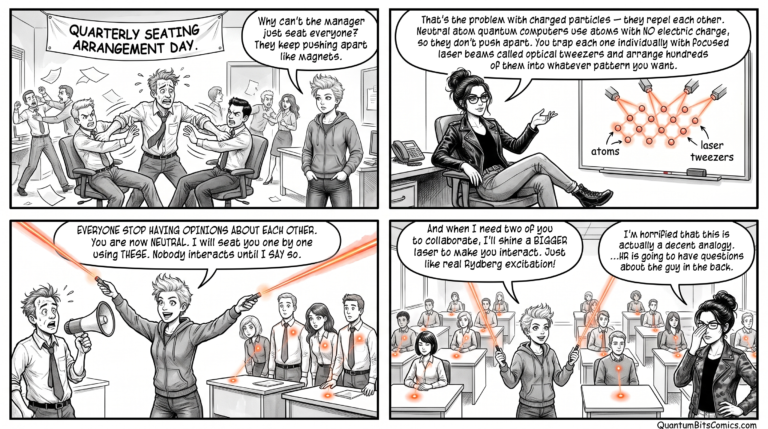
Neutral Atoms and Quantum Computing
A quantum computing platform that uses laser-trapped individual atoms as qubits.
March 29, 2026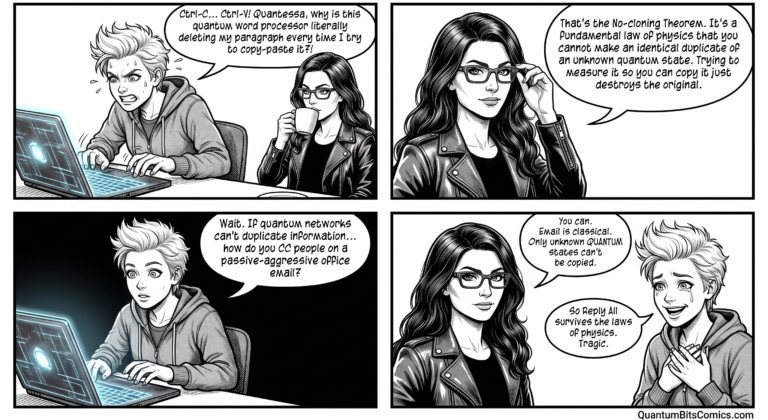
No Cloning Theorem
The impossibility of creating an exact copy of an unknown quantum state, a fundamental law of quantum mechanics.
September 13, 2026Native Gates
The specific set of quantum operations a processor can execute directly in hardware.
NISQ
Noisy intermediate-scale quantum: devices that run circuits without full error correction.
Noise
Any unwanted disturbance that degrades a qubit's quantum state, from stray heat to electromagnetic interference.
Noise Bias
A strong imbalance between error types, such as far fewer bit flips than phase flips, which a code can exploit.
Noise Model
A mathematical description of the errors a quantum processor experiences, used to predict performance and design error correction and mitigation strategies.
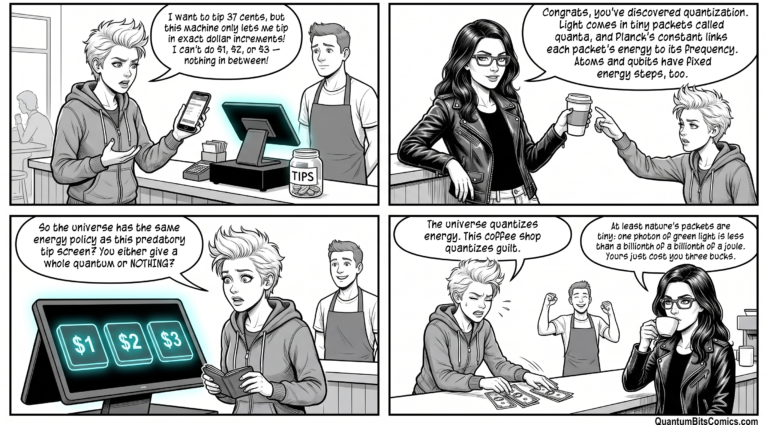
Parity Check
A procedure that compares qubits to detect whether an error has occurred without revealing the actual data stored in them.
Pauli Frame
A software record of the corrections a decoder has found, applied by reinterpreting later operations and measurements instead of pulsing the qubits.
Pauli Gates
A set of three single-qubit operations, X, Y, and Z, that correspond to fundamental transformations of a qubit state.
Phase Flip
An error that reverses the relative sign between the |0⟩ and |1⟩ components of a qubit’s superposition.
Photon
A single particle of light, used as a qubit carrier in photonic quantum computing and quantum communication.
Photonic Quantum Computing
A quantum computing approach that encodes information in photons and processes it using optical components.
Physical Qubit
A single hardware qubit, such as one atom, one ion or one superconducting circuit, as opposed to an error-corrected logical qubit.
Post-Quantum Cryptography
Classical cryptographic algorithms, for key establishment and digital signatures, designed to remain secure even against attacks by future quantum computers.
Postselection
Keeping only the runs or states that pass a check and discarding the rest; it raises quality at the cost of repeated attempts.
Probability
A number between 0 and 1 describing how likely an event is to occur.
Probability Amplitude
A complex number whose squared magnitude gives the probability of a quantum measurement outcome.
Pseudo-Threshold
The physical error rate at which one specific code, at one size, gives a logical error rate equal to the physical one.
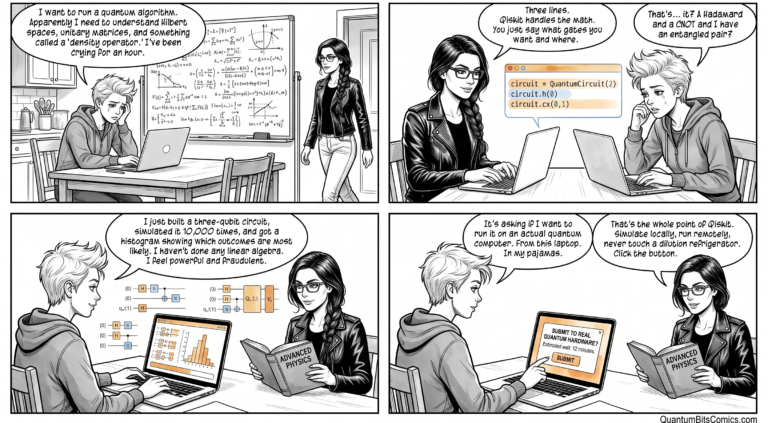
Qiskit
IBM's open-source software framework for programming and running quantum circuits on real and simulated hardware.
June 28, 2026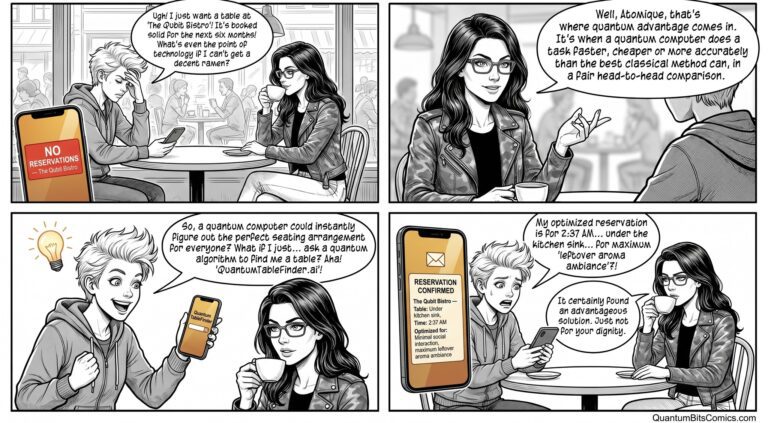
Quantum Advantage
A demonstration that a quantum computer outperforms the best known classical approach on a specific task; claims stay provisional until independent classical experts have tried to match them.
February 22, 2026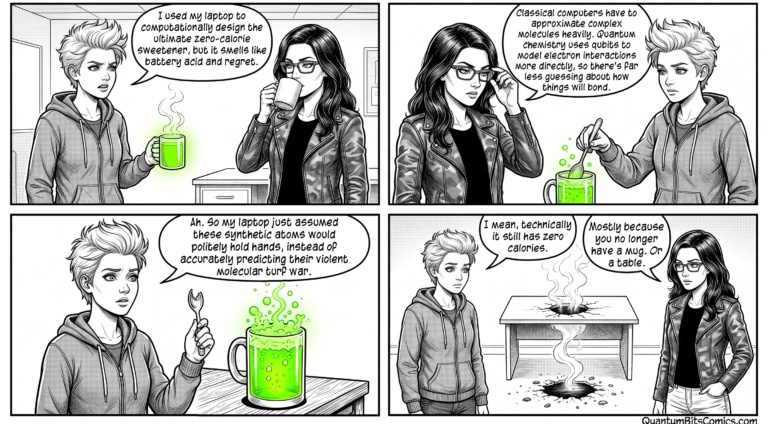
Quantum Chemistry
The use of quantum computers to simulate molecular behavior, which could improve drug discovery and materials science.
November 1, 2026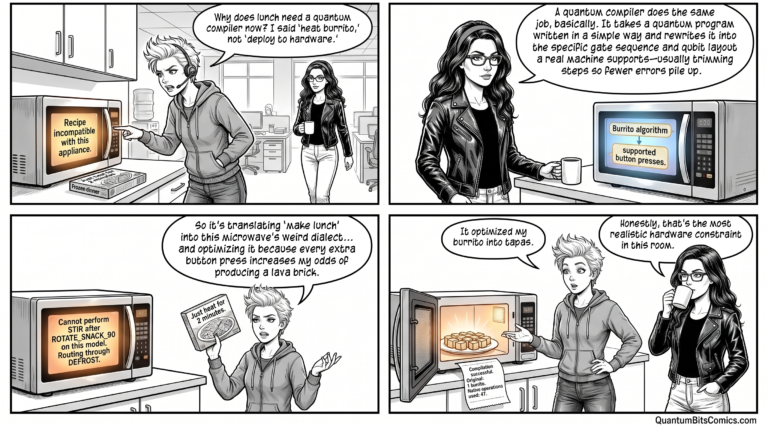
Quantum Compiler
Software that turns an algorithm into the gates and pulses a particular machine can run, respecting its connectivity and native gates.
August 23, 2026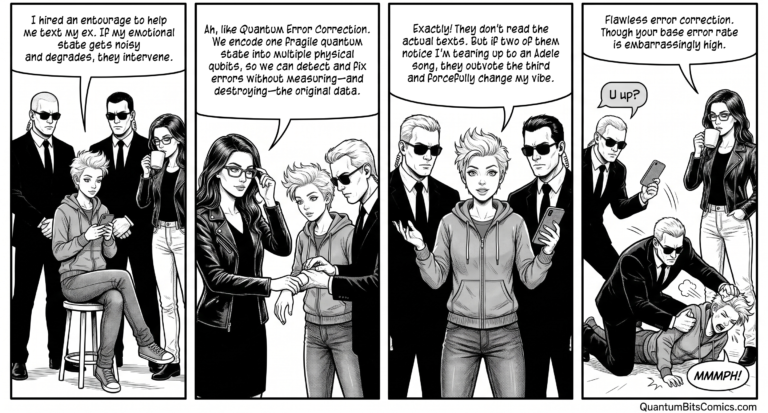
Quantum Error Correction
Techniques that protect quantum information by encoding it in an entangled state of many physical qubits and repeatedly checking for errors.
April 12, 2026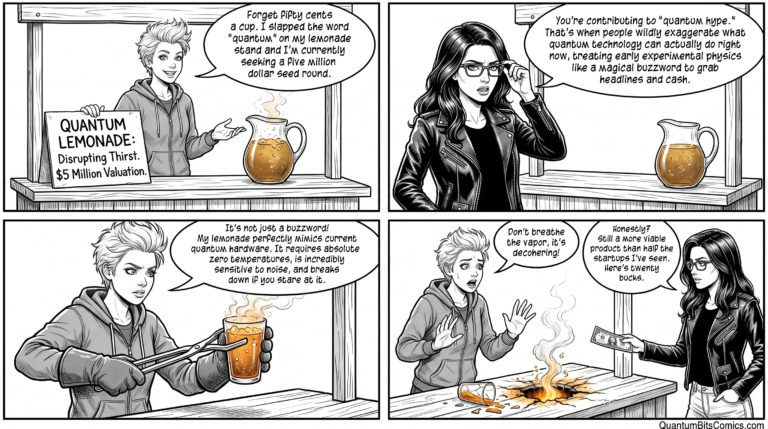
Quantum Hype
The gap between public expectations of near-term quantum computing and the technology's actual current capabilities.
March 22, 2026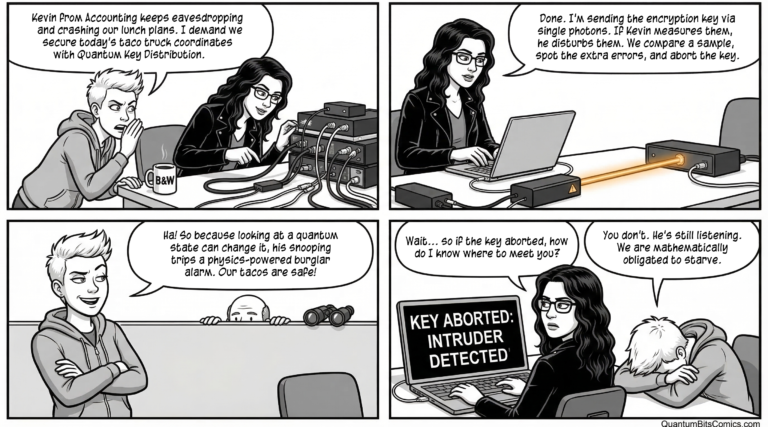
Quantum Key Distribution
A protocol that uses quantum states to share encryption keys so that eavesdropping can be detected. Physics guarantees that detection only under the protocol's security assumptions and with ideal devices; real systems must also be protected against device flaws and side-channel attacks.
May 31, 2026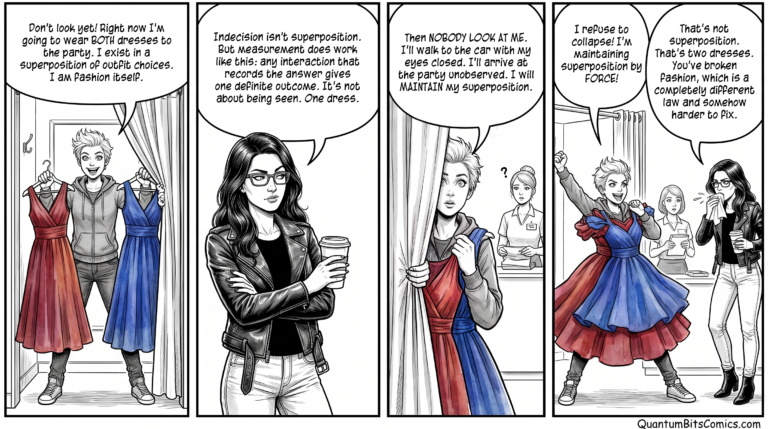
Quantum Measurement
Extracting classical information from qubits. A full readout in the 0/1 basis collapses a qubit's superposition into a definite outcome; a check can instead measure one joint property of several qubits.
April 26, 2026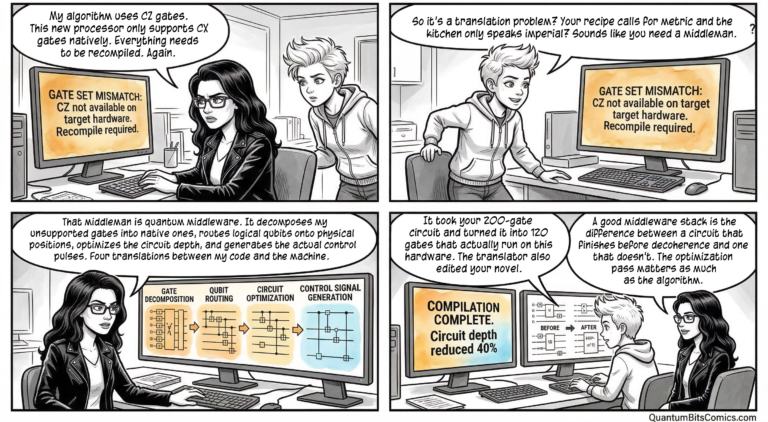
Quantum Middleware
Software that sits between a user's quantum application and the hardware, handling compilation, scheduling, and error management.
August 30, 2026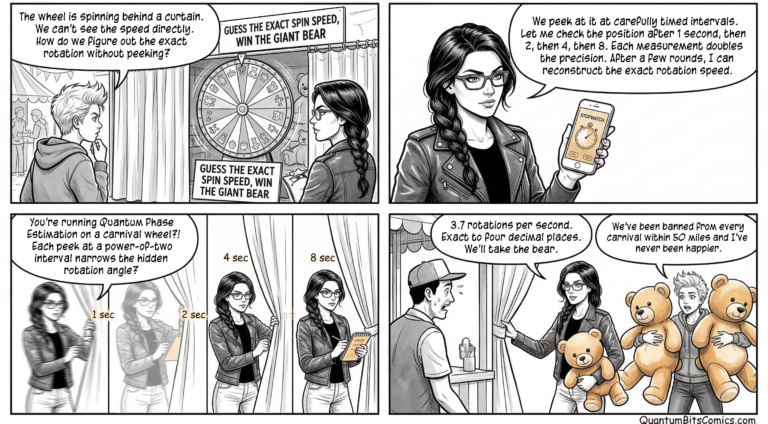
Quantum Phase Estimation
An algorithm that determines the eigenvalue associated with a quantum state, a key subroutine in many quantum algorithms.
May 17, 2026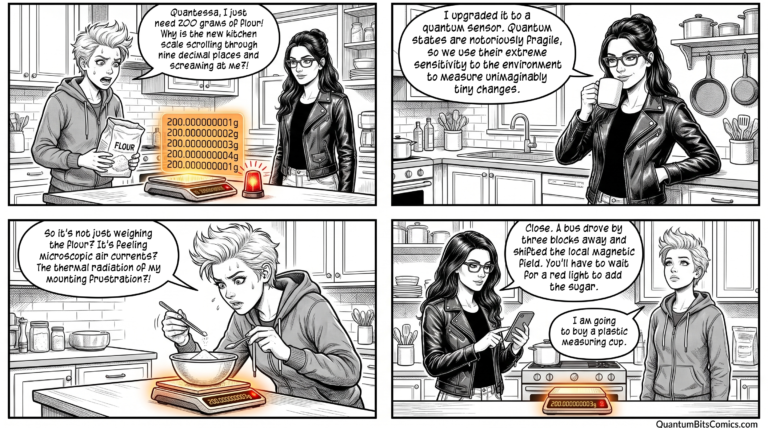
Quantum Sensing
Using quantum systems to measure quantities such as time, motion, gravity or magnetic fields; in particular applications and conditions this can improve accuracy, stability or sensitivity over classical sensors.
July 5, 2026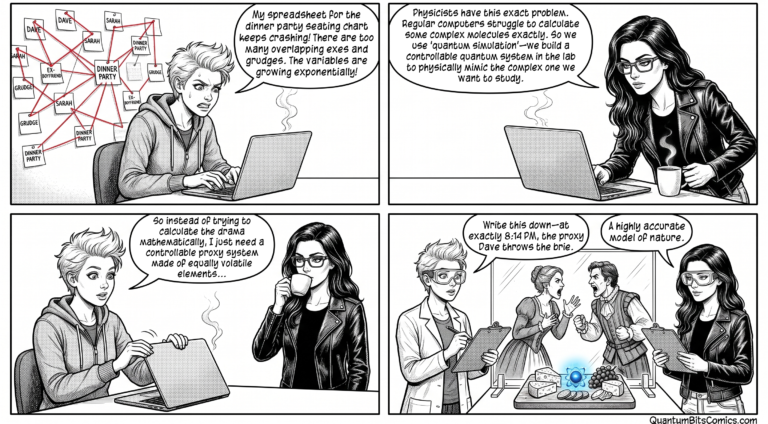
Quantum Simulation
Using quantum hardware to model the behavior of other quantum systems, such as molecules and materials.
July 19, 2026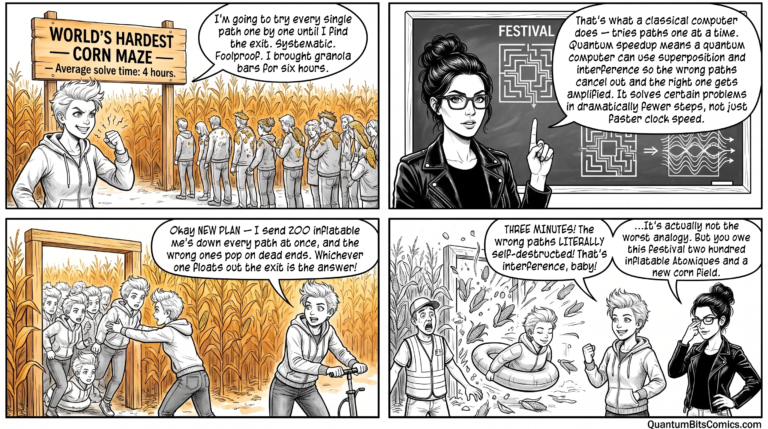
Quantum Speedup
The advantage a quantum algorithm provides over the best known classical algorithm for a specific problem.
July 12, 2026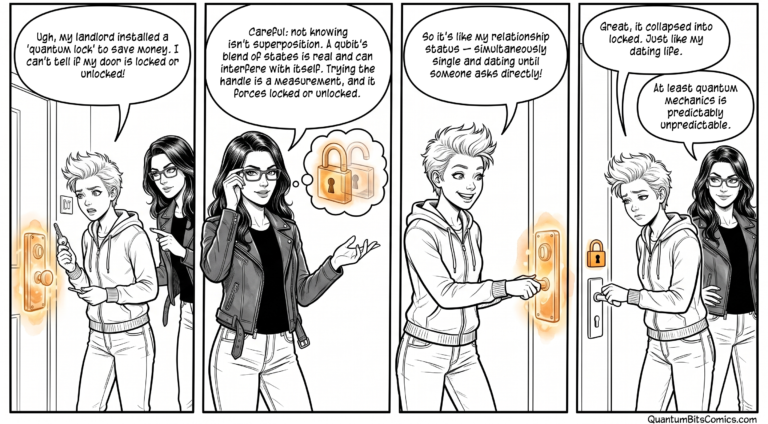
Quantum Superposition
A qubit state that is a weighted combination of 0 and 1, whose amplitudes can interfere; measurement gives one definite outcome, and unwanted interaction with the environment can destroy it.
March 15, 2026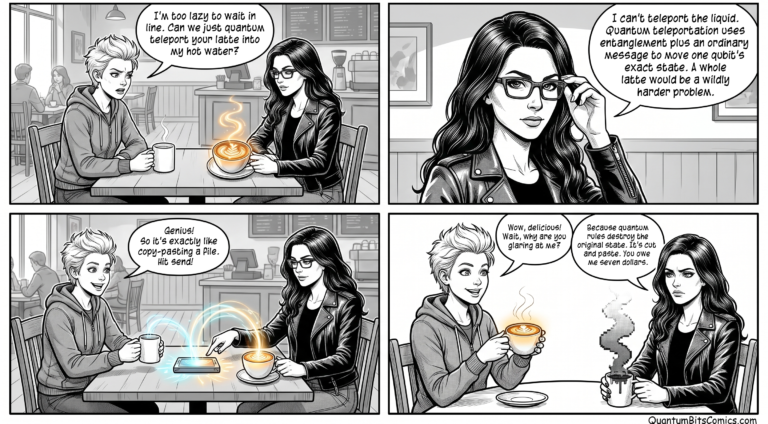
Quantum Teleportation
Moving a quantum state from one qubit to another using shared entanglement, a measurement and classically communicated corrections.
May 3, 2026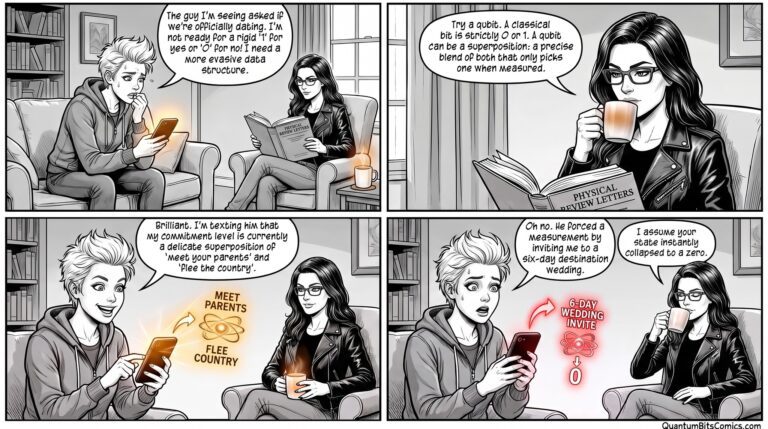
Qubit
The basic unit of quantum information: a superposition, or weighted combination, of 0 and 1 that gives one definite value when measured.
March 1, 2026QAOA
Quantum Approximate Optimization Algorithm — a hybrid algorithm that alternates quantum and classical steps to find near-optimal solutions.
QEC Cycle
One round of error-correction checks: entangling helper qubits with data qubits, measuring the helpers and resetting them.
qLDPC
Quantum low-density parity-check codes, whose checks each touch only a few qubits. The surface code is the simplest; newer members add some long-range connections to protect several logical qubits with far fewer physical qubits.
Quantum-HPC Integration
Connecting quantum processors with classical high-performance computing systems so that hybrid workflows can use each for the steps it suits best.
Quantum Annealer
A special-purpose analog quantum device that seeks low-energy configurations of a programmed system, used for optimization and sampling; it does not guarantee the optimal solution.
Quantum Backaction
The unavoidable disturbance a measurement imposes on a quantum system, a consequence of the measurement postulate.
Quantum Channel
A communication link that transmits quantum information, typically encoded in photons sent through optical fiber or free space.
Quantum Circuits
A diagram and execution model describing a quantum computation as a sequence of gates applied to qubits.
Quantum Computing as a Service (QCaaS)
Cloud-based access to quantum processors, letting users run quantum computations without owning the hardware.
Quantum Cryptography
Security protocols that use quantum mechanical principles to protect communication. Their security proofs hold under stated assumptions about the protocol and devices, so real implementations still need careful engineering and certification.
Quantum Error Mitigation
Techniques that reduce the bias noise causes in averaged results without full error correction; used today and expected alongside early error correction.
Quantum Finance
The application of quantum algorithms to financial problems such as portfolio optimization and risk analysis.
Quantum Firmware
Low-level control software that translates gate instructions into the precise electrical and laser pulses that manipulate qubits.
Quantum Fourier Transform
A quantum algorithm that efficiently extracts frequency information from a quantum state, central to many quantum speedups.
Quantum Gate
An operation that transforms the state of one or more qubits, the quantum equivalent of a logic gate.
Quantum Gravimeter
A sensor that measures local gravity by tracking falling laser-cooled atoms with atom interferometry; its absolute, low-drift readings suit some survey and monitoring tasks.
Quantum Internet
A future network that transmits quantum information between distant nodes using entanglement and quantum repeaters.
Quantum Jobs in the Batch Queue
Submitting quantum work through an HPC center's existing scheduler, so a job can request quantum time alongside classical nodes, together or in stages, as its workflow requires.
Quantum Machine Learning
Algorithms that use quantum processors with the aim of accelerating or improving pattern recognition, classification, and optimization tasks.
Quantum Magnetometry
Measuring magnetic fields with quantum sensors such as atomic vapors or defects in diamond, which can improve sensitivity, size or operating conditions in particular applications.
Quantum Memory
A device that stores quantum states faithfully over time, essential for quantum networks and repeaters.
Quantum Monte Carlo
A family of classical simulation methods that use random sampling to approximate the behavior of quantum systems.
Quantum Optimization
Using quantum algorithms to search for the best solution among many possibilities, with the potential to outperform classical methods on some problems.
Quantum Oracle
A black-box subroutine in a quantum algorithm that encodes the problem by marking correct answers with a phase change.
Quantum Parallelism
The apparent ability of a quantum computer to evaluate a function on many inputs simultaneously through superposition, though interference is what actually extracts a single useful answer.
Quantum Radar
A proposed sensing approach that may use quantum correlations to improve detection in noisy environments. Advantages have been shown only at very low signal power and short range.
Quantum Random Number Generator
A device that produces truly random numbers by measuring inherently unpredictable quantum events.
Quantum Register
A collection of qubits that together store and process quantum information within an algorithm.
Quantum Repeater
A network node that extends the range of quantum communication by creating entanglement across intermediate distances.
Quantum Reservoir Computing
A machine learning approach that uses the complex dynamics of a quantum system as a fixed computational resource.
Quantum Roadmap
A multi-year plan outlining the milestones needed to progress from today's noisy devices to fault-tolerant quantum computers.
Quantum State
The complete mathematical description of a quantum system at a given moment.
Quantum Supremacy
A milestone in which a quantum computer performs a specific task believed to be impractical for classical computers; such claims can be overturned by better classical methods, and the term is often replaced by ‘quantum computational advantage.’
Quantum Talent Strategy
A plan for building quantum capability by cross-training existing engineers and scientists rather than competing only for scarce quantum specialists.
Quantum Tunneling
A phenomenon where a quantum particle passes through an energy barrier that would be impassable in classical physics.
Quantum Utility
The point at which a quantum computer becomes a useful scientific tool, reliably running problems too large for exact classical simulation, even before it delivers a proven business advantage.
Quantum Volume
A benchmark that measures a quantum computer’s overall capability by combining qubit count, connectivity, and gate fidelity into a single number.
Quantum Winter
A potential period of reduced funding and interest if quantum computing fails to meet near-term expectations.
Qubit Connectivity
The pattern of which qubits can directly interact in a quantum processor, affecting circuit efficiency.
Qubit Fidelity
The accuracy with which a qubit preserves and reproduces its intended quantum state, typically expressed as a percentage close to 100%.
Qubit Overhead
The number of physical qubits needed per logical qubit, from tens to thousands depending on the code, the hardware and the target error rate.
Qubit Shuttling
Physically moving qubits, such as atoms or ions, between positions or zones of a processor so distant qubits can interact.
Qudit
A quantum information unit with more than two levels, generalizing the qubit to higher-dimensional states.
Questions to Ask a Quantum Vendor
A due-diligence checklist for looking past qubit counts: error rates, connectivity, coherence, published benchmarks and evidence of advantage on your problem.
The QPU Meets IT Security
Bringing a quantum computer under a center's security and IT operations: network segmentation, identity and access control, controlled vendor access, change control and incident response. Migrating the center's cryptography to post-quantum algorithms is a separate task.
The Quantum Help Desk
User support for quantum computing at an HPC center: training, example workflows and staff who bridge domain science and quantum programming.
Readout
Real-Time Decoding
Decoding syndrome data as fast as the quantum computer produces it, so corrections and dependent operations never wait on a growing backlog.
Reconfigurable Atom Arrays
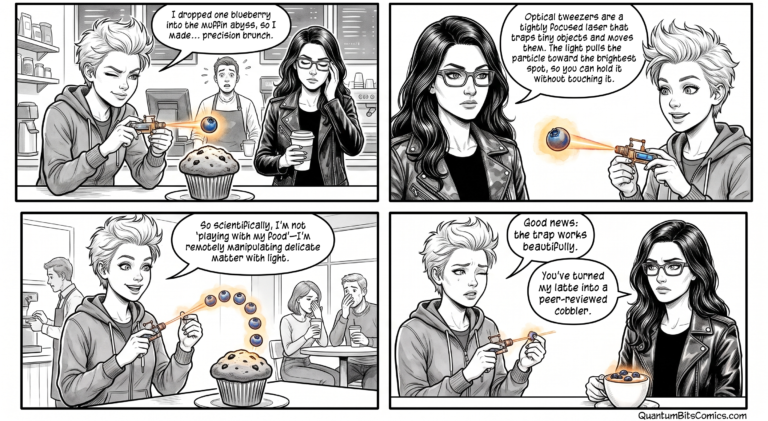
Neutral-atom processors whose qubits can be rearranged with optical tweezers during a computation, giving flexible, on-demand connectivity.
Relative Phase
The difference in phase between components of a superposition, invisible to direct measurement but critical for interference.
Repetition Code
The simplest code: a value stored as several identical copies (000 or 111) and checked by comparing neighbors; its quantum version catches only one type of flip.
Reporting Success to Your Funders
Showing a quantum system's value with users, research results, integrated workflows, people trained and honest classical comparisons, not just utilization.
Resource Estimation
Calculating the physical qubits, gates, runtime, and magic states that a target algorithm would require on a fault-tolerant machine.
Rotation Gate
A single-qubit gate that rotates the qubit's state by a specified angle around an axis of the Bloch sphere.
Rubidium
An alkali metal whose atoms are widely used as qubits in neutral-atom quantum computers.
Rydberg Blockade
A mechanism where exciting one atom to a high-energy Rydberg state prevents nearby atoms from being excited, enabling controlled interactions.
Rydberg State
A highly excited atomic state whose outer electron orbits far from the nucleus, making nearby atoms interact strongly; the basis of neutral-atom two-qubit gates.
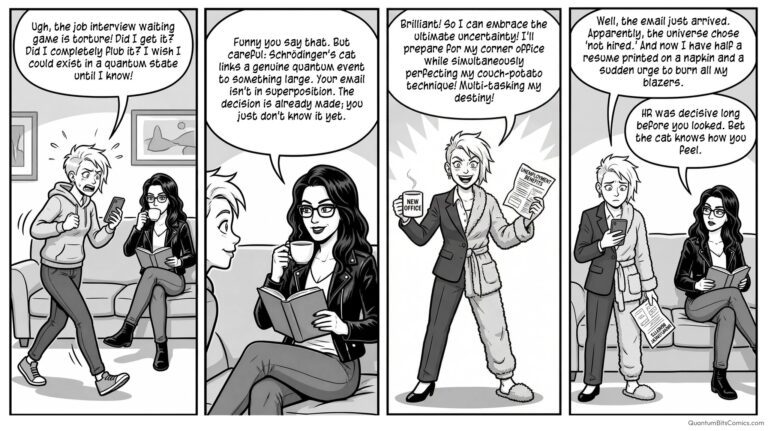
Schrödinger’s Cat
Schrödinger's 1935 thought experiment in which a cat's fate is tied to a quantum event, so quantum rules alone would leave it alive and dead at once until observed. He meant it to show how strange superposition looks when stretched to everyday objects.
March 8, 2026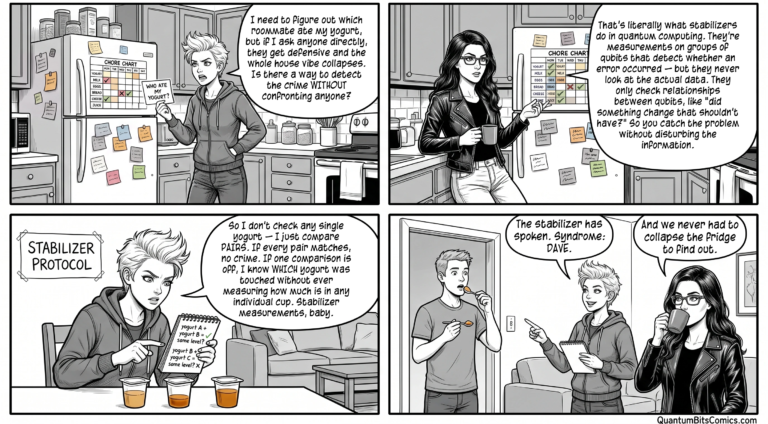
Stabilizers
Multi-qubit checks that leave every valid encoded state unchanged; measuring them reveals whether an error has occurred without reading the encoded data.
September 6, 2026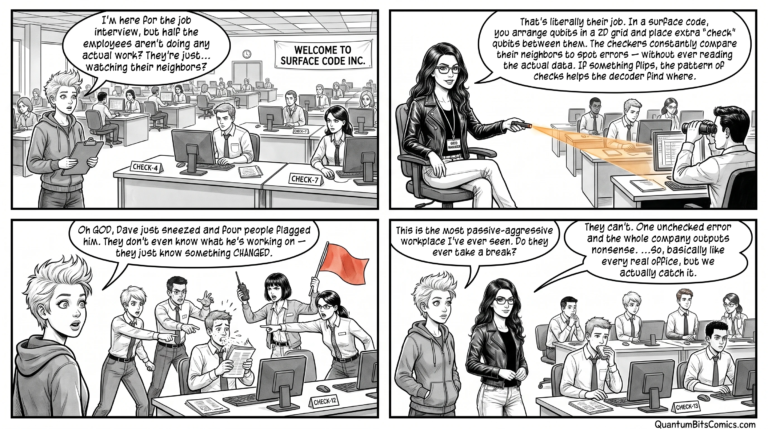
Surface Codes
A leading quantum error correction scheme that arranges physical qubits in a two-dimensional grid with nearest-neighbor checks.
June 21, 2026Scalability
The ability of a quantum system to grow in size while maintaining performance and error control.
Shor's Algorithm
A quantum algorithm for factoring large integers much faster than any known classical algorithm, with major implications for widely used public-key cryptography.
Shot
One run of a quantum program, ending in one measurement. Programs are repeated thousands of times and the answer is built from the statistics.
Shots, Not Node-Hours
Accounting for quantum system time in shots (repeated runs of a circuit), tasks or reserved hours, rather than the node-hours used for classical allocations.
Single-Qubit Gate
A quantum operation that acts on one qubit at a time, such as the Hadamard, Pauli, or rotation gates.
Single Photon Source
A device designed to emit one photon at a time on demand; real sources are rated by efficiency, purity and indistinguishability.
Spin Qubit
A qubit encoded in the intrinsic angular momentum of a single electron, typically confined in a semiconductor quantum dot.
State Injection
Preparing a special state, such as a magic state, on a physical qubit or small code, then growing a full code around it.
State Preparation
The process of initializing qubits into a known quantum state before computation begins.
Steane's Code
A seven-qubit quantum error correction code that can detect and correct any single-qubit error.
Subsystem Codes
Codes that leave some extra degrees of freedom unprotected so that their checks can be measured in smaller, simpler pieces.
Superconducting Qubits
Qubits made from superconducting circuits cooled near absolute zero, the most widely deployed quantum computing technology today.
Syndrome
The pattern of check results from a round of error-correction measurements, which points to likely errors without revealing the data.
Syndrome Measurement
A measurement on ancilla qubits that gives clues about which error most likely occurred, without collapsing the protected data.
The Site Survey
An assessment of whether a facility meets a quantum system's physical needs: floor space and loading, power, cooling, vibration, magnetic fields and temperature stability.
T-count
The number of T gates an algorithm needs, a common measure of its cost on an error-corrected machine.
T-depth
The number of layers of T gates that must run one after another; it strongly affects how long an error-corrected computation takes.
T Gate
A non-Clifford single-qubit gate that applies a π/4 phase, making universal quantum computation possible when combined with Clifford gates.
Three Qubits, Eight Numbers
Why describing entangled qubits takes one number (amplitude) for every combination of their values, doubling with each added qubit, while a measurement returns only one combination.
Timesharing One QPU
Sharing one quantum processor, which usually runs one job at a time, among many users by interleaving short jobs, reserving blocks for long ones, scheduling around calibration and keeping classical work off the device.
Toffoli Gate
A three-qubit, non-Clifford gate that flips a target qubit only when both control qubits are 1.
Topological Qubit
A proposed qubit that stores information in a global property of an exotic material, aiming for built-in protection against local noise. Not yet clearly demonstrated.
Transmon Qubit
The most common superconducting qubit design, prized for its reduced sensitivity to charge noise.
Transversal Gate
Fault-tolerant gates applied to each physical qubit of a code independently, so a single fault cannot spread within a code block.
Trapped Ions
A quantum computing platform that uses electromagnetically confined individual ions as qubits, manipulated with laser pulses.
Two-Qubit Gate
A quantum operation that acts on a pair of qubits, most commonly the CNOT, used to create entanglement between them.
Union-Find Decoder
A fast decoder that grows clusters around flagged checks and merges those that touch; for many codes it is nearly as accurate as matching.
Universal Gate Set
A small collection of quantum gates from which any quantum computation can be built to arbitrary accuracy.
Universal Quantum Computer
A quantum computer whose gates can build any quantum algorithm, as logic gates can build any classical program. Universal does not mean faster at every task; noisy machines are universal only for short circuits, and error correction makes long algorithms practical.
Uptime and the Service Agreement
Contract terms that define a hosted quantum system's availability by its performance while running, with response times and remedies when targets are missed.
Variational Quantum Algorithm
A hybrid algorithm where a quantum circuit proposes solutions and a classical optimizer iteratively improves them.
Wave Function
The mathematical object that describes a quantum system's state, encoding all possible measurement outcomes and their amplitudes.
Who Gets the QPU?
An allocation policy for a shared quantum computer: how proposals are reviewed and how time is split among research, training and exploratory users.
Writing a Quantum RFP
Preparing a request for proposals that states workloads, benchmarks, error rates, integration, support and upgrade needs, and how each will be measured.
Your New Maintenance Window
Treating the regular recalibration of a quantum processor as scheduled downtime, planned like maintenance on classical systems.
Zoned Architecture
A layout with separate storage, gate and measurement regions, with qubits moved between them.
No terms match your search.