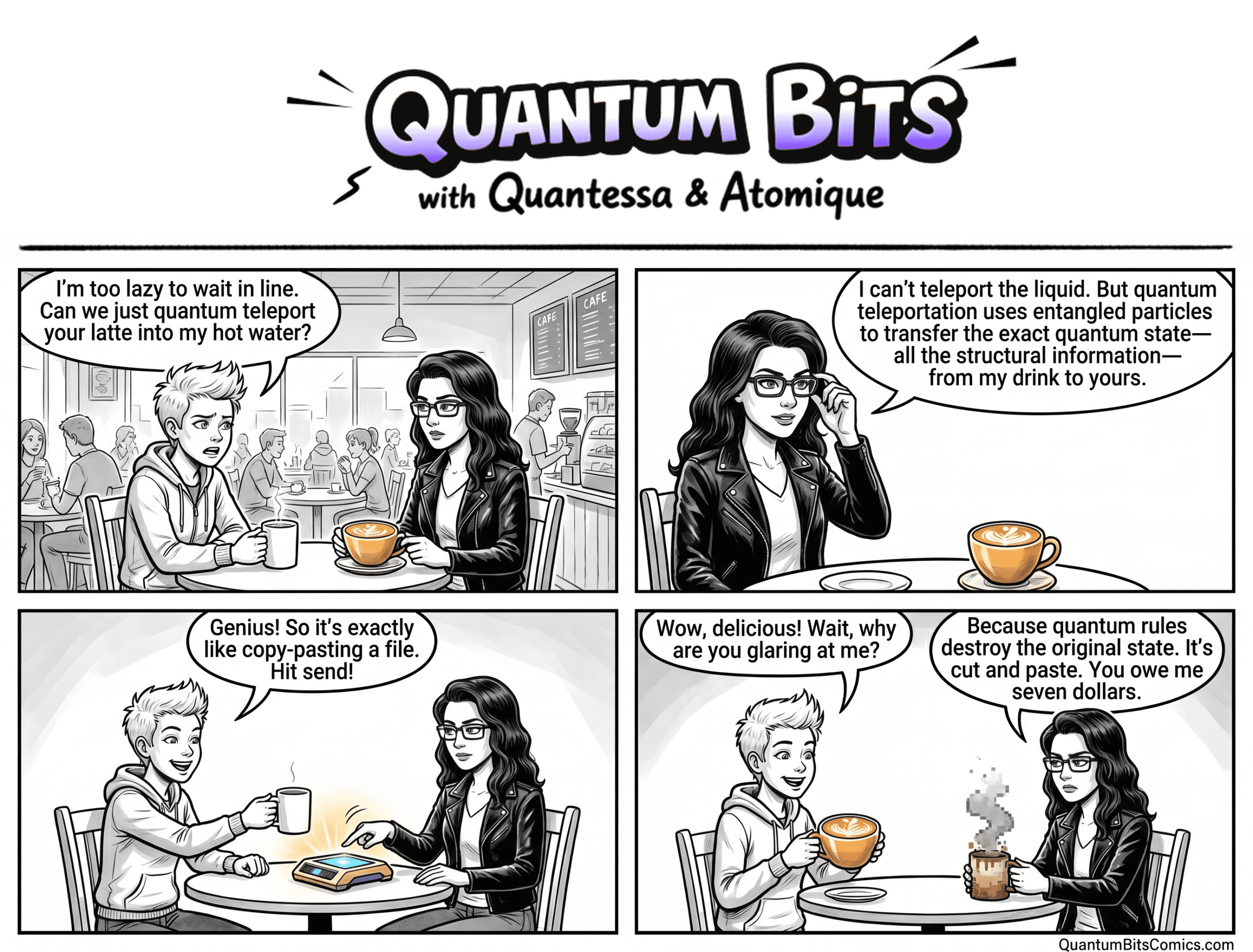
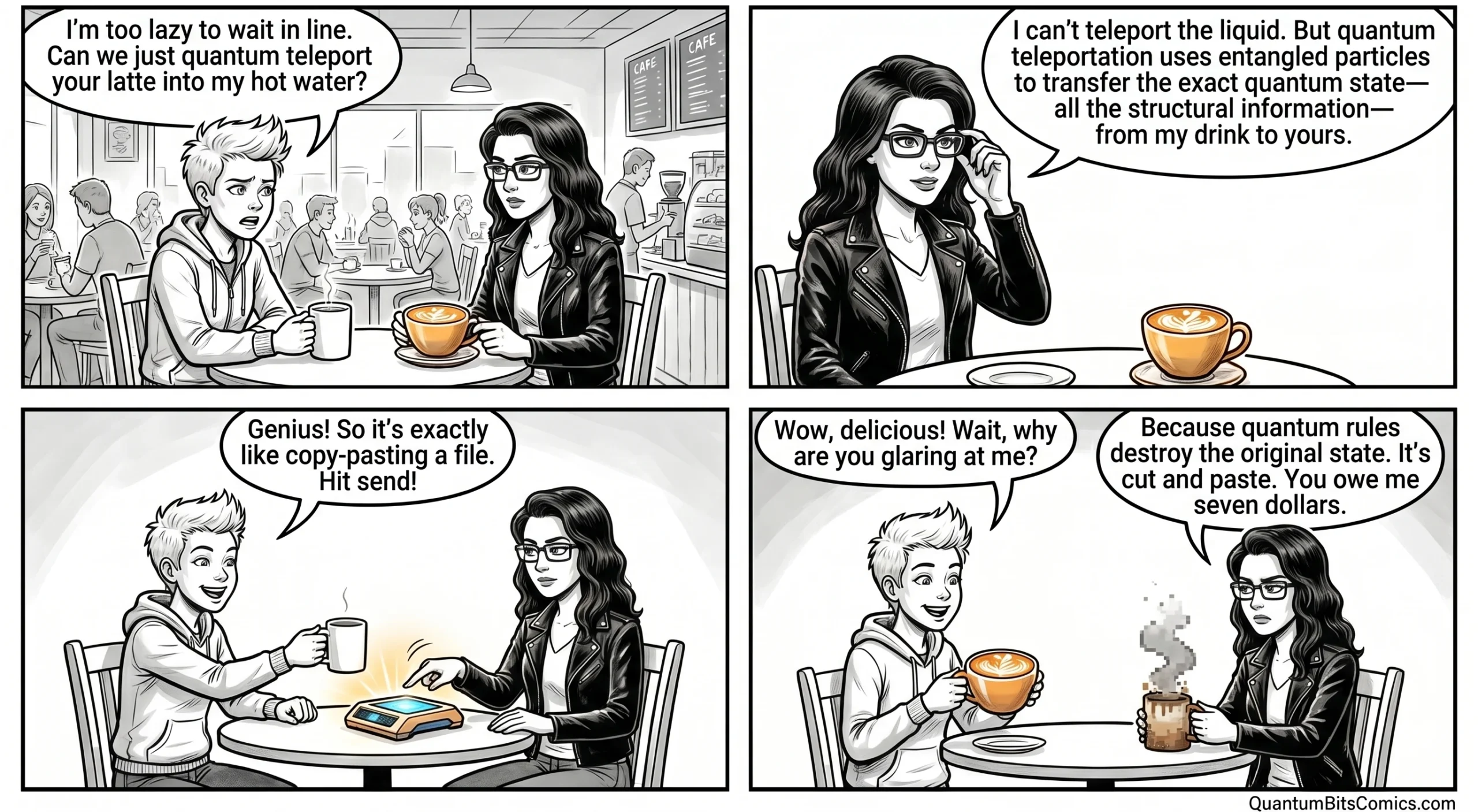
Quantum teleportation transfers the exact quantum state of one particle to another particle at a distant location, without physically moving anything between them. Despite the name, it has nothing to do with science fiction transportation. It is a precisely defined quantum information protocol, first proposed by Charles Bennett and colleagues in 1993 and experimentally demonstrated in 1997.
The protocol requires three ingredients: the source qubit whose state you want to transfer, a pair of entangled qubits (one held by the sender, one by the receiver), and a classical communication channel.
The sender performs a joint measurement on the source qubit and their half of the entangled pair. This measurement yields two classical bits of information and destroys the source qubit’s quantum state. The measurement also instantaneously changes the state of the receiver’s entangled qubit, but in a way that depends on the measurement outcome. The sender transmits the two classical bits to the receiver through an ordinary channel. The receiver applies a specific quantum gate chosen based on those two bits. After this correction, the receiver’s qubit is in exactly the state the source qubit originally held.
The original state is destroyed in the process, consistent with the no-cloning theorem: information is moved, not copied. The protocol cannot transmit information faster than light, because the receiver must wait for the classical message. And the entangled pair is consumed: each teleportation requires a fresh one.
Quantum teleportation is a foundational building block for quantum networking, enabling quantum information to be transmitted between distant nodes without exposing it to decoherence in a physical channel. It also appears in certain quantum computing architectures and in error correction protocols. It is not a curiosity. It is infrastructure.
Subscribe on Substack at https://qubitguy.substack.com/