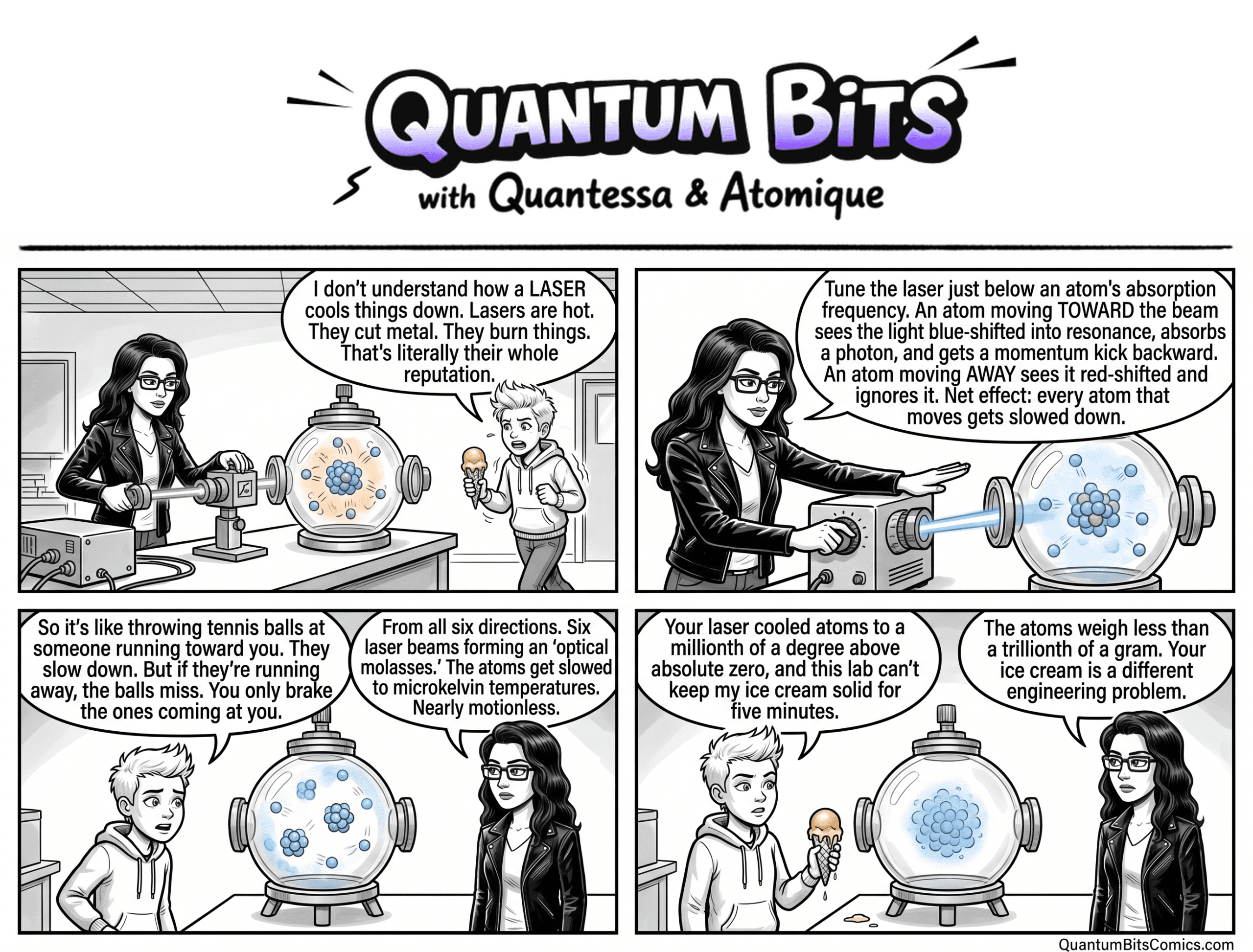
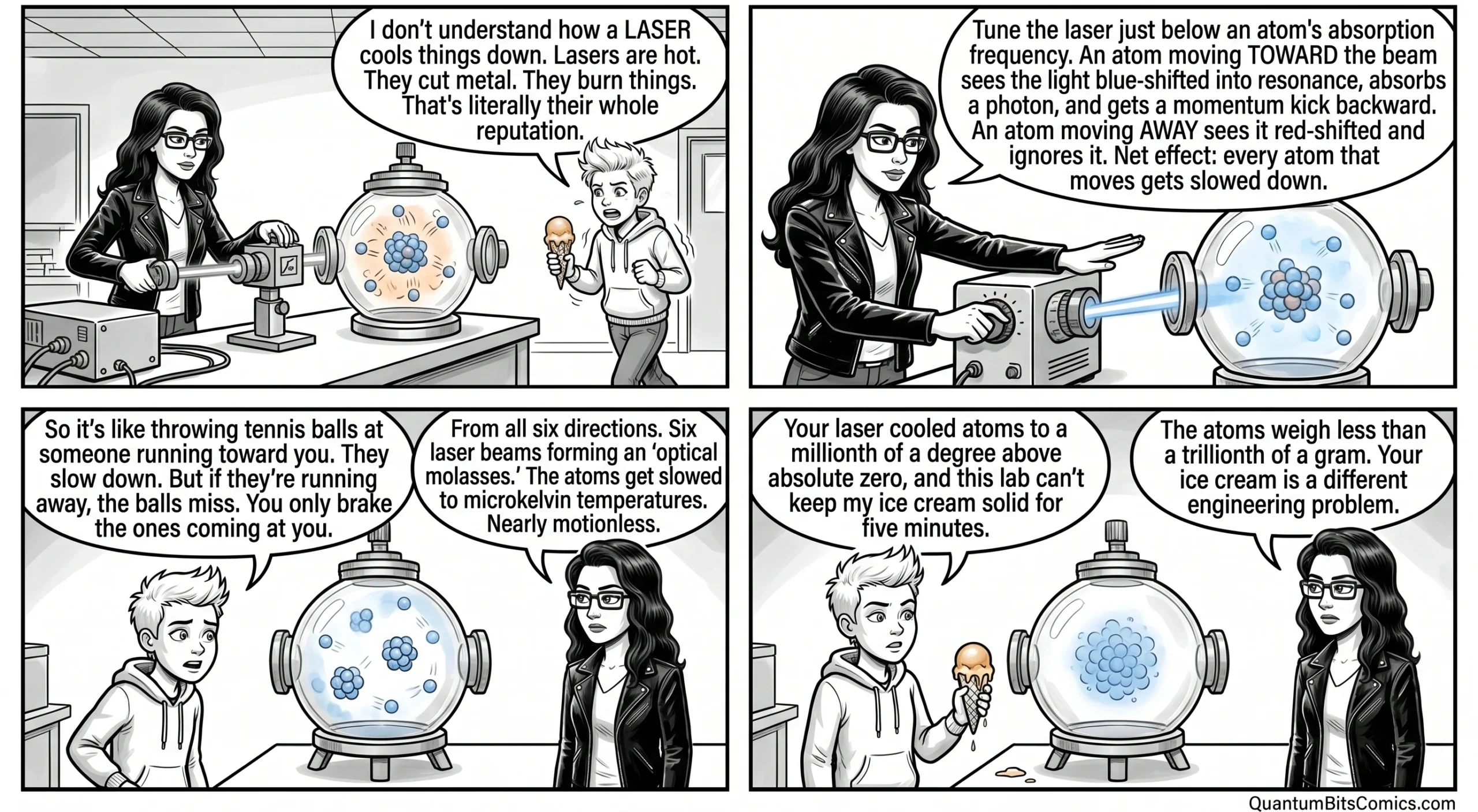
Atoms at room temperature move at hundreds of meters per second, far too fast to serve as qubits. To use individual atoms for quantum computing, scientists must slow them almost to a standstill. Laser cooling is the primary technique for doing this.
The mechanism relies on the Doppler effect. A laser is tuned to a frequency slightly below an atom’s absorption resonance. An atom moving toward the laser beam sees the light blue-shifted into resonance, absorbs a photon, and receives a momentum kick in the opposite direction, slowing it down. An atom moving away from the beam sees the light red-shifted further from resonance and ignores it. The net effect: atoms moving in any direction get slowed, while while nearly stationary atoms experience minimal net force.
By arranging six laser beams in three perpendicular pairs (pointing inward from all directions), scientists create what is called optical molasses. Atoms caught in this intersection are slowed from every direction simultaneously. Temperatures below one millikelvin are routinely achieved, and more advanced techniques like Sisyphus cooling and evaporative cooling can push temperatures into the microkelvin and nanokelvin range.
Laser cooling is not unique to quantum computing. It earned Steven Chu, Claude Cohen-Tannoudji, and William Phillips the 1997 Nobel Prize in Physics, and it underpins atomic clocks, cold-atom physics experiments, and Bose-Einstein condensate research. In quantum computing, laser cooling is a prerequisite step for neutral-atom and trapped-ion platforms: atoms must be cold enough that their thermal motion does not disrupt gate operations or cause them to escape their traps.
The technique is mature and reliable. The remaining engineering challenges are about integration: combining laser cooling with optical trapping, Rydberg excitation, and readout in a single apparatus that can scale to thousands of atoms.
Subscribe on Substack at https://qubitguy.substack.com/