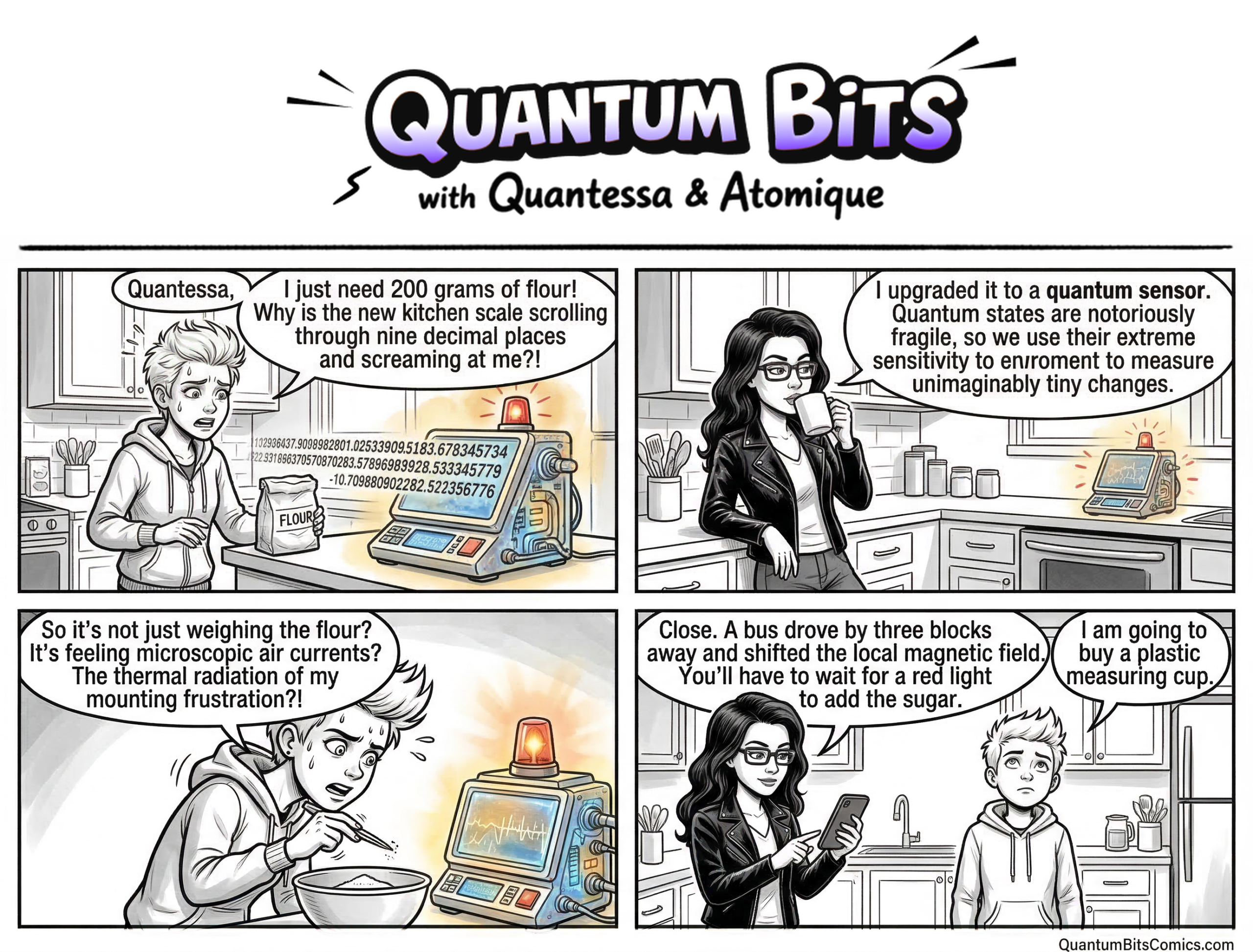
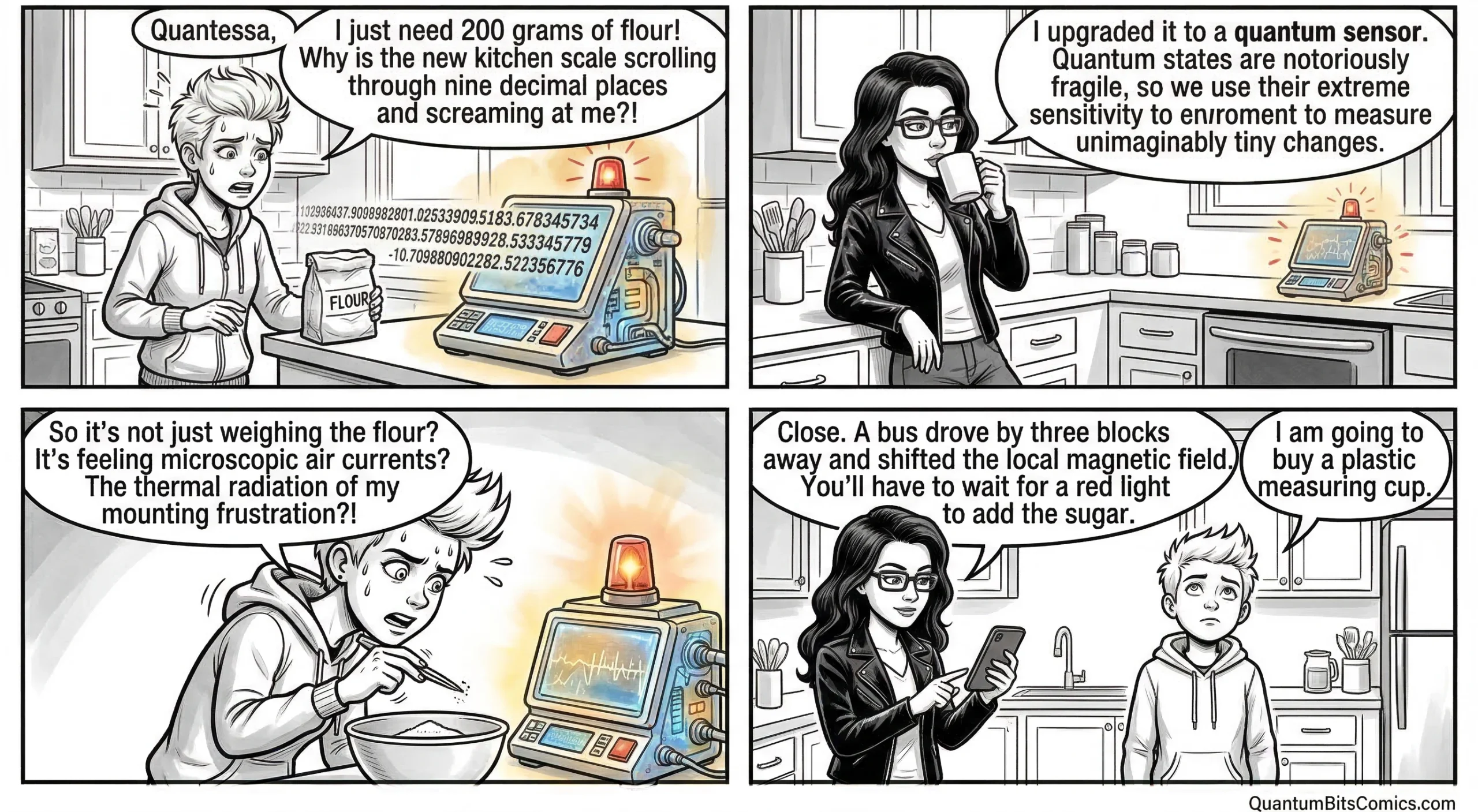
The same fragility that makes quantum computing so difficult to build makes quantum systems extraordinarily useful as sensors. A qubit is sensitive to everything around it: magnetic fields, electric fields, temperature, pressure, gravity, rotation. In a quantum computer, this sensitivity is a problem to be engineered away. In a quantum sensor, it is the entire point.
The basic principle is straightforward. You prepare a quantum particle in a superposition. When this particle encounters the field you want to measure, the field causes the different parts of the superposition to evolve at slightly different rates, like two clocks ticking at different speeds. When you measure the particle, you can determine how much the clocks went out of sync, which tells you exactly how strong the field was.
What makes quantum sensors special is their precision. By using entangled particles, sensors can achieve sensitivity beyond what’s possible with classical devices. With regular sensors, doubling your number of detectors makes measurements about 40% more precise. With entangled quantum sensors, doubling your detectors can double your precision, a scaling advantage that compounds as sensor arrays grow larger.
Practical quantum sensors are already in use. Atomic clocks that synchronize GPS satellites measure time by tracking the vibrations of cesium atoms. Doctors use quantum sensors to detect the tiny magnetic fields produced by brain activity. Geologists use quantum gravity sensors to find underground structures by detecting minute variations in gravitational pull. The underlying hardware varies: some sensors use clouds of ultra-cold atoms, others use nitrogen-vacancy defects in diamond crystals, and still others use vapor cells filled with rubidium gas.
Quantum sensing is arguably the most mature commercial application of quantum technology. While quantum computers remain experimental and quantum communication networks are just beginning deployment, quantum sensors are already at work in hospitals, research labs, and even in outer space. Their impact will only grow as they become smaller, cheaper, and more sensitive.
Subscribe on Substack at https://qubitguy.substack.com/