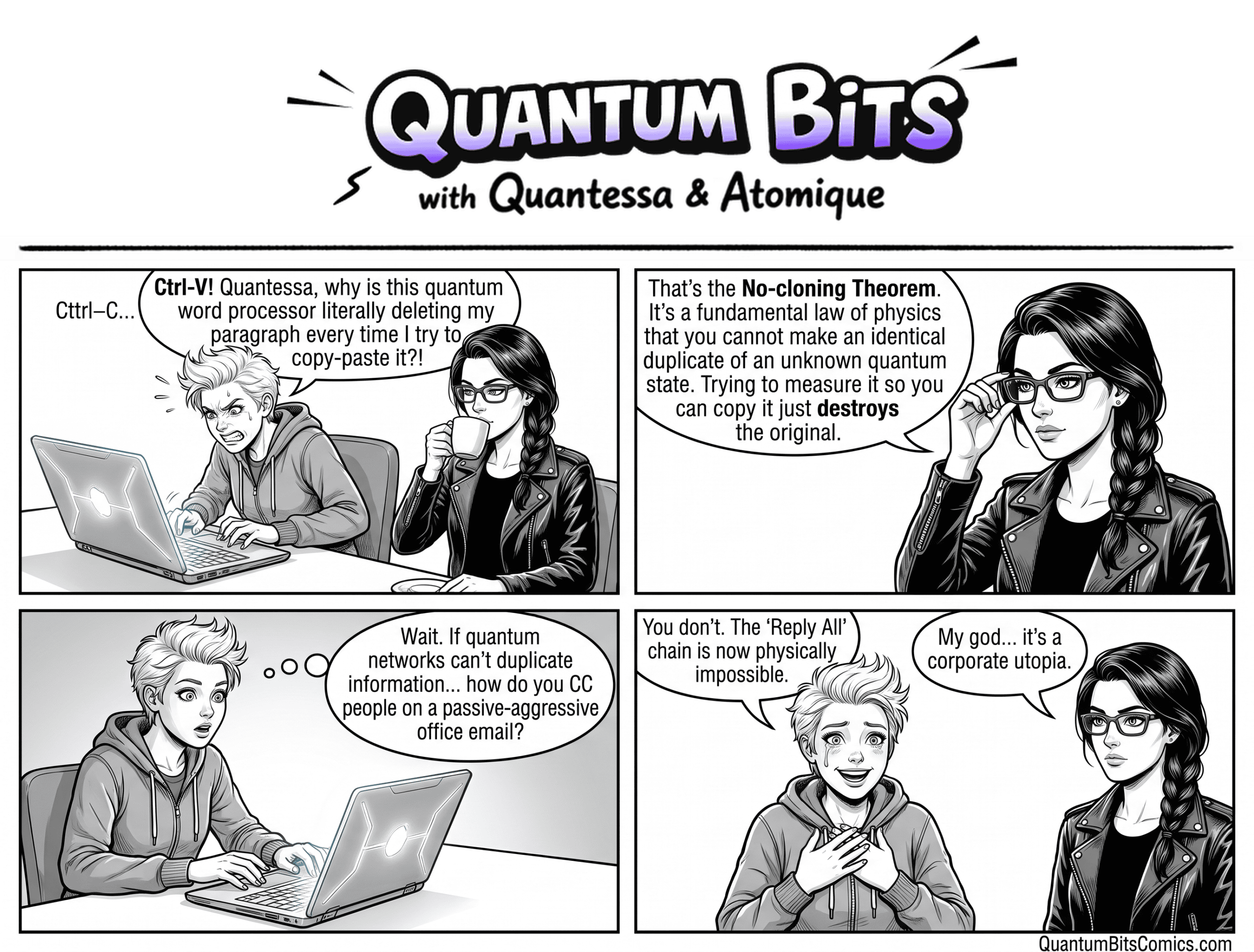
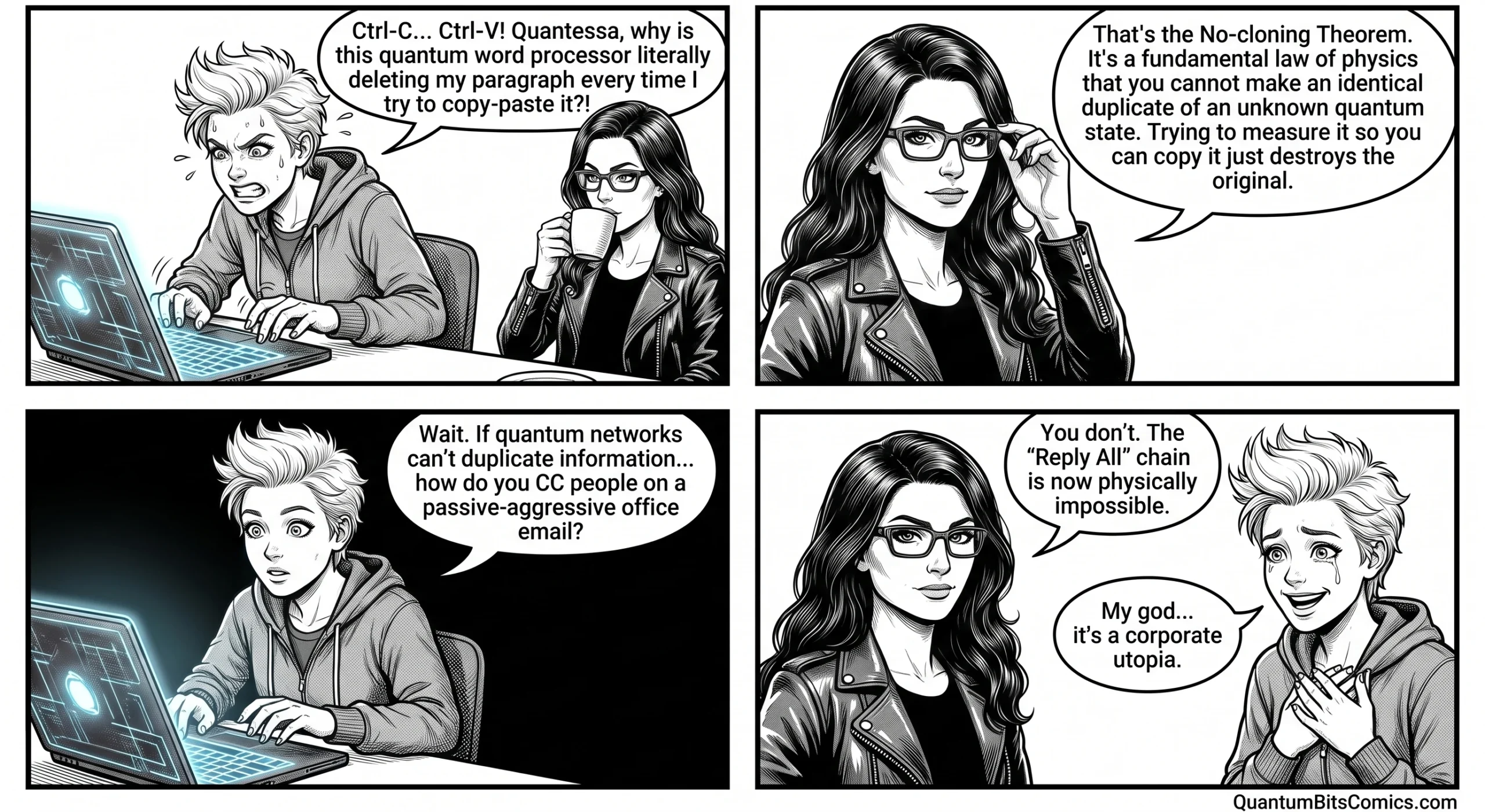
You cannot copy an unknown quantum state. This is not an engineering limitation that better technology might overcome. It is a mathematical consequence of the structure of quantum mechanics, proven by William Wootters and Wojciech Zurek in 1982. Dennis Dieks independently published the same result at essentially the same time.
The proof is surprisingly simple. Quantum operations (other than measurement) are linear: they preserve the mathematical relationships between states. Cloning would require a process that takes an arbitrary input state and produces two identical copies. It turns out that linearity makes this impossible. A cloning machine that works perfectly for one specific state will inevitably distort others. There is no universal quantum copier.
For quantum computing, this creates a fundamental design constraint. Classical error correction works by making redundant copies of data and comparing them: if three copies say “1” and one says “0,” you know the odd one out is the error. Quantum error correction cannot use this strategy. Instead, it encodes information in the entangled state of multiple qubits in a way that allows error detection without ever reading (or copying) the protected data. This is dramatically harder to engineer, and it is the reason quantum error correction requires so much overhead.
The no-cloning theorem also has a constructive side. It is the foundation of quantum key distribution security. If an eavesdropper intercepts a quantum message, they cannot copy the quantum states and pass the originals along undetected. In an ideal QKD protocol, an eavesdropper attempting to extract information introduces detectable disturbances. Practical systems must still be engineered carefully to prevent implementation attacks.
A common misconception: the no-cloning theorem does not prevent quantum teleportation. Teleportation transfers a quantum state from one location to another, but it destroys the original in the process. It moves quantum information rather than duplicating it, which is fully consistent with the theorem.
Subscribe on Substack at https://qubitguy.substack.com/