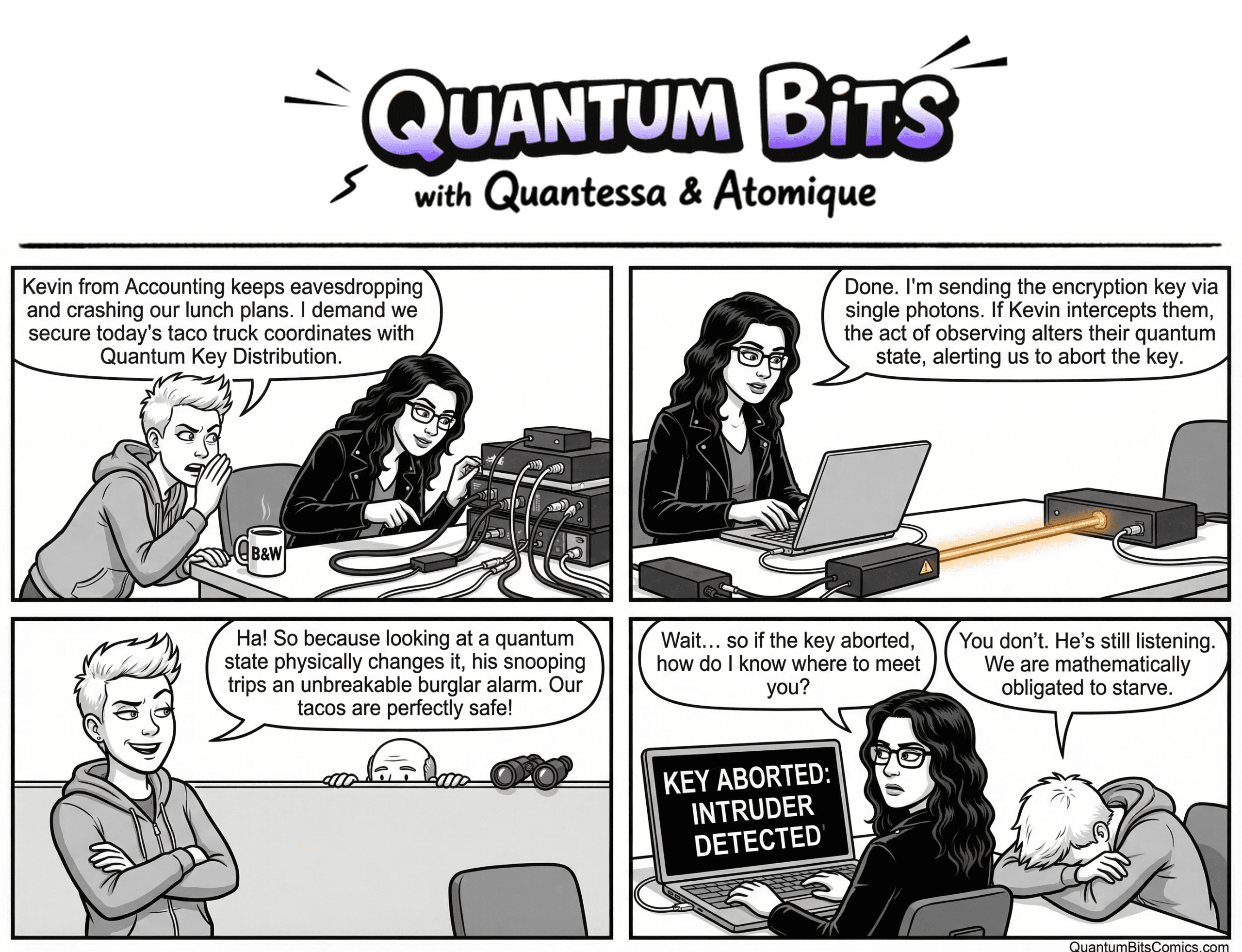
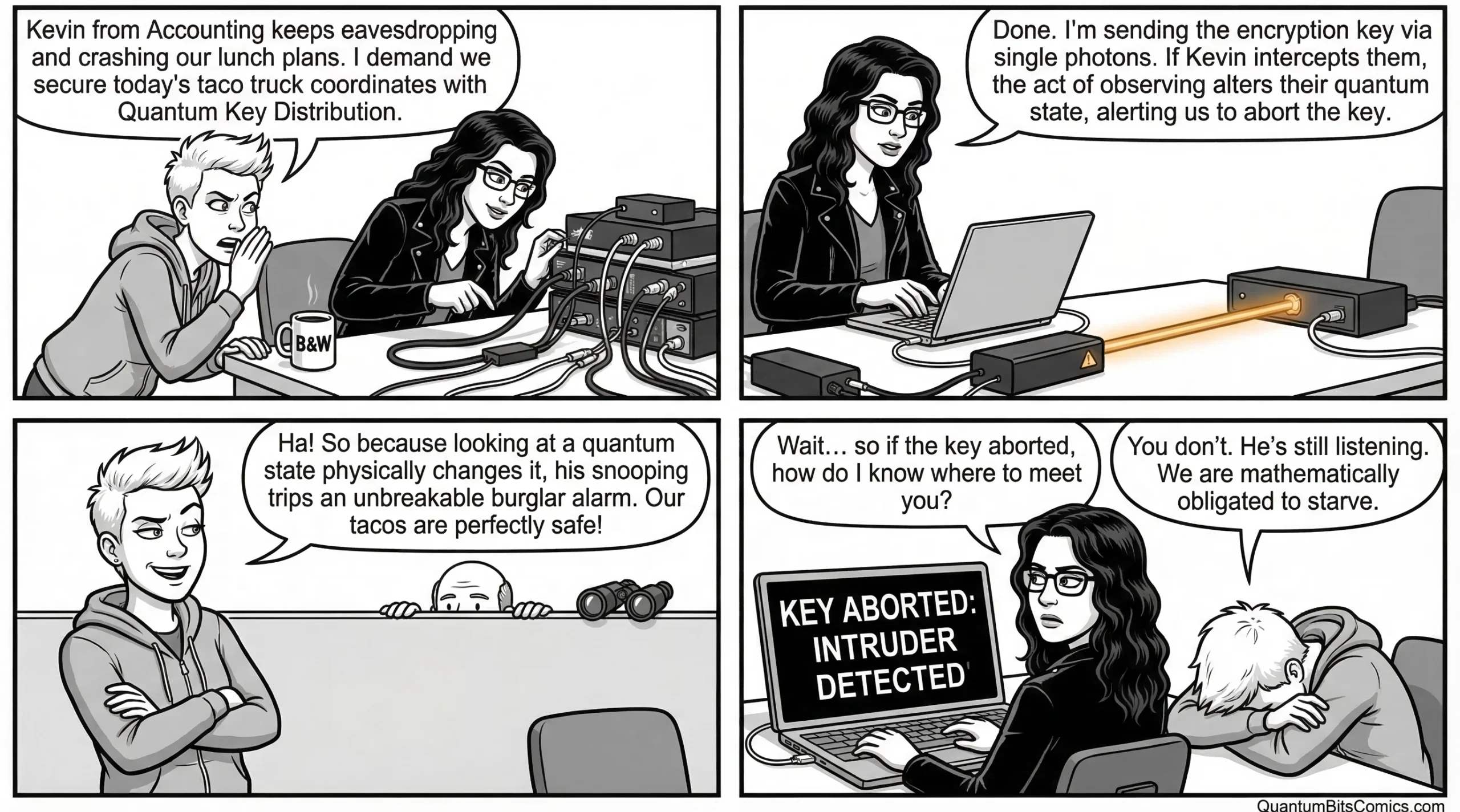
Quantum Key Distribution (QKD) is the most mature application of quantum cryptography. It solves a specific problem: allowing two parties to generate a shared secret key with a guarantee, based on physics, that no eavesdropper has a copy.
The best-known protocol, BB84, works like this. The sender transmits individual photons, each prepared with a specific polarization. Think of polarization like the orientation of a wave. In BB84, each photon is prepared in one of four orientations grouped into two pairs. Within each pair, the orientations are perpendicular: vertical versus horizontal, or diagonal-right versus diagonal-left.
The receiver measures each incoming photon to determine its polarization. The quantum mechanical constraint is this: to measure a photon’s polarization, you must choose which pair of orientations to check for. If a photon was prepared as vertical and you measure using the vertical/horizontal pair, you’ll correctly identify it as vertical. But if you measure that same vertical photon using the diagonal pair instead, you’ll get a random result.
Both sender and receiver randomly choose which pair to use for each photon. After transmission, they publicly announce their choices for each position (but not what they measured). They keep only the results where they happened to choose the same pair, forming their raw key.
The physics then provides the security. If an eavesdropper intercepted a photon to learn its polarization, they would face the same challenge: choosing which pair to measure with. When they guess wrong (which happens half the time), their measurement disturbs the photon. If they forward a replacement photon to avoid detection, it won’t always match the original. This introduces errors that the sender and receiver can detect by comparing a sample of their key bits. Too many errors means someone was listening, and they discard the key.
Subscribe on Substack at https://qubitguy.substack.com/