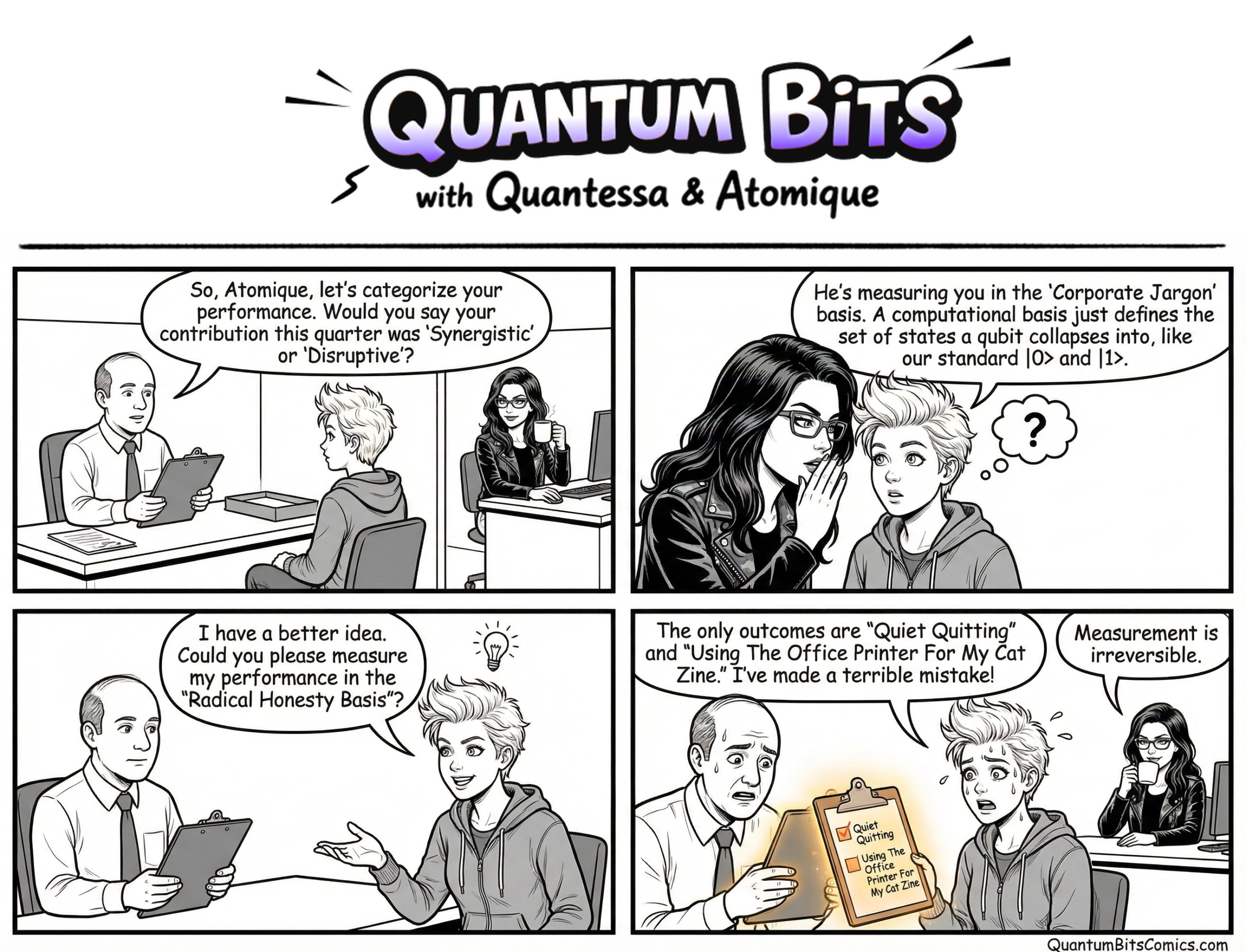

A classical bit is defined by its two possible states: 0 or 1. Every piece of classical information, from a text message to a video stream, is ultimately built from this simple binary foundation. A quantum bit, or qubit, also needs a reference point that connects back to this classical world. This reference is the computational basis, a pair of distinct quantum states labeled |0⟩ (called “ket-zero”) and |1⟩ (“ket-one”). These two states are the quantum analogs of the classical 0 and 1. Without a computational basis, there would be no way to read an answer out of a quantum computer. It is the bridge between the quantum world where computation happens and the classical world where results are used.
The computational basis plays a crucial role during measurement, the final step of most quantum algorithms. While a qubit can exist in a complex superposition of both |0⟩ and |1⟩ during a computation, it cannot remain there when we try to read its value. Measuring a qubit in the computational basis forces it into one of the two basis states, collapsing its superposition. The result is no longer a quantum state, but a definite classical bit: 0 or 1. The probabilities of getting either outcome are determined by the qubit’s state right before measurement.
While it is the standard for getting answers out of a quantum computer, the |0⟩ and |1⟩ computational basis is not the only way to view a qubit. An infinite number of other valid bases exist, each consisting of two perfectly distinguishable quantum states. For example, the Hadamard basis (or X-basis) consists of the |+⟩ and |−⟩ states, which are themselves equal superpositions of |0⟩ and |1⟩. Measuring a qubit in a different basis is like asking it a different question. This ability to switch between bases is a fundamental resource in quantum computing, used extensively in algorithms and quantum communication protocols.
Ultimately, the computational basis provides a shared language for quantum computing. It establishes the default input states for algorithms and defines the standard output format for results. When a quantum algorithm is designed, it is engineered so that by the time computation ends, the qubits’ state has been shaped — through interference — to favor the correct answer.
Subscribe on Substack at https://qubitguy.substack.com/