In 1981, physicist Richard Feynman pointed out a fundamental mismatch in computer science. Nature is inherently quantum mechanical, but the computers we use to model it are strictly classical. He proposed a direct solution. If you want to make an accurate simulation of nature, you should make the computer itself out of quantum mechanical elements. This observation became the original motivation for building a quantum computer.
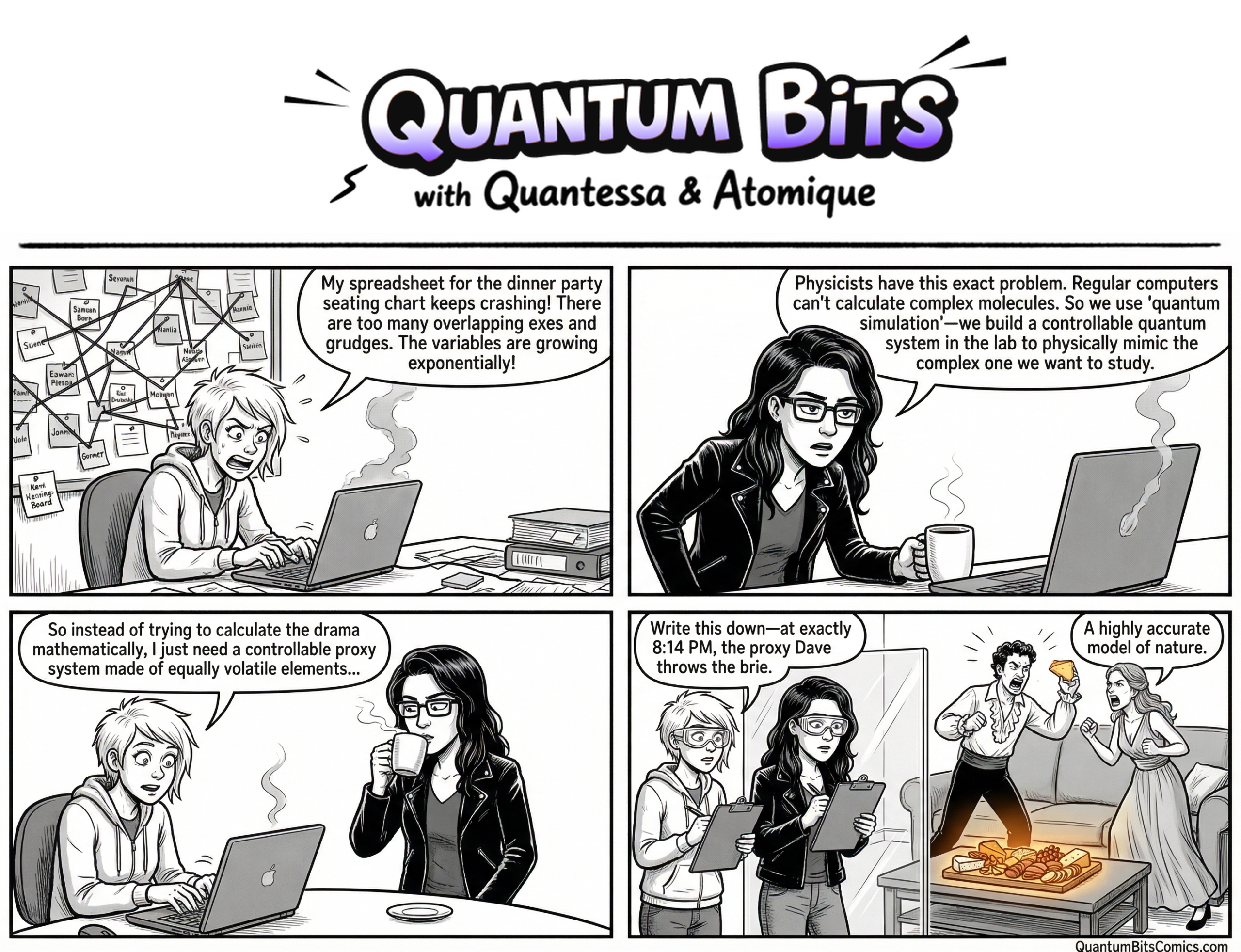
Simulating chemical reactions or novel materials on a classical machine hits a wall very quickly. Every time you add an electron to an exact molecular model, the mathematical space required to track all possible quantum states and interactions grows exponentially. The largest classical supercomputers run out of memory trying to exactly model a cluster of just a few dozen atoms. To study anything larger, scientists must rely on heavy mathematical approximations.
Quantum simulation bypasses this scaling problem by using qubits to directly represent the electrons and atoms of the target system. Because the qubits operate under the same rules of quantum mechanics as the molecule being studied, they naturally capture the complexity without needing to store astronomical amounts of data. The quantum computer uses its own physical state to map the underlying physics of the target molecule. Setting up this mapping still requires careful algorithmic choices about which molecular properties to represent and how to encode them onto qubits, but the fundamental scaling advantage holds.
The primary goal is resolving open questions in chemistry and physics that strictly resist classical modeling. Mapping the exact catalyst reactions required to efficiently produce synthetic fertilizer or understanding the mechanics behind high temperature superconductors requires perfect quantum-level detail. Cheaper fertilizer production alone could reshape global agriculture, and room-temperature superconductors would transform energy transmission and computing hardware. By building controllable laboratory systems that map directly to these phenomena, researchers gain a practical way to study the quantum world on its own terms.
Subscribe on Substack at https://qubitguy.substack.com/