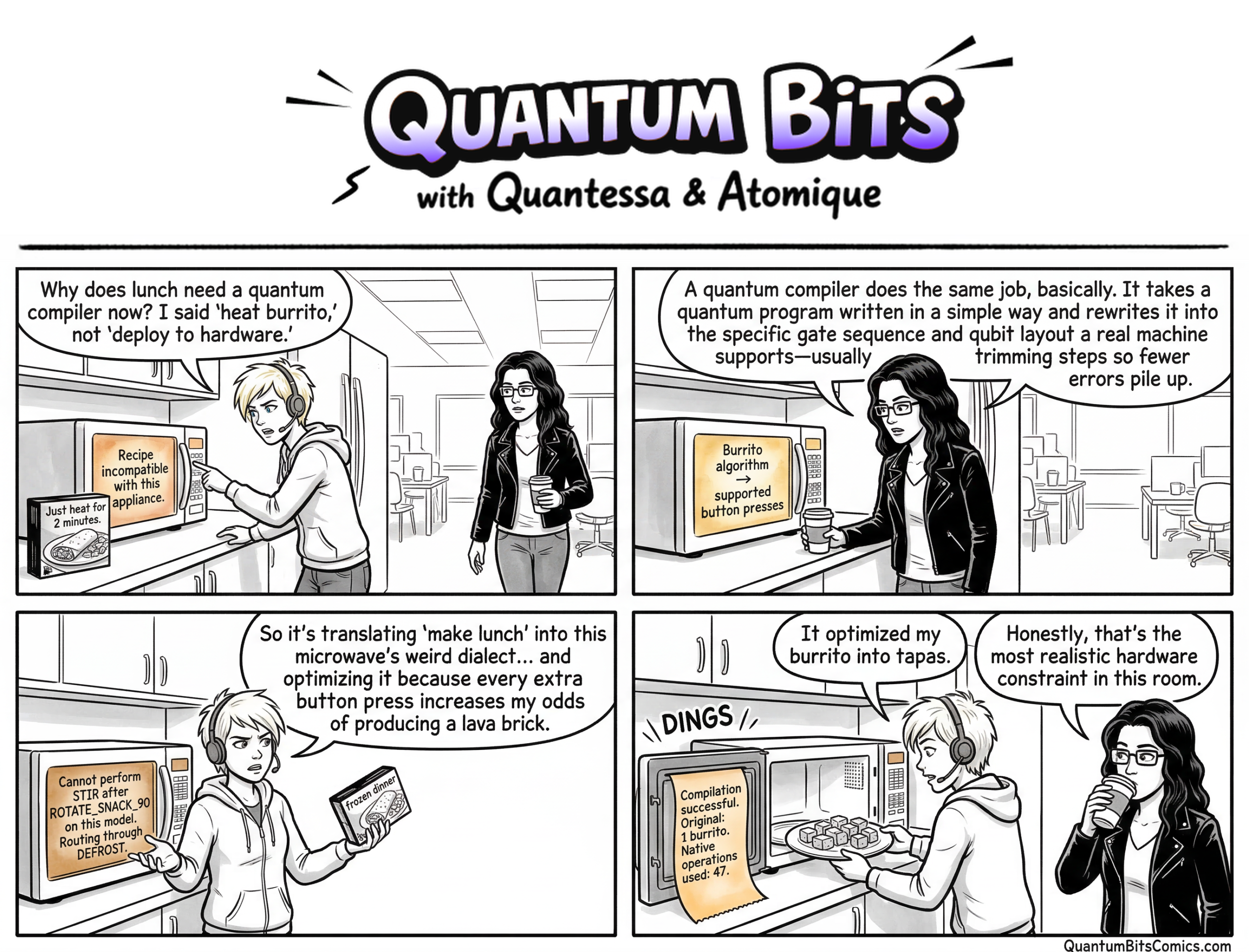
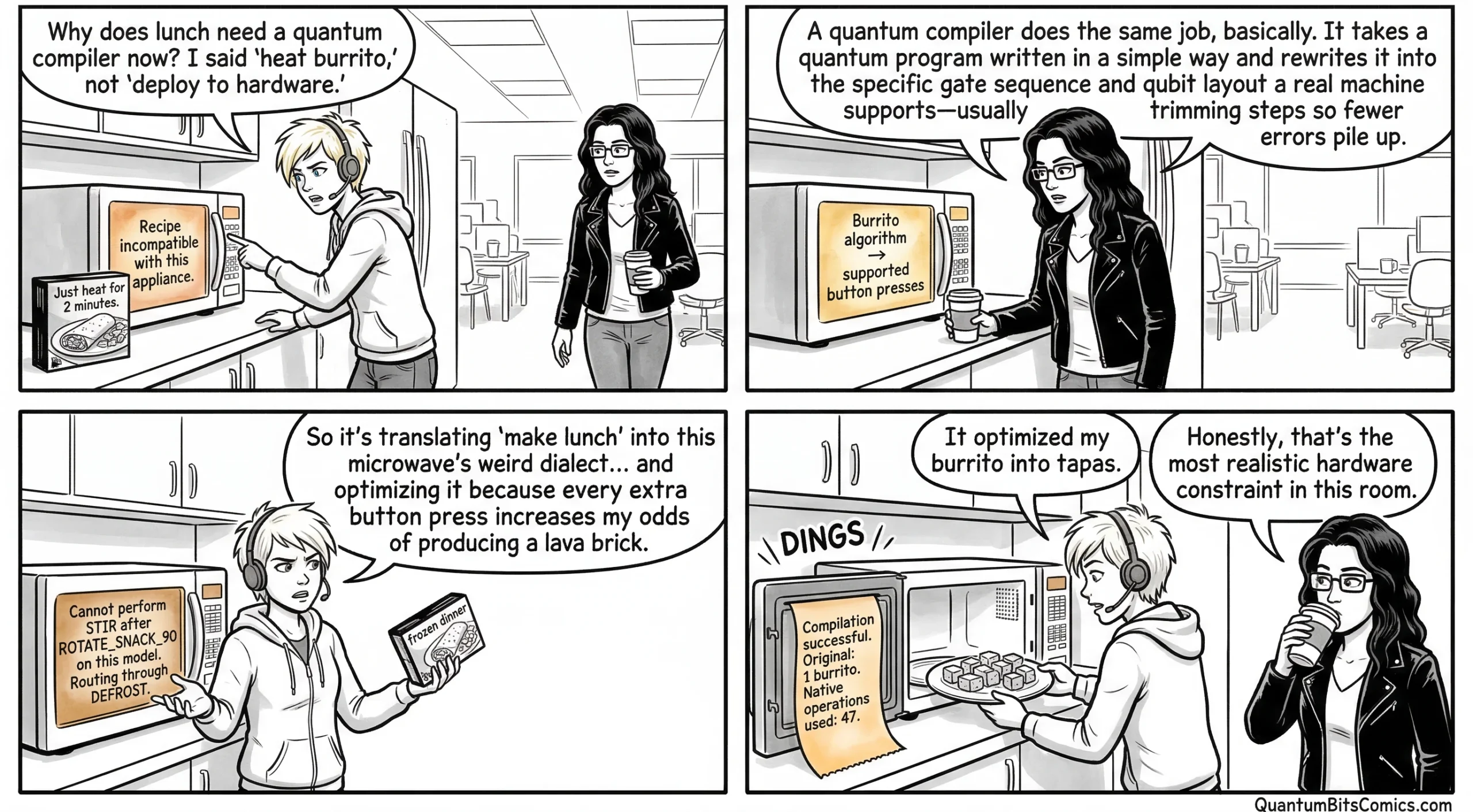
A quantum compiler translates a quantum algorithm, expressed as a sequence of abstract gates, into a form that specific quantum hardware can execute. This translation involves several steps, each addressing a different mismatch between what the algorithm assumes and what the hardware provides.
The first step is gate decomposition. An algorithm might call for a Toffoli gate (a three-qubit controlled operation), but the hardware only supports single-qubit rotations and two-qubit CZ gates natively. The compiler breaks the Toffoli into a sequence of supported operations that produce the same mathematical result.
The second step is qubit mapping and routing. The algorithm assumes any qubit can interact with any other. Some hardware platforms have a fixed connectivity graph where each physical qubit can only interact directly with its neighbors, requiring the compiler to insert swap operations. Others, including neutral-atom systems, offer reconfigurable connectivity that reduces or eliminates this routing overhead.
The third step is optimization. The naive translation from steps one and two typically produces a circuit that is longer than necessary. The compiler applies passes that cancel redundant gates, merge consecutive rotations, and reorder operations to reduce circuit depth. Since every additional gate introduces noise and every additional time step allows more decoherence, shorter circuits produce better results.
The quality of the compiler directly affects whether a computation succeeds or fails. A good compiler can reduce circuit depth by 30-50%, which on current hardware can mean the difference between a meaningful result and noise. As processors scale and algorithms grow more complex, compiler optimization will become increasingly critical.
Subscribe on Substack at https://qubitguy.substack.com/