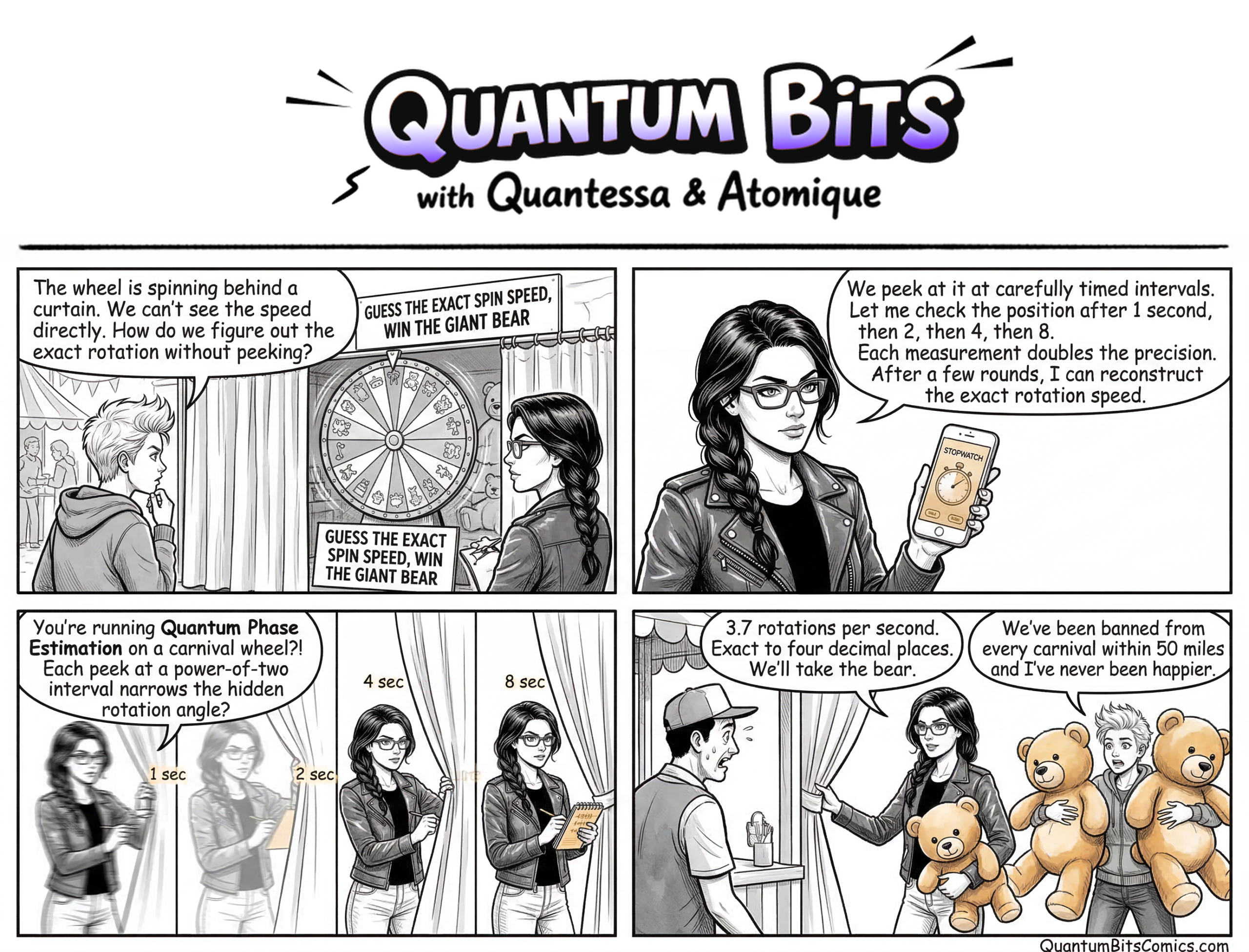
Quantum Phase Estimation (QPE) is an algorithm that extracts a hidden angle, called a phase, from a quantum operation. When certain quantum operations act on specific quantum states, they rotate those states by a characteristic angle. QPE determines what that angle is.
This matters because many important physical quantities correspond directly to these phases. The energy levels of a molecule, for example, are encoded as phases of the quantum operation that describes that molecule’s behavior. Finding these phases is equivalent to finding the energy levels, a task where classical computers struggle because the computational cost grows exponentially with the size of the molecule.
The algorithm works by applying the quantum operation in a controlled way across a set of auxiliary qubits, then using the Quantum Fourier Transform to convert the phase information into a measurement result. The more auxiliary qubits used, the more precisely the phase can be determined.
QPE is not just a standalone algorithm. It appears as a subroutine inside several major quantum algorithms. Shor’s algorithm uses it to extract periods in its factoring routine. Quantum chemistry algorithms use it to determine molecular energy levels. Quantum simulation algorithms use it to measure properties of physical systems.
The practical challenge is significant. QPE requires deep circuits running across many qubits, making it highly sensitive to hardware errors. Running it on problems beyond classical reach will require large-scale fault-tolerant quantum computers. Until that hardware matures, researchers are developing variational alternatives that approximate QPE’s results using shallower circuits better suited to near-term processors.
Subscribe on Substack at https://qubitguy.substack.com/