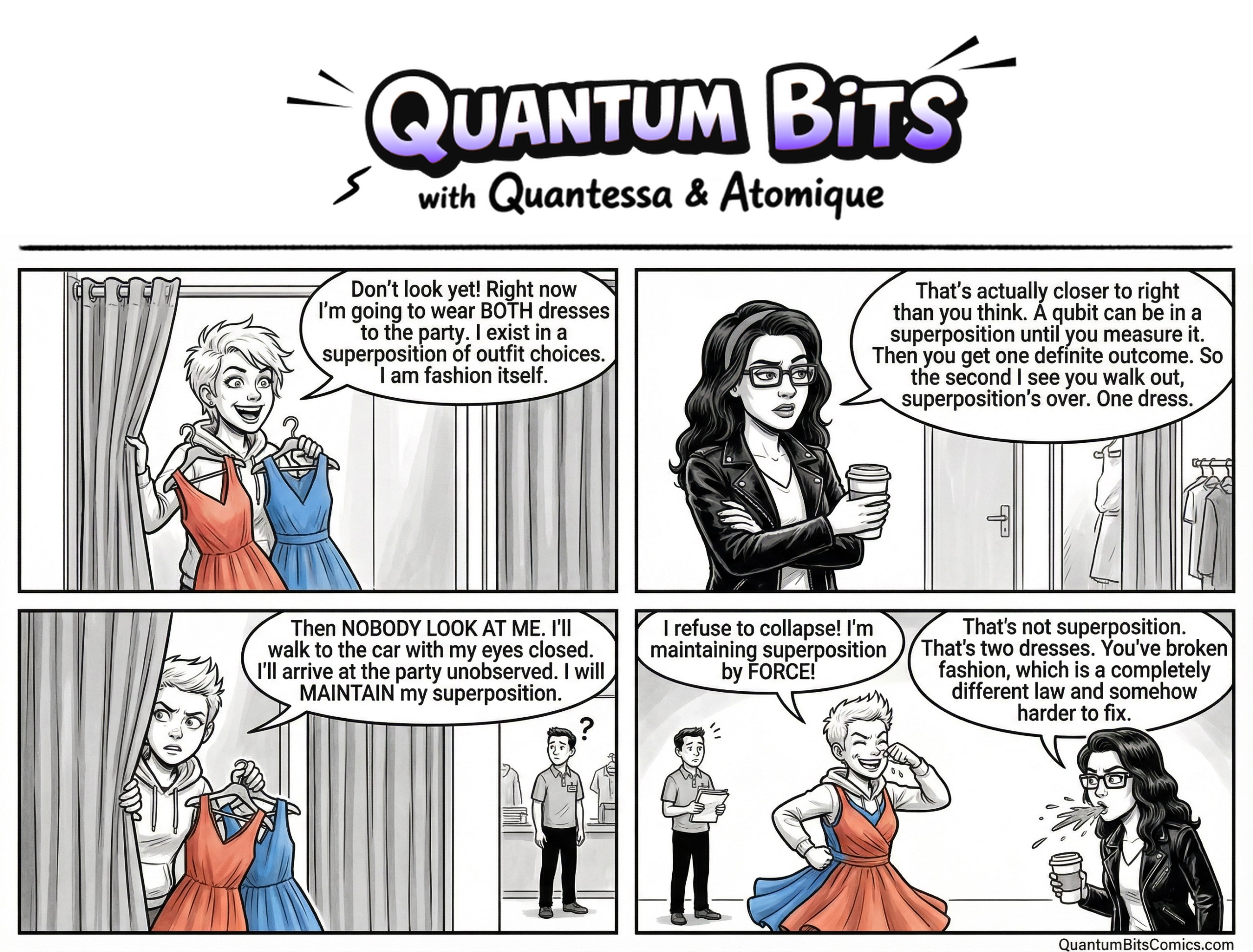
Carpenters say “measure twice, cut once.” Quantum physicists would say “measure once, and whatever you had is gone.” Measurement in quantum mechanics isn’t a gentle peek at what’s inside. It’s the end of the road for the superposition you worked so hard to create. Quantessa explains:
Measurement is where quantum mechanics meets classical reality. It is the act of extracting information from a qubit, and it is irreversible.
A qubit in superposition carries amplitudes for both 0 and 1. These amplitudes determine the probability of each outcome when measured: if the amplitude for 1 is larger, measuring 1 is more likely. But measurement does not simply reveal a pre-existing value. It forces the qubit to commit. The superposition collapses, the qubit becomes a definite 0 or 1, and the quantum state that existed before measurement is gone permanently. If you measure the same qubit again, you will get the same result every time. The superposition is not hiding somewhere waiting to return. It has been destroyed.
This is not a limitation of our instruments. It is a fundamental feature of quantum mechanics. The information encoded in the amplitudes and phase of a superposition cannot be fully extracted by measurement. You get one classical bit out. The rest is lost.
This creates the central design constraint of quantum computing. During computation, qubits must remain unmeasured to preserve their superpositions and entanglement. At the end, measurement must occur to extract the answer. The entire art of quantum algorithm design is arranging the computation so that when measurement finally happens, the correct answer appears with high probability — not certainty, but close enough that running the algorithm a few times all but guarantees it.
Measurement also plays a constructive role. In quantum error correction, ancilla (helper) qubits are measured mid-computation to detect errors on data qubits. These measurements are carefully designed to reveal information about errors without revealing (and thus destroying) the protected quantum information. Mid-circuit measurement combined with feed-forward, where subsequent operations depend on measurement outcomes, enables real-time error correction and is a prerequisite for fault-tolerant quantum computing.
Subscribe on Substack at https://qubitguy.substack.com/