Quantum Bits is intended to introduce quantum computing terms in a fun and accessible way. It is a personal project of Yuval Boger, whose day job is Chief Commercial Officer at QuEra Computing. You might also know Yuval from his Superposition Guy's Podcast series (listen here)

Subscribe on Substack at https://qubitguy.substack.com/ to get both comics and podcasts.


Latest Posts

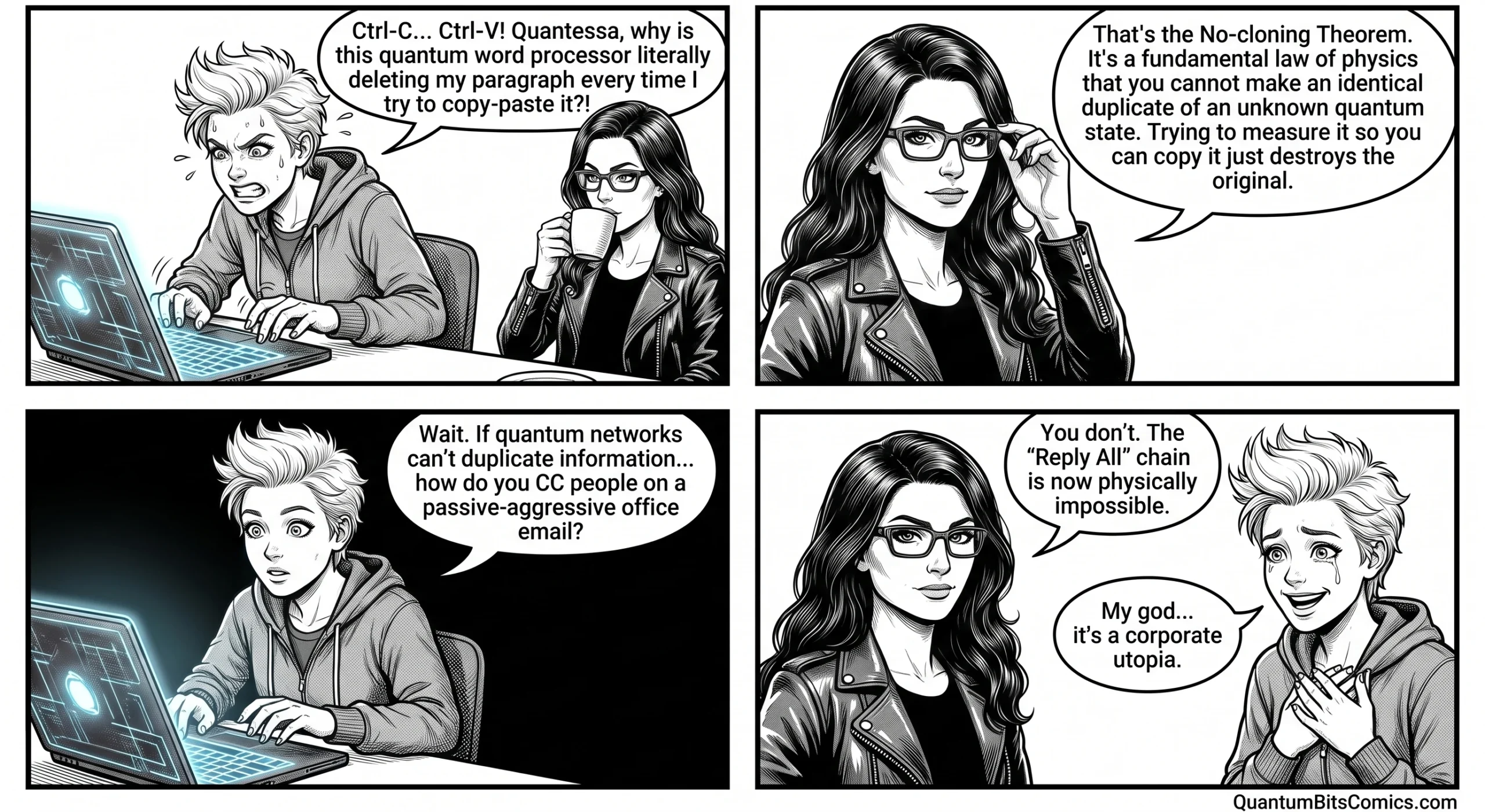
No Cloning Theorem

A quantum comic strip about no cloning theorem

You cannot copy an unknown quantum state. This is not an engineering limitation that better technology might overcome. It is a mathematical consequence of the structure of quantum mechanics, proven by William Wootters and Wojciech Zurek in 1982. Dennis Dieks independently published the same result at essentially the same time.

The proof is surprisingly simple. Quantum operations (other than measurement) are linear: they preserve the mathematical relationships between states. Cloning would require a process that takes an arbitrary input state and produces two identical copies. It turns out that linearity makes this impossible. A cloning machine that works perfectly for one specific state will inevitably distort others. There is no universal quantum copier.

For quantum computing, this creates a fundamental design constraint. Classical error correction works by making redundant copies of data and comparing them: if three copies say “1” and one says “0,” you know the odd one out is the error. Quantum error correction cannot use this strategy. Instead, it encodes information in the entangled state of multiple qubits in a way that allows error detection without ever reading (or copying) the protected data. This is dramatically harder to engineer, and it is the reason quantum error correction requires so much overhead.

The no-cloning theorem also has a constructive side. It is the foundation of quantum key distribution security. If an eavesdropper intercepts a quantum message, they cannot copy the quantum states and pass the originals along undetected. In an ideal QKD protocol, an eavesdropper attempting to extract information introduces detectable disturbances. Practical systems must still be engineered carefully to prevent implementation attacks.

A common misconception: the no-cloning theorem does not prevent quantum teleportation. Teleportation transfers a quantum state from one location to another, but it destroys the original in the process. It moves quantum information rather than duplicating it, which is fully consistent with the theorem.

Subscribe on Substack at https://qubitguy.substack.com/
Stabilizers

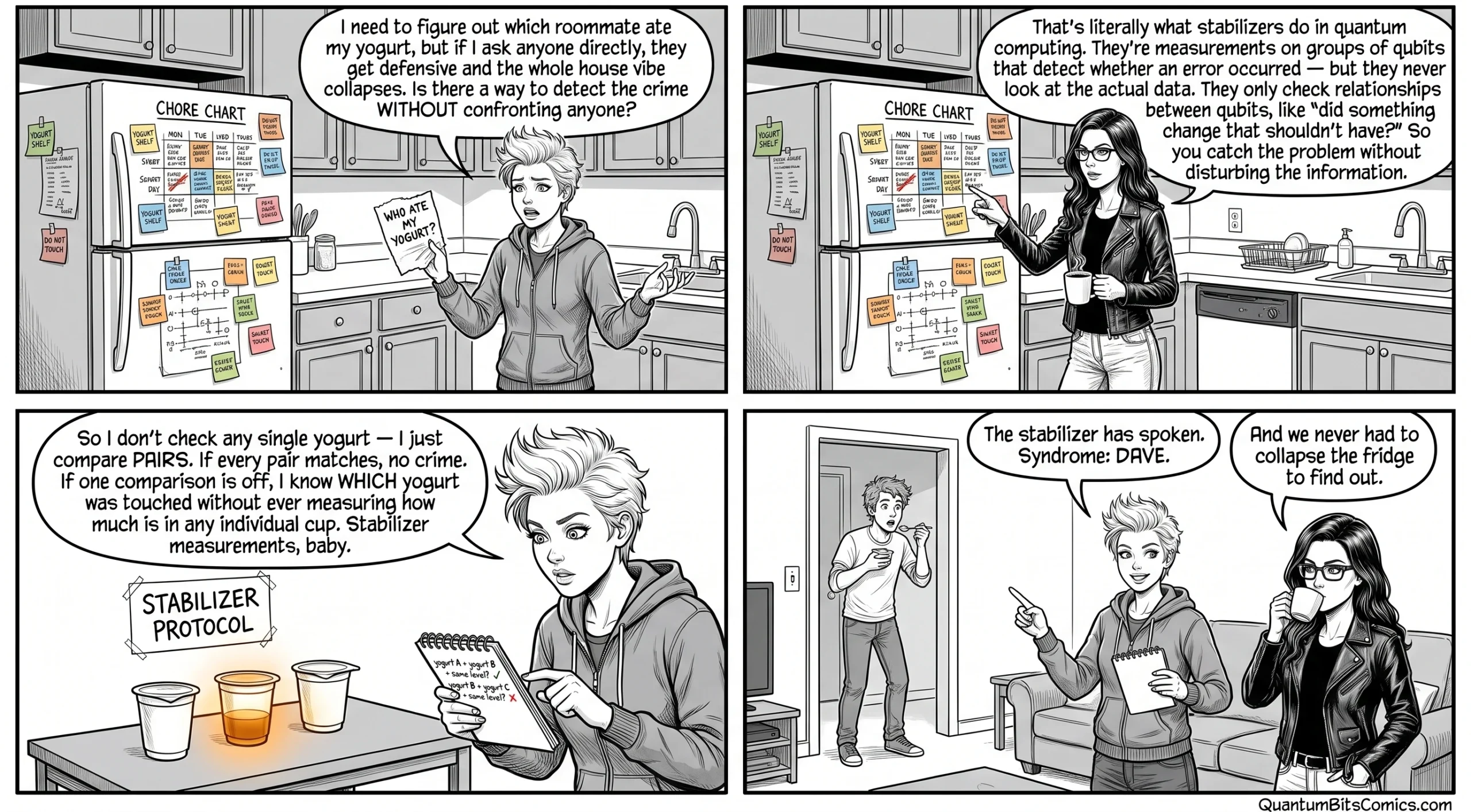
A quantum comic strip about stabilizers

The fundamental paradox of quantum error correction is that you cannot look at your data. Measuring a quantum state forces it to collapse into classical bits, destroying any delicate superposition. Furthermore, the laws of physics forbid copying unknown quantum information to keep a safe backup. To build a reliable quantum computer, engineers had to find a way to detect and fix errors without ever looking directly at the information they were trying to protect.

The solution is a mathematical and physical technique called a stabilizer measurement. Instead of asking a specific qubit what state it is in, a quantum computer asks a group of qubits if any of them have changed relative to one another. It does this by temporarily entangling the data qubits with an extra helper qubit, often called an ancilla, and then measuring only that helper.

Measuring the helper qubit yields a piece of classical information called a syndrome. This syndrome reveals the shared properties, or parity, of the group. If the readout shows an unexpected change, the system knows an error occurred on one of the data qubits. Crucially, because the measurement only extracted information about the relationship between the qubits, the underlying quantum information remains intact and unobserved. The term stabilizer comes from the mathematics of this process: measuring these specific properties actively forces the quantum state to remain stable within a defined, protected space.

Running these stabilizer checks is the heartbeat of a fault-tolerant quantum computer. In architectures like the surface code, data qubits are constantly entangled with helper qubits in an endless grid, checking for both bit-flip and phase-flip errors. Performing these checks is a massive engineering challenge. The helper qubits must interact with the data qubits, be measured, and be reset fast enough to catch errors before they cascade, all without introducing new errors during the measurement process itself.

When a hardware platform successfully performs these continuous stabilizer measurements faster than errors naturally accumulate, it crosses a critical threshold. At that point, the system is no longer just manipulating fragile physical qubits. It is maintaining a protected logical qubit, turning error-prone hardware into a reliable foundation capable of sustaining long, complex calculations.

Subscribe on Substack at https://qubitguy.substack.com/
Quantum Middleware

A quantum comic strip about quantum middleware

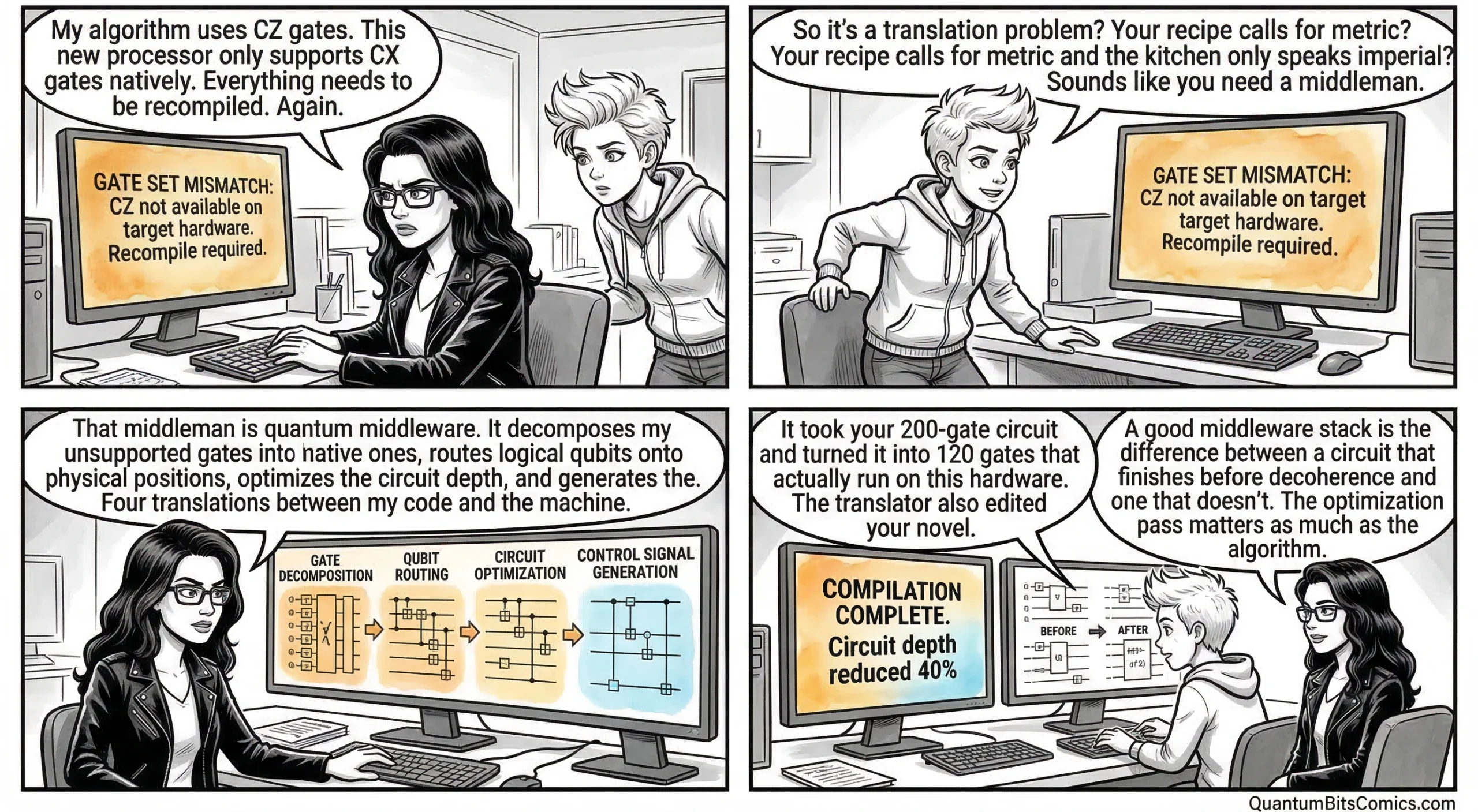
A quantum developer writing code today faces a fragmented hardware landscape. Different quantum processors support different native gate sets, different qubit connectivity, and different error characteristics. Code written for one machine may not run on another. Quantum middleware is the abstraction layer that sits between the developer and this hardware diversity.

The core function of middleware is hardware abstraction. A developer writes an algorithm once using a high-level framework like Qiskit, Cirq, or PennyLane. The middleware translates that algorithm into the specific instructions required by whichever backend will execute it, whether that is a superconducting processor, a trapped-ion system, a neutral-atom machine, or a classical simulator. The developer does not need to know the details of the target hardware.

Middleware also manages job orchestration. When a user submits a quantum program to a cloud platform, middleware handles queuing, scheduling, and resource allocation. It decides when the job runs, on which processor, and how to return results. For hybrid algorithms that require repeated quantum-classical iterations, middleware coordinates the handoff between the quantum processor and the classical optimizer, managing latency and data flow across the loop.

Some middleware platforms add a layer of intelligence to backend selection. Given a circuit’s structure, depth, and connectivity requirements, the middleware can route the job to the hardware best suited to execute it. As the number of available quantum processors grows and their capabilities diverge, this matchmaking function becomes increasingly valuable.

Middleware is where the quantum computing ecosystem becomes usable at scale. Without it, every developer would need to be a hardware specialist. With it, quantum computing begins to look like a callable resource within a broader computational workflow, which is what adoption ultimately requires.

Subscribe on Substack at https://qubitguy.substack.com/
Quantum Compiler

A quantum comic strip about quantum compiler

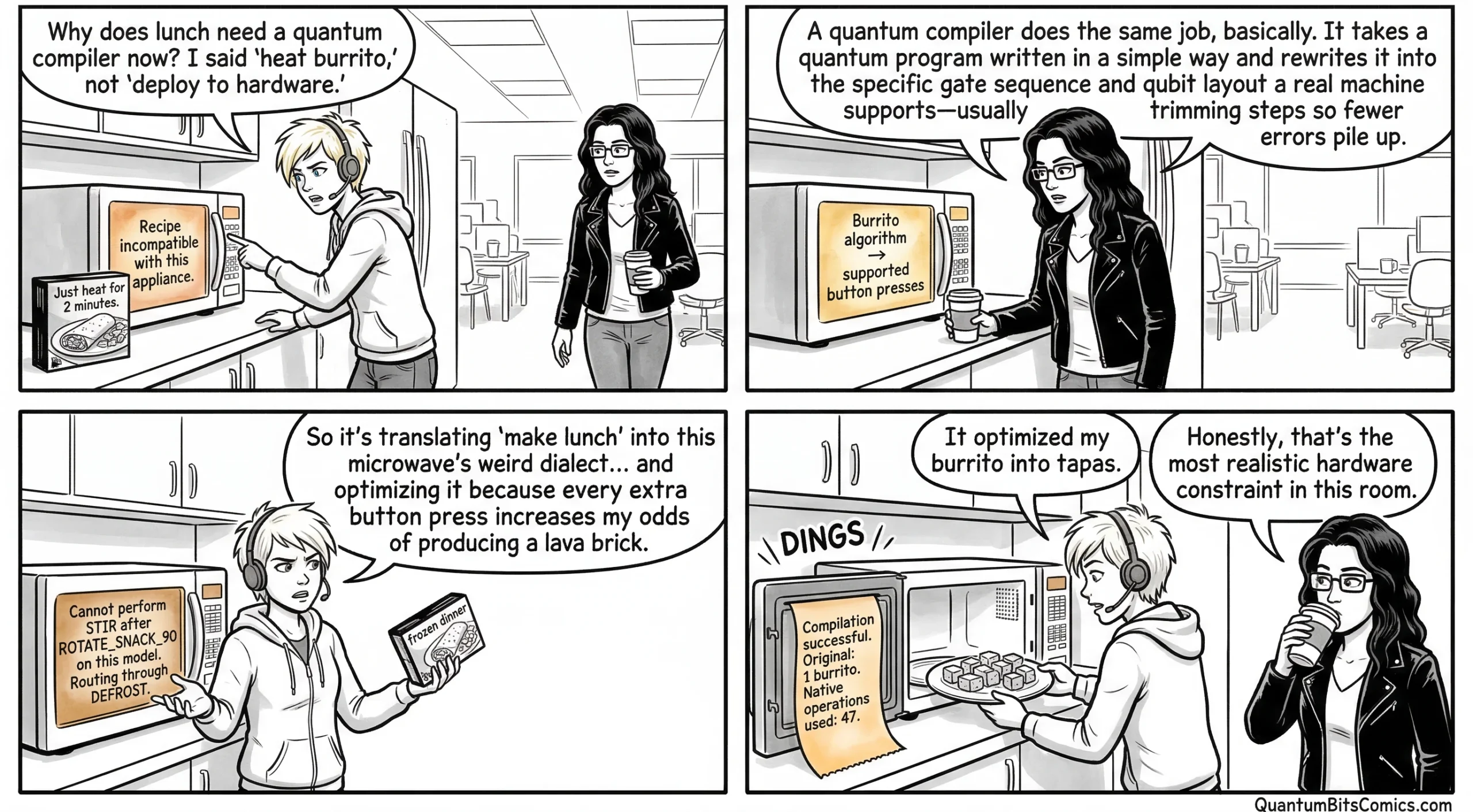
A quantum compiler translates a quantum algorithm, expressed as a sequence of abstract gates, into a form that specific quantum hardware can execute. This translation involves several steps, each addressing a different mismatch between what the algorithm assumes and what the hardware provides.

The first step is gate decomposition. An algorithm might call for a Toffoli gate (a three-qubit controlled operation), but the hardware only supports single-qubit rotations and two-qubit CZ gates natively. The compiler breaks the Toffoli into a sequence of supported operations that produce the same mathematical result.

The second step is qubit mapping and routing. The algorithm assumes any qubit can interact with any other. Some hardware platforms have a fixed connectivity graph where each physical qubit can only interact directly with its neighbors, requiring the compiler to insert swap operations. Others, including neutral-atom systems, offer reconfigurable connectivity that reduces or eliminates this routing overhead.

The third step is optimization. The naive translation from steps one and two typically produces a circuit that is longer than necessary. The compiler applies passes that cancel redundant gates, merge consecutive rotations, and reorder operations to reduce circuit depth. Since every additional gate introduces noise and every additional time step allows more decoherence, shorter circuits produce better results.

The quality of the compiler directly affects whether a computation succeeds or fails. A good compiler can reduce circuit depth by 30-50%, which on current hardware can mean the difference between a meaningful result and noise. As processors scale and algorithms grow more complex, compiler optimization will become increasingly critical.

Subscribe on Substack at https://qubitguy.substack.com/
Optical Tweezers

A quantum comic strip about optical tweezers

Neutral-atom quantum computers use individual uncharged atoms as qubits. Because these atoms carry no net electric charge, they do not repel each other, allowing researchers to pack large numbers of qubits into dense, configurable arrays.

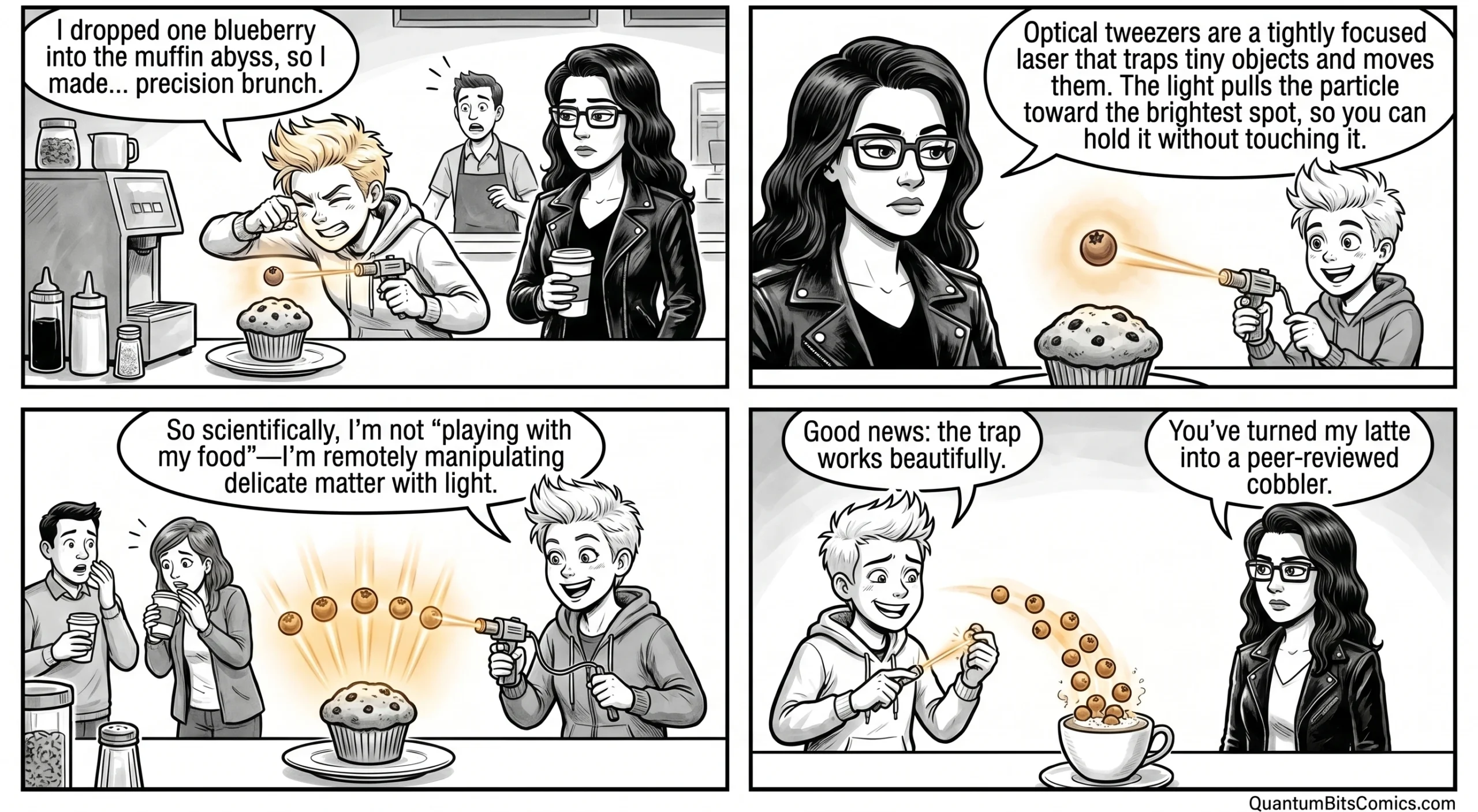
Individual atoms are trapped using tightly focused laser beams called optical tweezers. Each beam creates a potential well that holds a single atom in place. By controlling the positions of these beams, researchers can arrange atoms into two-dimensional grids, or three-dimensional structures, and reconfigure the layout between or even during computations. This geometric flexibility is a significant advantage over platforms where qubit positions are fixed at fabrication.

Quantum information is encoded in the internal energy states of each atom. Precisely timed laser pulses drive transitions between these states, implementing single-qubit gate operations.

Neutral-atom systems require laser cooling to bring atoms to microkelvin temperatures, cold enough that thermal motion does not disrupt trapping or gate operations. However, they do not require the millikelvin dilution refrigerators that superconducting platforms depend on, which simplifies the overall infrastructure.

The primary engineering challenges include maintaining trap stability over the duration of a computation, achieving high-fidelity two-qubit gates consistently across large arrays, and managing the optical systems needed to independently control thousands of atoms. Recent experiments have demonstrated arrays of over a thousand atoms and implemented quantum error-correction protocols, establishing neutral atoms as one of the leading platforms for scalable quantum computing. Companies including QuEra are actively developing this technology toward fault-tolerant systems.

Subscribe on Substack at https://qubitguy.substack.com/
Bit Flips

A quantum comic strip about bit flips

Quantum computers experience several distinct types of errors, each corrupting quantum information in a different way.

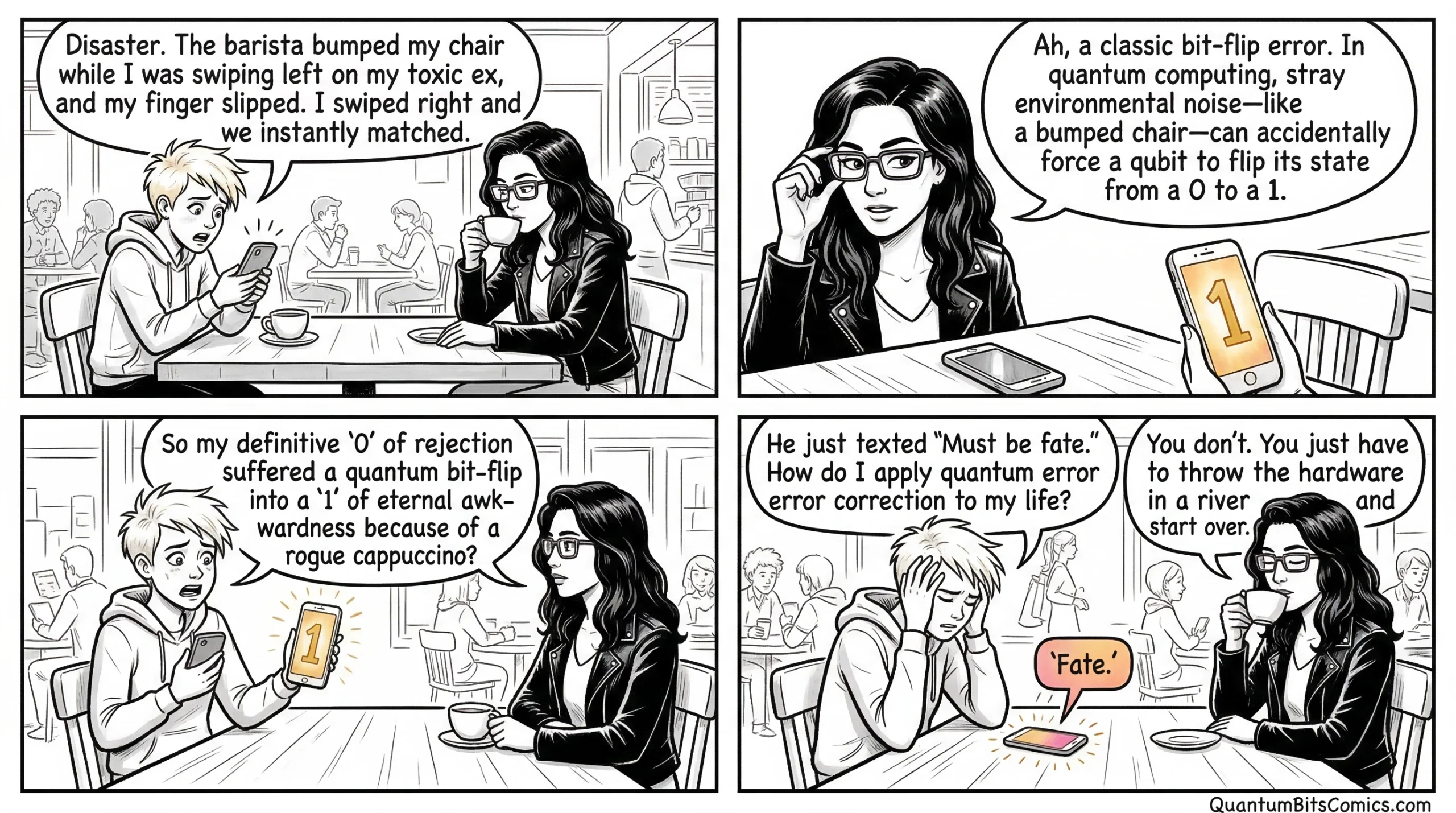
A bit-flip error swaps a qubit’s state, turning |0⟩ into |1⟩ or vice versa. This is the quantum analog of a classical bit error and the easiest to understand. A phase-flip error is subtler: it leaves the qubit’s probabilities unchanged but reverses the relative phase between the |0⟩ and |1⟩ components of a superposition. Phase-flip errors have no classical analog, but they are just as destructive because quantum algorithms depend on precise phase relationships to produce correct results through interference.

In practice, errors rarely arrive as clean bit-flips or phase-flips. Depolarizing errors randomly apply some combination of both, effectively pushing the qubit toward a random state. Amplitude damping describes the process by which an excited qubit decays to its ground state, releasing energy to the environment. This is the quantum equivalent of a system losing energy over time and is a dominant error source in many hardware platforms.

All of these errors stem from unwanted interactions between the qubit and its environment, a process collectively called decoherence. The rate at which errors accumulate determines how long a quantum computation can run before its results become unreliable. Reducing error rates through better hardware and correcting residual errors through error-correction codes together define the path to fault-tolerant quantum computing.

Subscribe on Substack at https://qubitguy.substack.com/
Deutsch Jozsa Algorithm

A quantum comic strip about deutsch jozsa algorithm

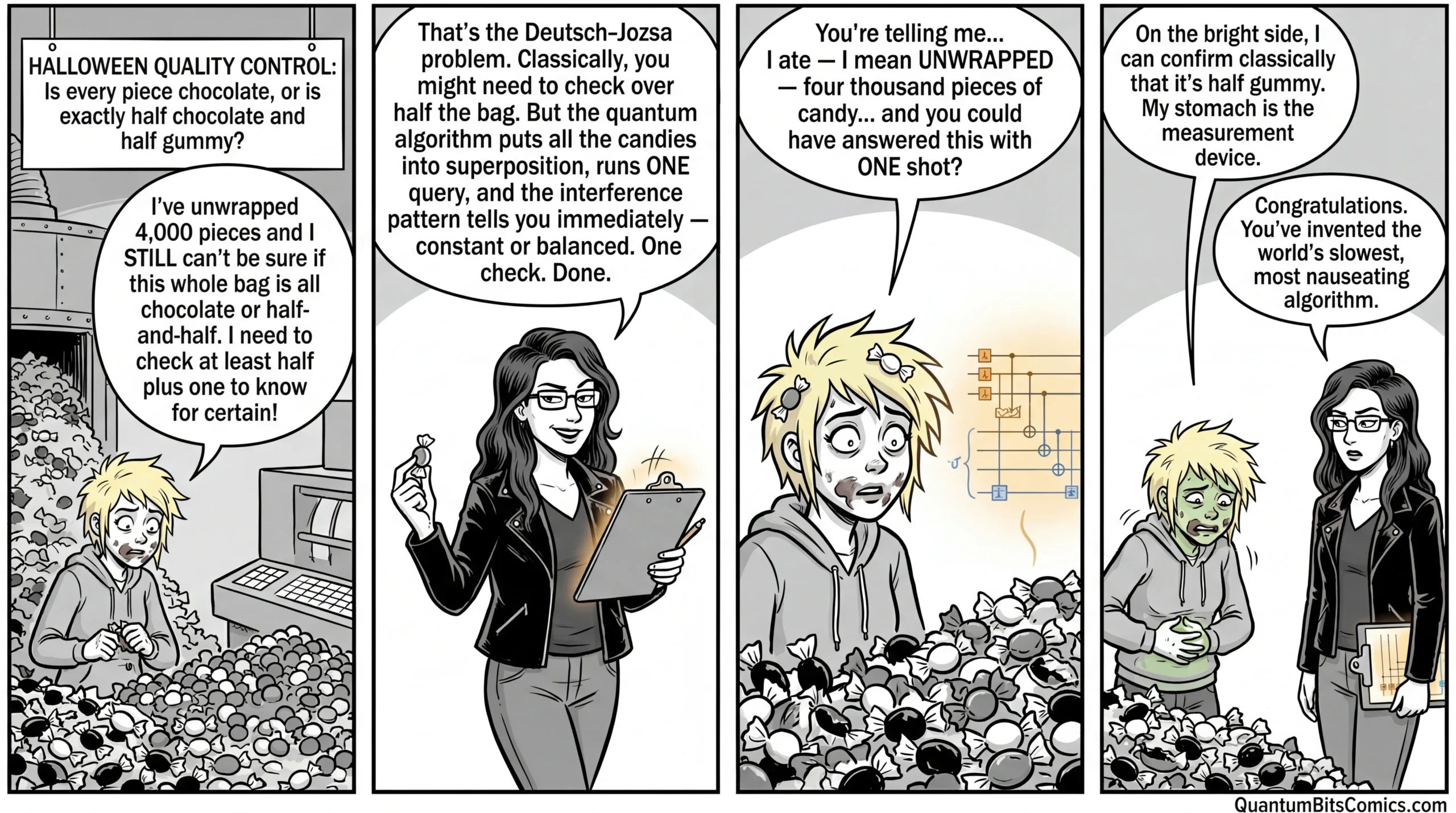
In 1992, physicists David Deutsch and Richard Jozsa posed a deceptively simple question. Imagine you have a black box containing a function that takes a string of bits as input. This function is guaranteed to be one of two types: either “constant,” meaning it gives the same output for every single input, or “balanced,” meaning it outputs 0 for exactly half its inputs and 1 for the other half. How many times must you use the box to figure out which type it is?

Classically, the answer is frustrating. To be absolutely certain, you might have to check just over half of all possible inputs. If the function takes a 100-bit number, the number of inputs is astronomical, far more than the number of atoms in the known universe. Checking even half of them is impossible. The Deutsch-Jozsa algorithm, however, solves the problem with a single call to the function. This was one of the first formal demonstrations that a quantum computer could solve a problem exponentially faster than any deterministic classical computer.

The algorithm achieves this feat not by checking every input in parallel, but by cleverly using quantum interference. It begins by placing a set of qubits into a superposition representing all possible inputs. When the black box function is applied to this superposition, it doesn’t compute all the outputs. Instead, it imparts a subtle shift, called a phase, to the quantum state. This phase shift depends on the global property of the function, whether it is constant or balanced.

A final set of quantum gates causes the different quantum states in the superposition to interfere with one another. For a constant function, all states interfere constructively, leading to a single, predictable outcome upon measurement. For a balanced function, the interference is destructive in a way that guarantees a different outcome. The Deutsch-Jozsa algorithm is more of a foundational lesson than a practical tool, but its true value was in establishing the core pattern for many quantum algorithms: prepare a superposition, apply a function to encode a global property into phases, and use interference to reveal the answer.

Subscribe on Substack at https://qubitguy.substack.com/

Controlled Not Gate

A quantum comic strip about controlled not gate

The CNOT (Controlled-NOT) gate is the standard two-qubit gate in quantum computing. It takes two qubits as input: a control qubit and a target qubit. If the control qubit is in state 1, the target qubit is flipped (0 becomes 1, 1 becomes 0). If the control is in state 0, the target is left unchanged. This conditional behavior is what makes it useful.

The CNOT gate becomes powerful when the control qubit is in superposition. If the control is in an equal superposition of 0 and 1, the CNOT creates entanglement between the two qubits. The resulting state cannot be described as two independent qubits; their fates are now linked. This ability to generate entanglement from superposition is why the CNOT gate (together with single-qubit rotations) forms a universal gate set: any quantum computation can be decomposed into a sequence of these operations. The CNOT is self-inverse: applying it twice returns both qubits to their original states.

In circuit diagrams, the CNOT is drawn as a dot on the control qubit’s wire connected by a vertical line to a circled plus symbol on the target qubit’s wire. Reading quantum circuit diagrams is a core skill, and the CNOT symbol appears in virtually every circuit of any complexity.

Different hardware platforms implement the CNOT differently. Superconducting systems use microwave pulses that couple two transmon qubits through a shared resonator. Trapped-ion systems use laser-driven interactions mediated by the ions’ shared motional modes. Neutral-atom systems often implement the closely related CZ (controlled-Z) gate natively using Rydberg interactions, then convert to CNOT through additional single-qubit rotations. The mathematical effect is the same; the physics varies.

The CNOT gate’s error rate is one of the most critical metrics in quantum hardware. Two-qubit gates are typically far noisier than single-qubit gates, often by an order of magnitude or more, making them the primary bottleneck for circuit depth and algorithm complexity. Improving two-qubit gate fidelity is one of the highest-impact engineering targets in the field.

Subscribe on Substack at https://qubitguy.substack.com/
Quantum Simulation

A quantum comic strip about quantum simulation

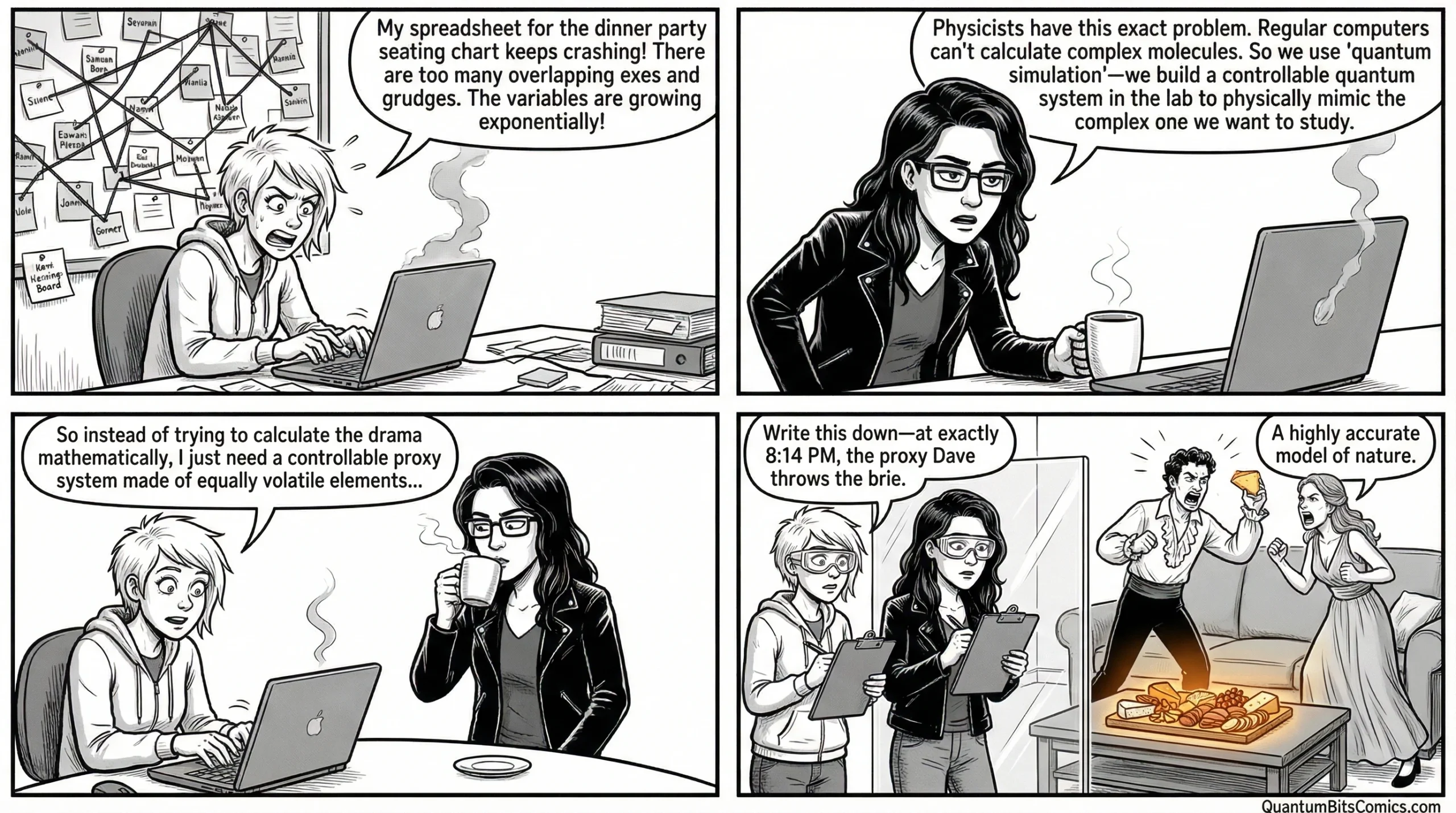
In 1981, physicist Richard Feynman pointed out a fundamental mismatch in computer science. Nature is inherently quantum mechanical, but the computers we use to model it are strictly classical. He proposed a direct solution. If you want to make an accurate simulation of nature, you should make the computer itself out of quantum mechanical elements. This observation became the original motivation for building a quantum computer.

Simulating chemical reactions or novel materials on a classical machine hits a wall very quickly. Every time you add an electron to an exact molecular model, the mathematical space required to track all possible quantum states and interactions grows exponentially. The largest classical supercomputers run out of memory trying to exactly model a cluster of just a few dozen atoms. To study anything larger, scientists must rely on heavy mathematical approximations.

Quantum simulation bypasses this scaling problem by using qubits to directly represent the electrons and atoms of the target system. Because the qubits operate under the same rules of quantum mechanics as the molecule being studied, they naturally capture the complexity without needing to store astronomical amounts of data. The quantum computer uses its own physical state to map the underlying physics of the target molecule. Setting up this mapping still requires careful algorithmic choices about which molecular properties to represent and how to encode them onto qubits, but the fundamental scaling advantage holds.

The primary goal is resolving open questions in chemistry and physics that strictly resist classical modeling. Mapping the exact catalyst reactions required to efficiently produce synthetic fertilizer or understanding the mechanics behind high temperature superconductors requires perfect quantum-level detail. Cheaper fertilizer production alone could reshape global agriculture, and room-temperature superconductors would transform energy transmission and computing hardware. By building controllable laboratory systems that map directly to these phenomena, researchers gain a practical way to study the quantum world on its own terms.

Subscribe on Substack at https://qubitguy.substack.com/
Quantum Speedup

A quantum comic strip about quantum speedup

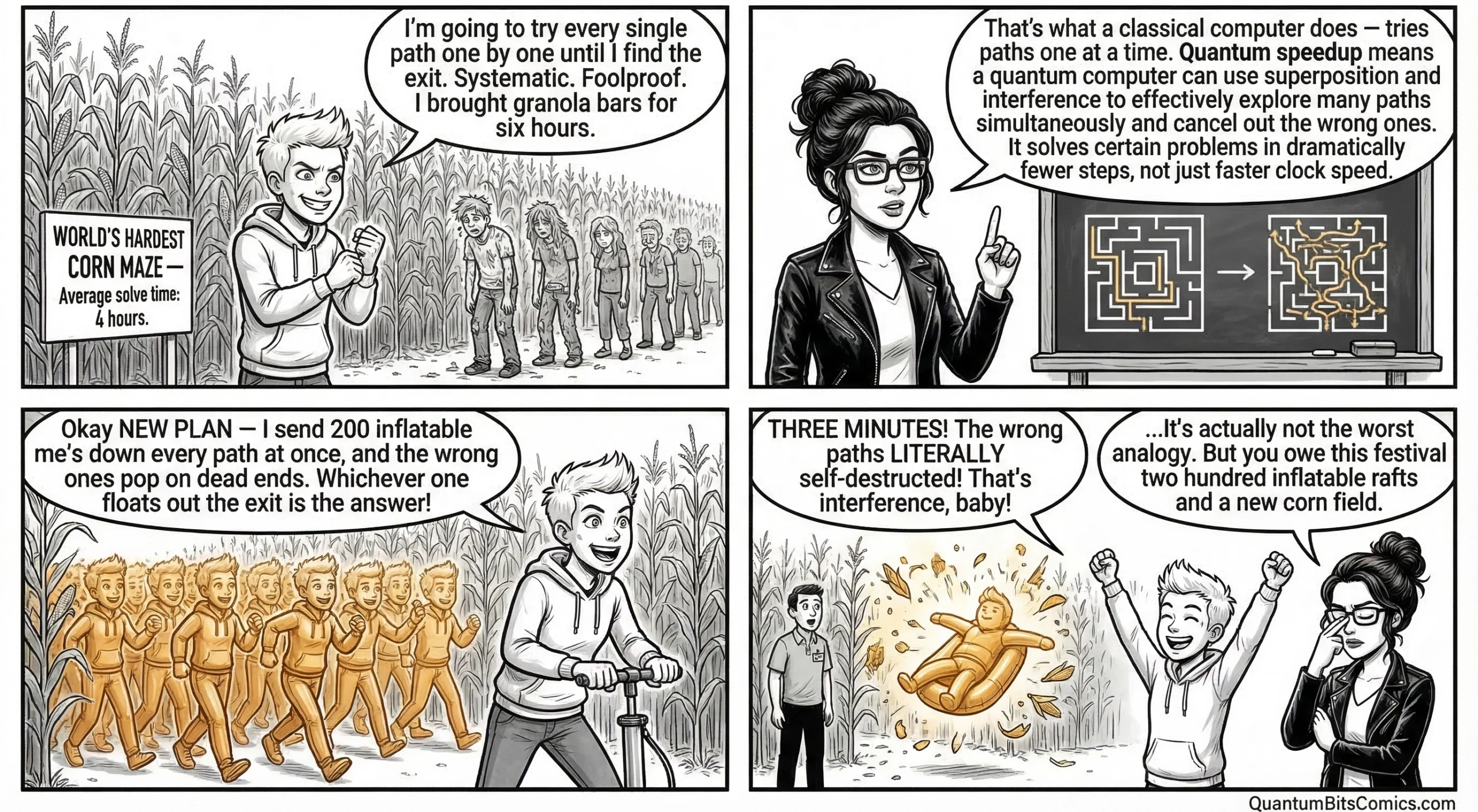
Quantum computing is not a faster version of classical computing. If you could run a standard word processor or web browser on a quantum machine, it would likely run slower than it does on your smartphone. The concept of quantum speedup refers to a completely different mathematical approach to solving highly specific, complex problems. It is not about increasing processor clock speeds, but rather about radically reducing the total number of computational steps required to reach an answer.

A common misconception is that a quantum computer achieves this speedup by trying every possible answer simultaneously. In reality, it works more like a carefully choreographed wave pool. A quantum algorithm assigns mathematical weights called amplitudes to different computational paths. Through a process called quantum interference, the algorithm suppresses wrong answers and amplifies correct ones. The speedup comes from this ability to manipulate probabilities to reinforce the right solution in far fewer steps than a classical machine would need to check all the options.

Because this mechanism relies on the mathematical structure of the problem itself, quantum speedup only applies to certain classes of tasks. Computer scientists divide these advantages into different categories. A polynomial speedup, like the one offered by Grover’s algorithm for searching unstructured data, turns a problem that scales terribly into one that scales more manageably. An exponential speedup, like Shor’s algorithm for factoring large numbers or algorithms for simulating quantum mechanics, is much more profound. It transforms a calculation that would take a classical supercomputer millions of years into one that a future quantum machine could solve in days or hours.

Achieving these theoretical speedups in the physical world requires large-scale, fault-tolerant hardware, yet today’s quantum processors are limited in the number of qubits and prone to errors.

Subscribe on Substack at https://qubitguy.substack.com/