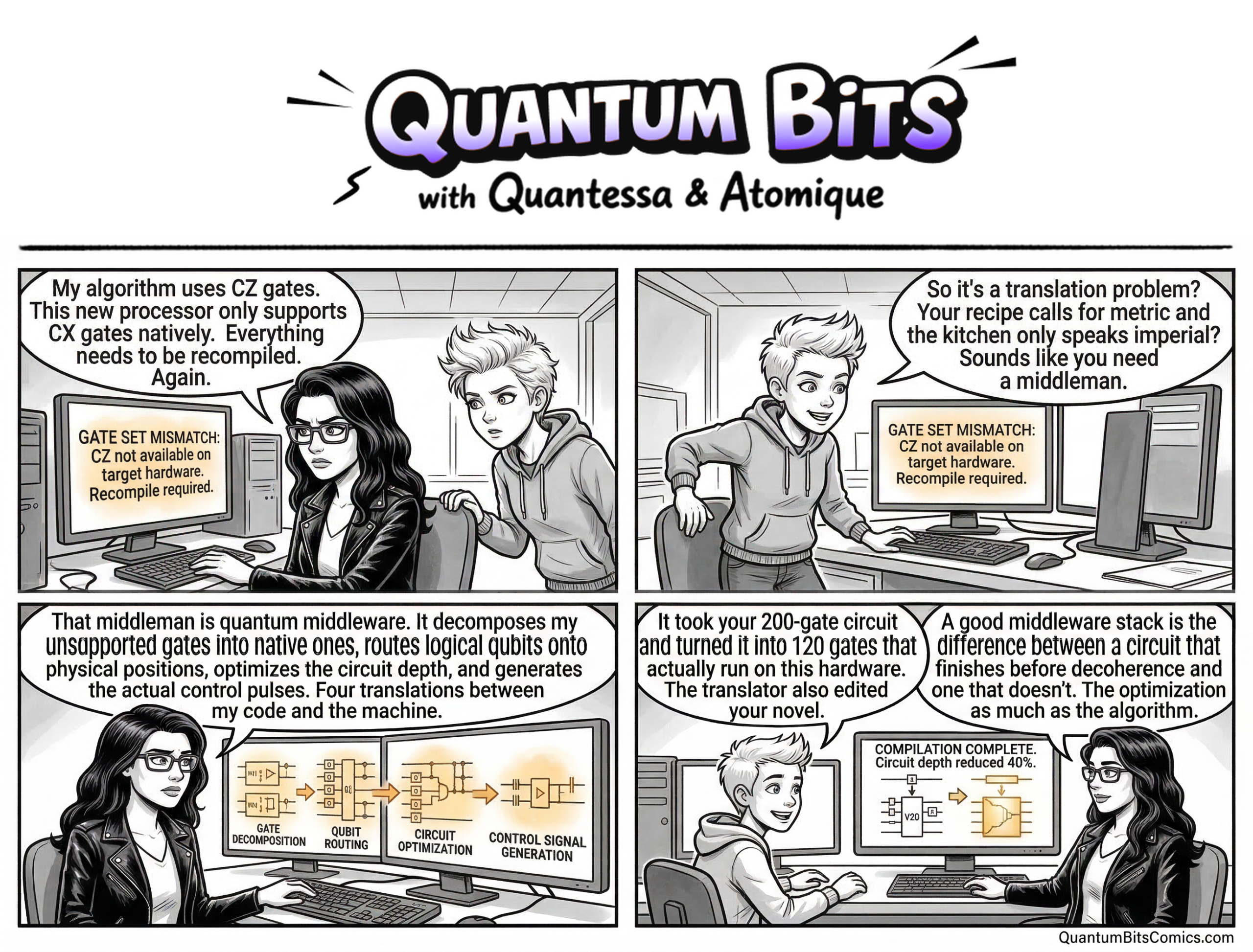
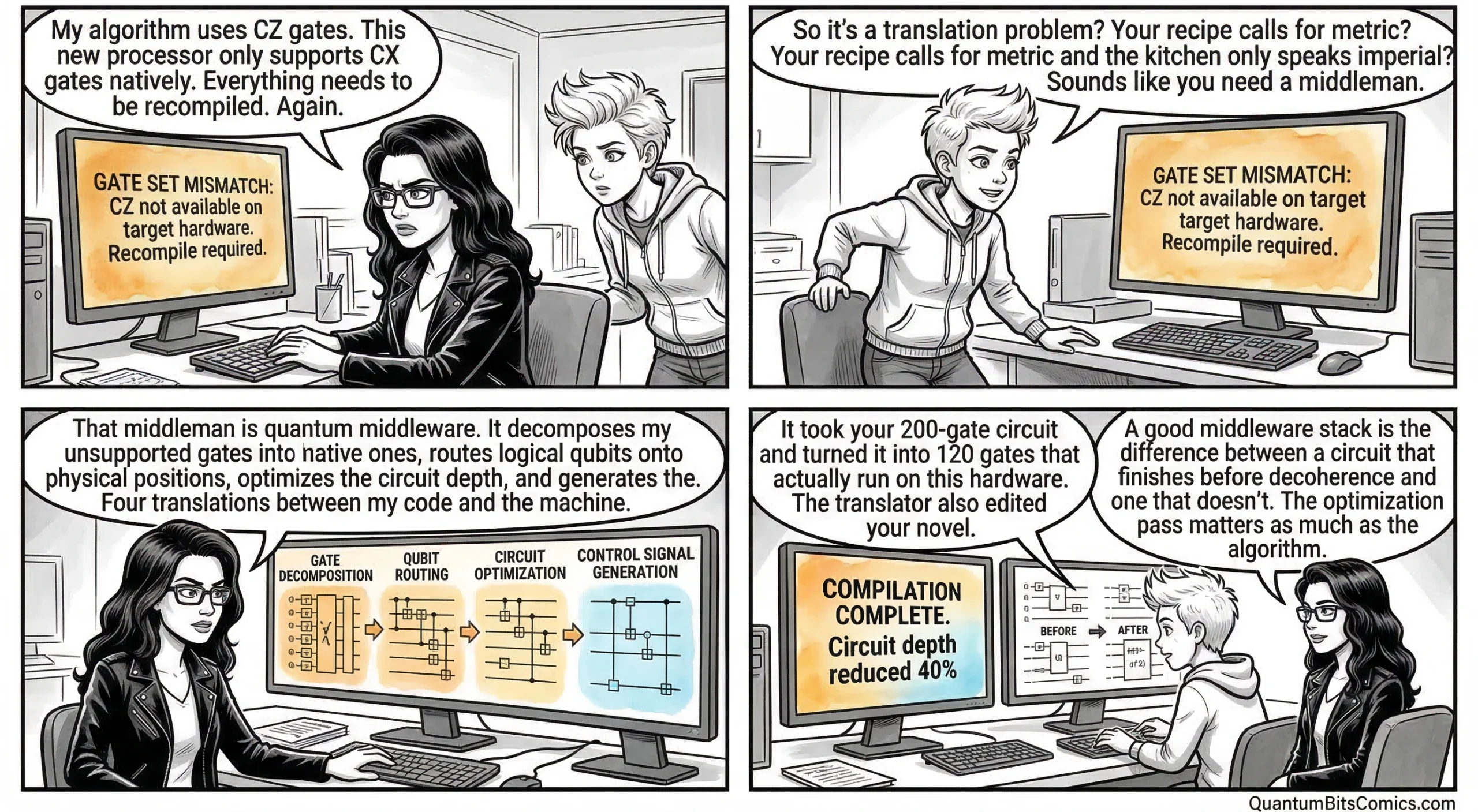
A quantum developer writing code today faces a fragmented hardware landscape. Different quantum processors support different native gate sets, different qubit connectivity, and different error characteristics. Code written for one machine may not run on another. Quantum middleware is the abstraction layer that sits between the developer and this hardware diversity.
The core function of middleware is hardware abstraction. A developer writes an algorithm once using a high-level framework like Qiskit, Cirq, or PennyLane. The middleware translates that algorithm into the specific instructions required by whichever backend will execute it, whether that is a superconducting processor, a trapped-ion system, a neutral-atom machine, or a classical simulator. The developer does not need to know the details of the target hardware.
Middleware also manages job orchestration. When a user submits a quantum program to a cloud platform, middleware handles queuing, scheduling, and resource allocation. It decides when the job runs, on which processor, and how to return results. For hybrid algorithms that require repeated quantum-classical iterations, middleware coordinates the handoff between the quantum processor and the classical optimizer, managing latency and data flow across the loop.
Some middleware platforms add a layer of intelligence to backend selection. Given a circuit’s structure, depth, and connectivity requirements, the middleware can route the job to the hardware best suited to execute it. As the number of available quantum processors grows and their capabilities diverge, this matchmaking function becomes increasingly valuable.
Middleware is where the quantum computing ecosystem becomes usable at scale. Without it, every developer would need to be a hardware specialist. With it, quantum computing begins to look like a callable resource within a broader computational workflow, which is what adoption ultimately requires.
Subscribe on Substack at https://qubitguy.substack.com/