Quantum Bits is intended to introduce quantum computing terms in a fun and accessible way. It is a personal project of Yuval Boger, whose day job is Chief Commercial Officer at QuEra Computing. You might also know Yuval from his Superposition Guy's Podcast series (listen here)

Subscribe on Substack at https://qubitguy.substack.com/ to get both comics and podcasts.


Latest Posts

Code Distance

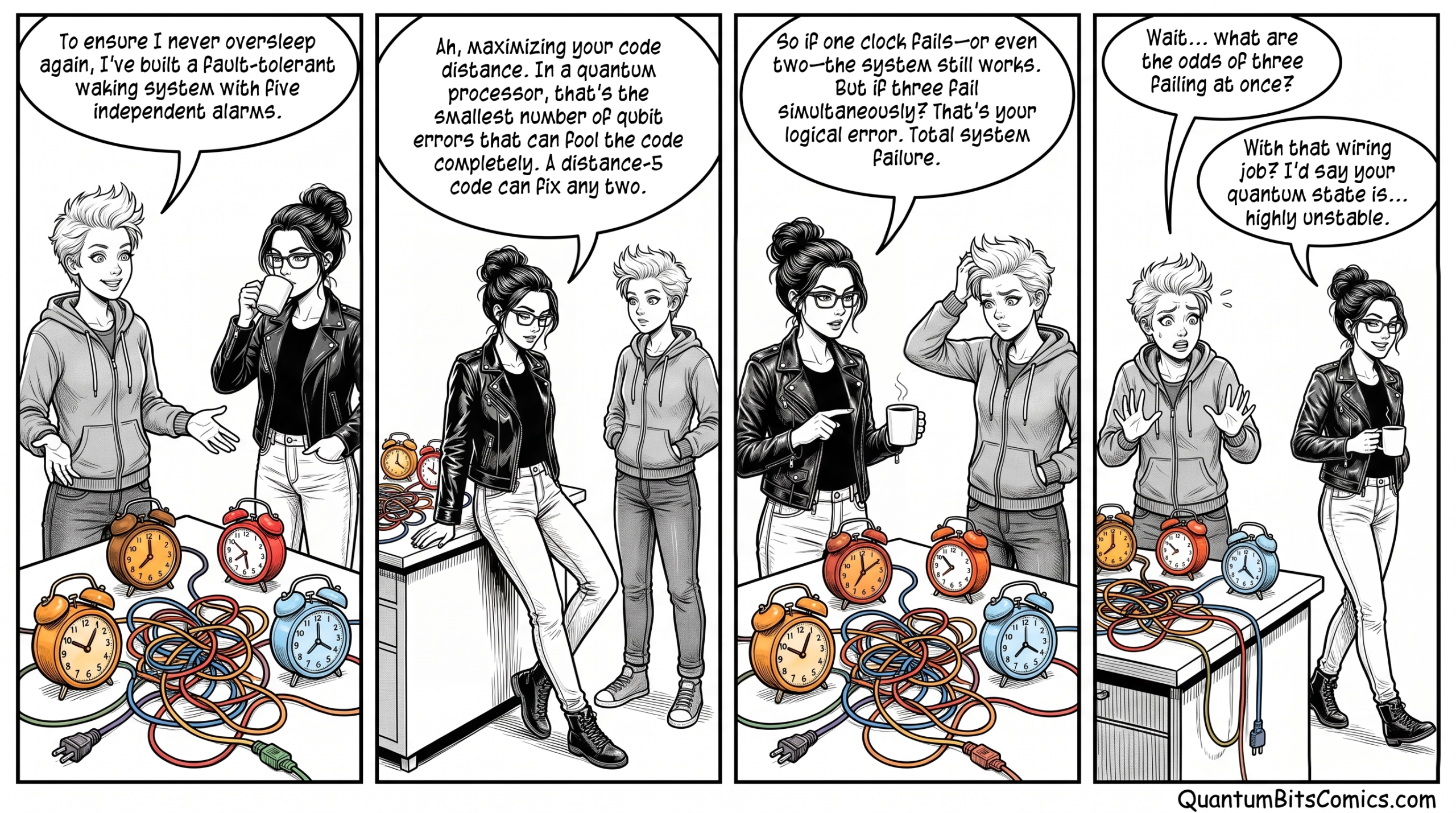
A quantum comic strip about code distance

Quantum information cannot be protected by copying. The no-cloning theorem forbids duplicating an unknown quantum state, so classical strategies like backup copies are unavailable. Instead, quantum error correction encodes information across the collective, entangled state of many physical qubits to create one robust logical qubit. The primary metric engineers use to measure the strength of this protection is code distance.

Code distance is the minimum number of physical-qubit errors that can combine to produce an undetected logical error. A code with distance d can detect up to d-1 errors and correct up to ⌊(d − 1)/2⌋ errors. These are different thresholds, and the distinction matters.

A distance-2 code can detect that a single error has occurred, but it cannot determine which qubit was affected, so it cannot correct it. This is useful for error detection schemes but not for fault-tolerant computation. A distance-3 code, such as Steane’s seven-qubit code, can correct any single-qubit error. A distance-5 code can correct two simultaneous errors. As long as the number of physical errors stays below the correction threshold, the system continuously detects and fixes mistakes without ever measuring or destroying the underlying quantum information.

Building quantum computers with high code distances is a central hardware challenge. Increasing the distance requires committing more physical qubits to encode each logical qubit. Steane’s distance-3 code requires 7 physical qubits. A distance-7 surface code requires hundreds. System architects constantly weigh the need for a high code distance against the practical cost of building and controlling large arrays of physical qubits. Lower physical error rates ease this tradeoff: the cleaner the hardware, the less redundancy is needed to reach a given level of logical protection.

Subscribe on Substack at https://qubitguy.substack.com/
Erasure Conversion

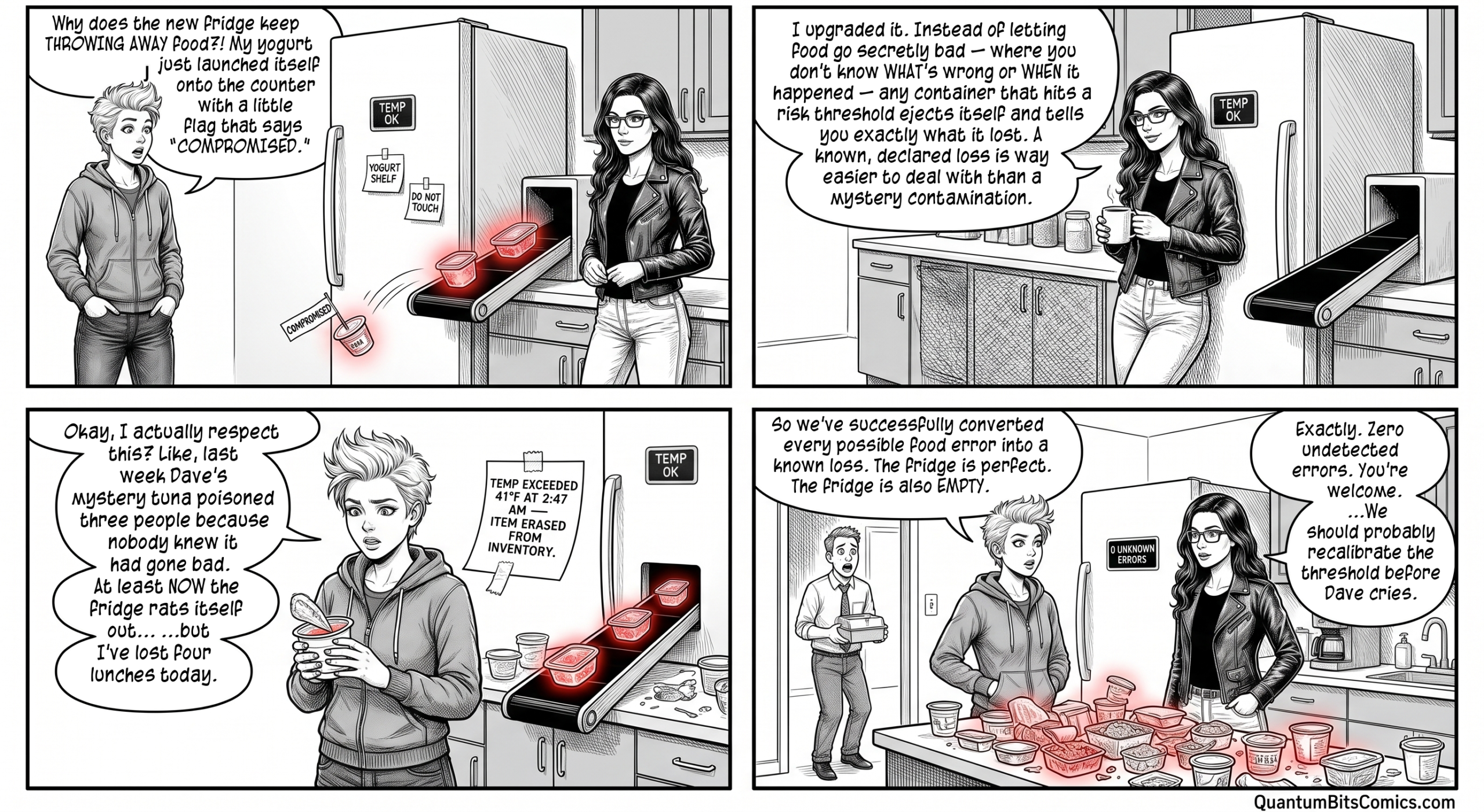
A quantum comic strip about erasure conversion

In quantum error correction, finding an error is often harder than fixing it. Most quantum errors are silent corruptions. A qubit might subtly lose its quantum state or flip its phase, and it will not trigger any alarms. To find these silent errors without destroying the quantum information, a quantum computer must run complex diagnostic checks across a large grid of qubits. But if the system knows exactly which qubit failed, the math of error correction becomes drastically simpler. A known failure at a known location is called an erasure.

Quantum error correction codes can handle erasure errors far better than silent corruptions. For standard error correction to work, the rate of silent errors must remain below a stringent threshold, often around one percent. If the errors are erasures instead, that threshold jumps significantly. A system can tolerate losing a much larger fraction of its qubits as long as it knows exactly where those losses occurred. The problem is that quantum hardware does not naturally produce erasures. Left alone, physical qubits simply degrade in silence.

Erasure conversion is an engineering technique that forces silent errors to announce themselves. Hardware designers structure the qubits so that their most common failure modes result in a recognizable flag. In neutral-atom quantum computers developed by companies including QuEra, quantum information is stored in specific energy levels of an atom. When a common error like spontaneous decay occurs, the atom does not just subtly shift its computational state. It drops into a completely different energy state that sits outside the working area.

By scanning the system for atoms in this discarded energy state, the quantum computer can pinpoint exactly which qubits have failed. This check converts an unknown, hard-to-diagnose error into a known, easy-to-manage erasure. The technique provides a massive shortcut on the path to fault tolerance. By trading silent corruptions for known erasures, engineers can drastically reduce the number of physical qubits required to build a reliable logical qubit.

Subscribe on Substack at https://qubitguy.substack.com/
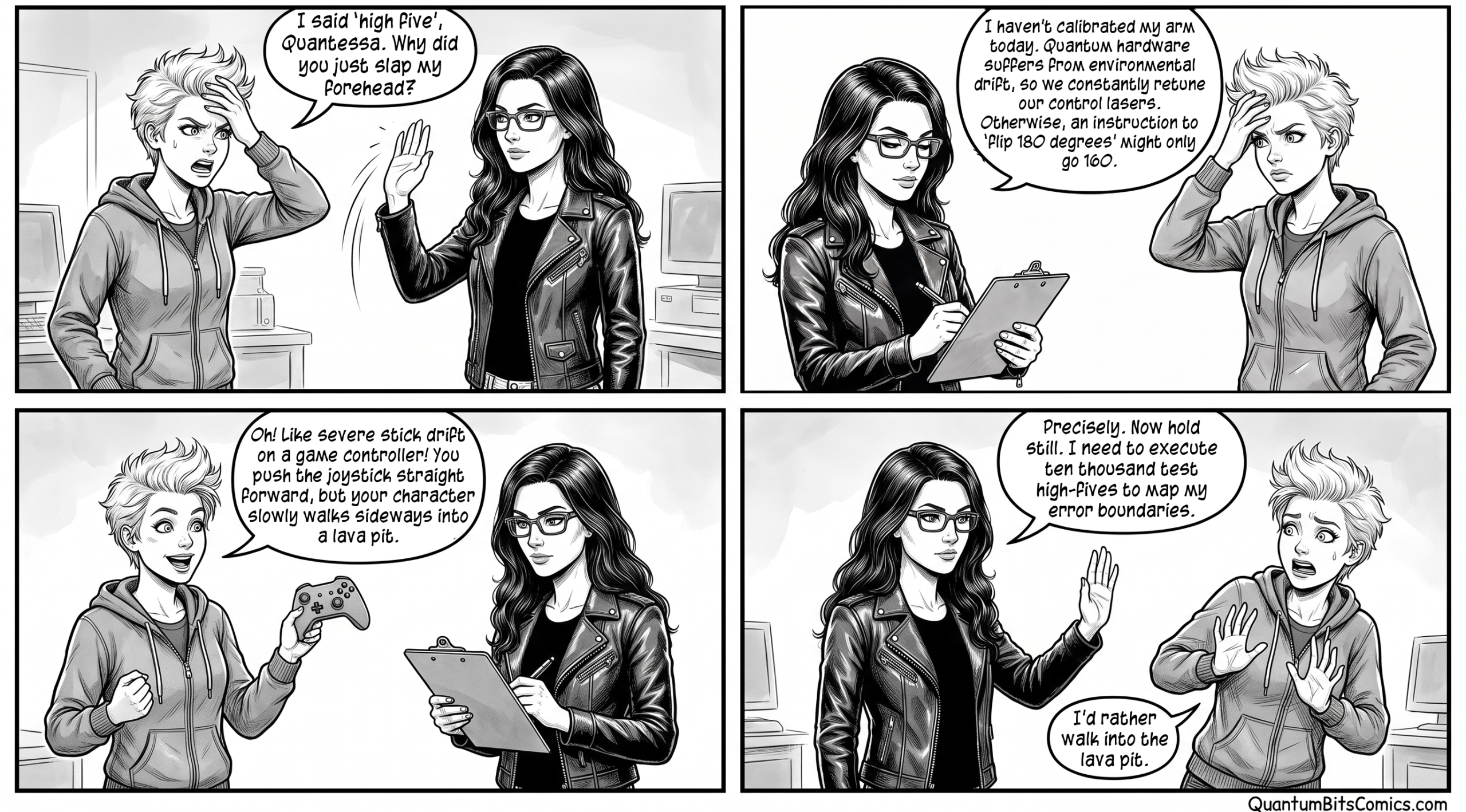
Calibration

A quantum comic strip about calibration

A quantum computer is an instrument that constantly falls out of tune. If you send a precisely shaped microwave pulse to a superconducting qubit at noon to perform a specific logic gate, that exact same pulse might produce an error just five minutes later. The physical environment shifts constantly. Temperatures fluctuate by fractions of a degree, background electromagnetic noise varies, and the hardware itself drifts. To keep the system executing accurate operations, the control signals must be continuously updated through a process called calibration.

Calibration acts as the bridge between abstract quantum algorithms and physical reality. It involves running thousands of short diagnostic circuits with known outcomes. If an operation is meant to flip a qubit perfectly from a zero state to a one state, the control system executes the command and measures the result. If the qubit under-rotates, the system calculates a correction. It might increase the amplitude of a microwave burst or adjust the frequency of a laser beam in neutral-atom platforms like those developed by QuEra. These adjustments ensure the hardware continues to faithfully follow its mathematical instructions.

This diagnostic work carries massive overhead. On current generation quantum hardware, calibration routines can consume hours of system time every day. Tuning a small handful of isolated qubits is straightforward. But as processors scale up to hundreds of qubits, the complexity compounds. The system must map and correct for crosstalk, which occurs when a control signal meant for one qubit unintentionally affects its neighbors. Every new qubit added to a processor multiplies the number of potential interactions that must be measured and compensated for.

Moving from experimental prototypes to reliable computers requires removing humans from this loop entirely. Software engineers are building automated calibration systems that run continuously in the background. Many platforms now use machine learning to track historical drift and predict exactly when a specific qubit will need adjustment before its error rate spikes. This autonomous tuning is a strict prerequisite for building larger machines. Without meticulously calibrated physical operations, the foundational requirements for quantum error correction can never be met.

Subscribe on Substack at https://qubitguy.substack.com/
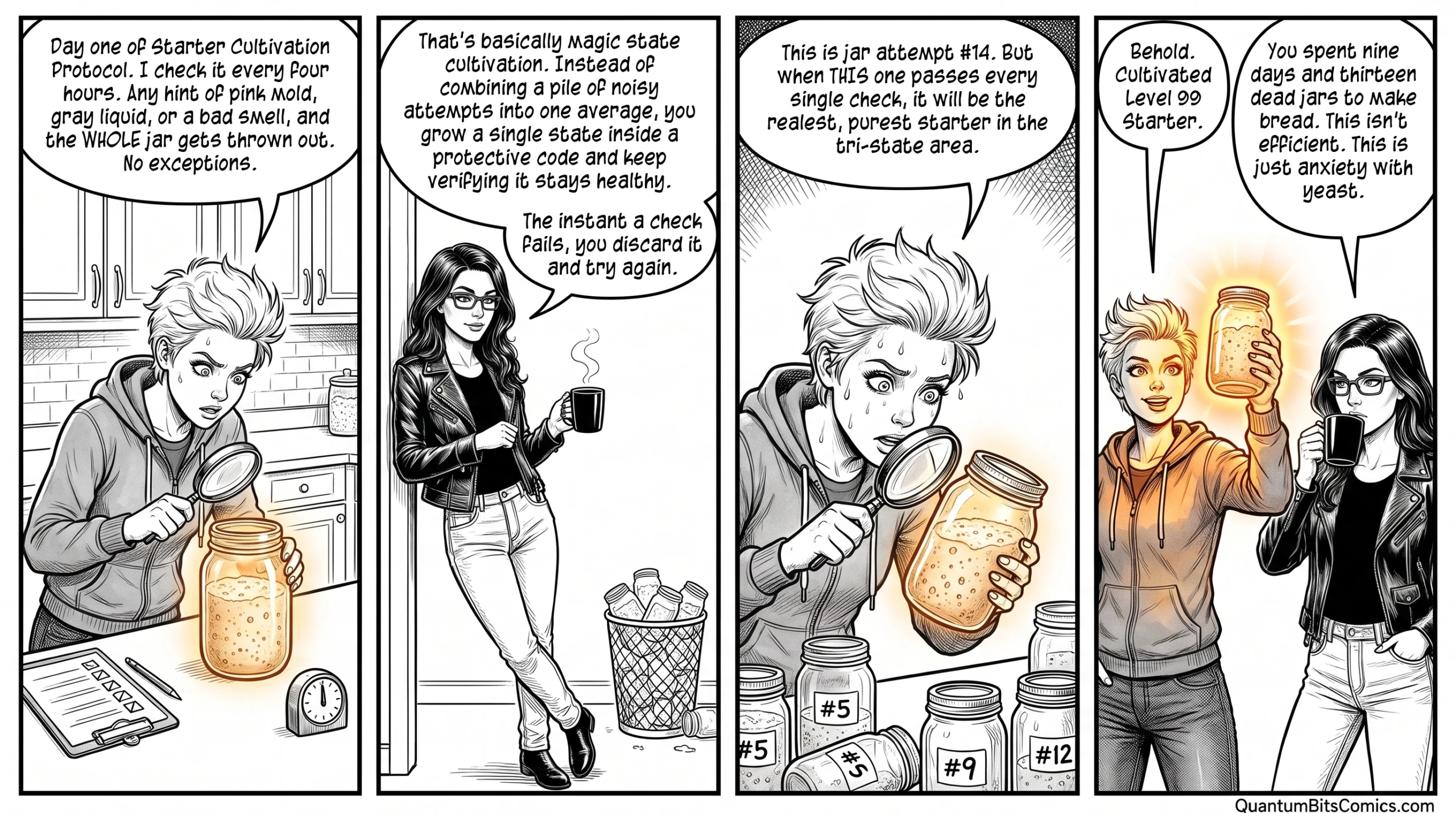
Magic State Cultivation

A quantum comic strip about magic state cultivation

A fault-tolerant quantum computer cannot reach its full potential using only the easiest operations. Most error-correction codes naturally support a set of operations known as Clifford gates. These are relatively straightforward to protect from noise, but there is a catch: according to the Gottesman-Knill theorem, a circuit built exclusively from Clifford gates can be perfectly simulated by a standard classical computer. To perform calculations a classical machine cannot match, a quantum computer needs a non-Clifford operation, such as a T gate.

Executing a protected T gate directly is nearly impossible in most standard codes. Instead, researchers use a special resource called a magic state, a carefully prepared quantum state that is consumed during the computation. By combining it with standard Clifford gates and measurements, the computer can mathematically force a T gate into existence. Because the state is destroyed in the process, complex algorithms require a massive, continuous supply.

The challenge is that magic states are fragile and hard to create with high fidelity. Historically, the solution was magic state distillation, which takes many low-quality, noisy states and squeezes them into a single accurate one. Distillation works, but it is extremely inefficient. In a large-scale algorithm, distilling enough magic states could consume over ninety percent of the computer’s hardware, leaving few qubits for the actual computation.

Magic state cultivation offers a more efficient path. Rather than mass-producing noisy states and discarding most of them, cultivation focuses on preparing high-fidelity magic states from the very beginning. By using specialized encoding techniques or specific hardware properties, engineers can prepare these states with far fewer initial errors, drastically reducing the hardware overhead needed to power complex algorithms.

Solving the magic state problem is a strictly necessary step for practical fault tolerance. Without an efficient way to generate these non-Clifford resources, quantum computers will stay bottlenecked by the sheer size required for error correction. Cultivation provides a realistic strategy for scaling, ensuring future machines have the resources to execute advanced algorithms.

Subscribe on Substack at https://qubitguy.substack.com/
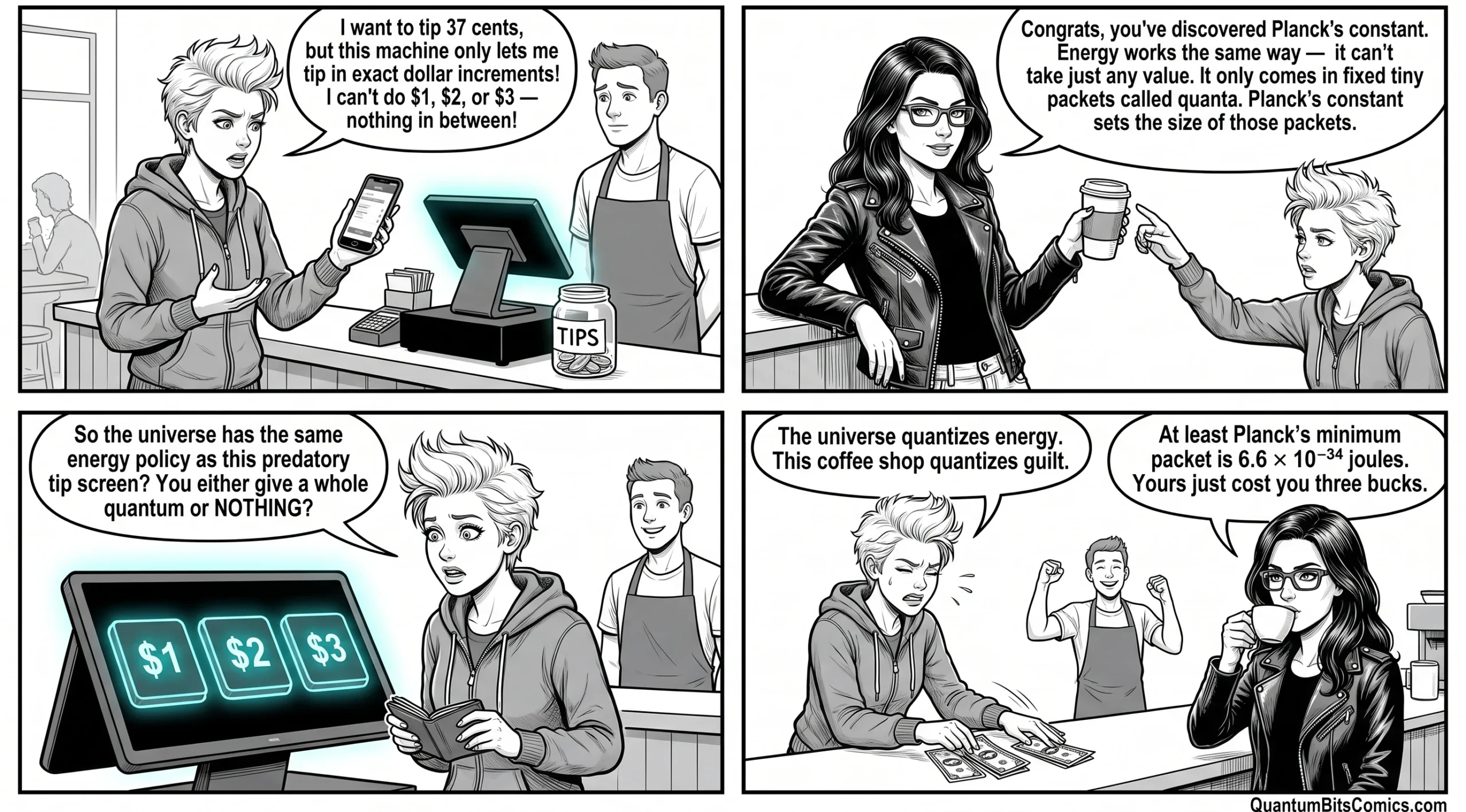
Planck’s Constant

A quantum comic strip about planck's constant

In 1900, physicist Max Planck was trying to explain how hot objects emit light. Classical physics could not reproduce the observed spectrum, so Planck introduced a radical idea: matter could emit or absorb energy only in distinct amounts linked to the frequency of the radiation. The constant connecting energy and frequency became known as Planck’s constant. A few years later, Albert Einstein extended the idea by proposing that light itself comes in individual packets, now called photons.

Planck’s constant is extraordinarily small in everyday units. Written as a decimal in joule-seconds, it begins with a decimal point followed by thirty-three zeros before the first nonzero digit. Its small value helps explain why quantum behavior is difficult to notice in daily life. A kettle, a flashlight, or a moving baseball involves immense numbers of quantum events whose individual effects blend together. At the scale of atoms and electrons, however, energy often comes in clearly separated levels. Planck’s constant sets the basic scale of this quantum behavior, although the spacing between levels depends on the physical system.

Quantum computers deliberately operate in this microscopic realm. A qubit’s zero and one correspond to two quantum states, often separated by a small energy gap. Engineers control superconducting qubits with carefully shaped microwave pulses and manipulate atomic qubits with laser light. The frequency, strength, phase, and duration of each pulse determine how the qubit changes. Small inaccuracies do not necessarily make an operation fail completely, but they introduce errors that can accumulate during a computation.

Keeping qubits stable is therefore a major engineering challenge. In superconducting processors, ordinary thermal energy can excite the qubits and disturb their delicate quantum states. Dilution refrigerators cool these devices to temperatures only a few thousandths of a degree above absolute zero, while shielding and filtering reduce unwanted electromagnetic noise. Neutral-atom computers take a different approach: lasers cool and trap the atoms, while an ultra-high vacuum prevents disruptive collisions. Different quantum technologies have different requirements, but they share the same goal—isolating quantum states long enough to control them accurately and perform a computation.

Subscribe on Substack at https://qubitguy.substack.com/
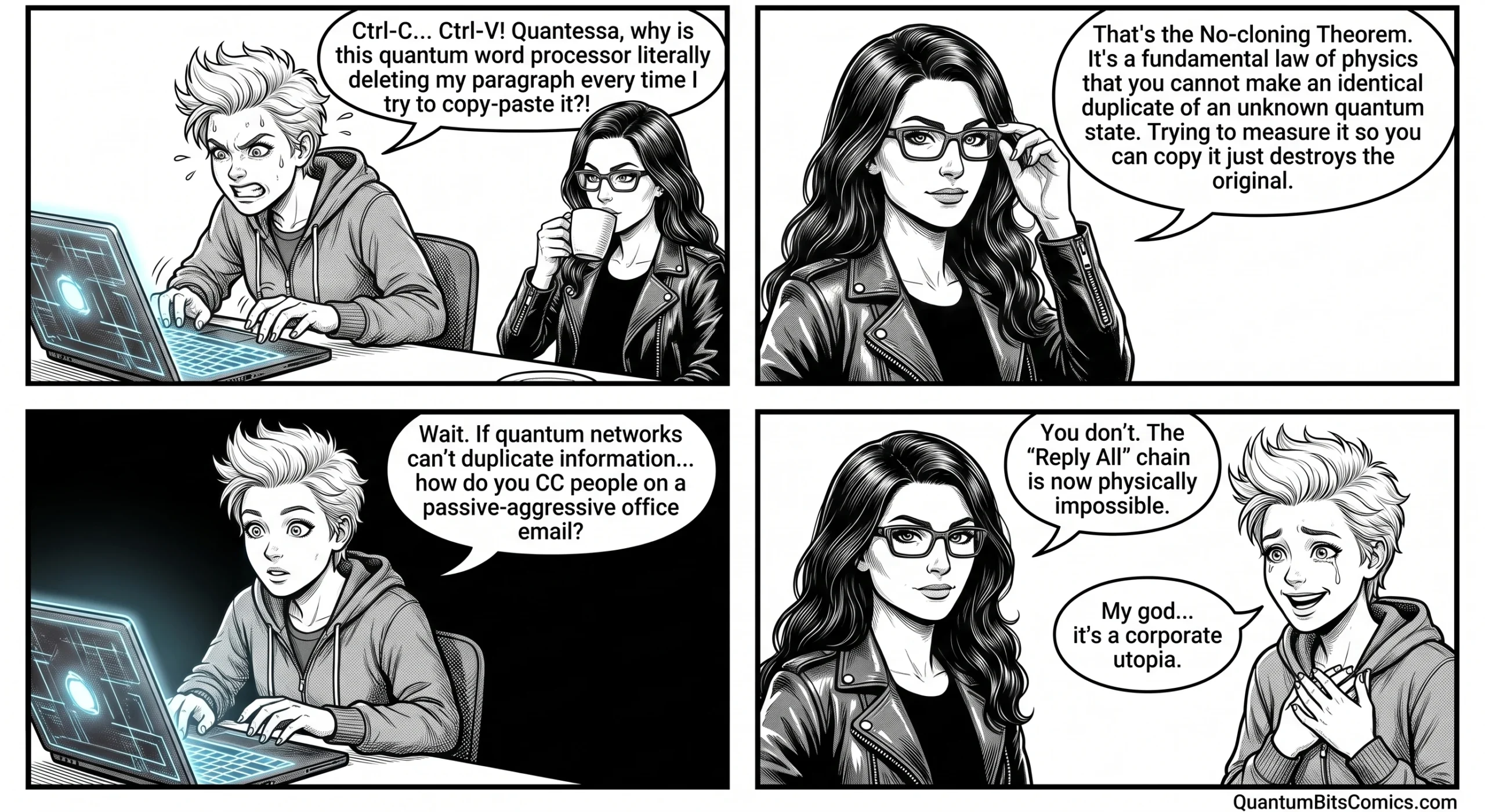
No Cloning Theorem

A quantum comic strip about no cloning theorem

You cannot copy an unknown quantum state. This is not an engineering limitation that better technology might overcome. It is a mathematical consequence of the structure of quantum mechanics, proven by William Wootters and Wojciech Zurek in 1982. Dennis Dieks independently published the same result at essentially the same time.

The proof is surprisingly simple. Quantum operations (other than measurement) are linear: they preserve the mathematical relationships between states. Cloning would require a process that takes an arbitrary input state and produces two identical copies. It turns out that linearity makes this impossible. A cloning machine that works perfectly for one specific state will inevitably distort others. There is no universal quantum copier.

For quantum computing, this creates a fundamental design constraint. Classical error correction works by making redundant copies of data and comparing them: if three copies say “1” and one says “0,” you know the odd one out is the error. Quantum error correction cannot use this strategy. Instead, it encodes information in the entangled state of multiple qubits in a way that allows error detection without ever reading (or copying) the protected data. This is dramatically harder to engineer, and it is the reason quantum error correction requires so much overhead.

The no-cloning theorem also has a constructive side. It is the foundation of quantum key distribution security. If an eavesdropper intercepts a quantum message, they cannot copy the quantum states and pass the originals along undetected. In an ideal QKD protocol, an eavesdropper attempting to extract information introduces detectable disturbances. Practical systems must still be engineered carefully to prevent implementation attacks.

A common misconception: the no-cloning theorem does not prevent quantum teleportation. Teleportation transfers a quantum state from one location to another, but it destroys the original in the process. It moves quantum information rather than duplicating it, which is fully consistent with the theorem.

Subscribe on Substack at https://qubitguy.substack.com/
Stabilizers

A quantum comic strip about stabilizers

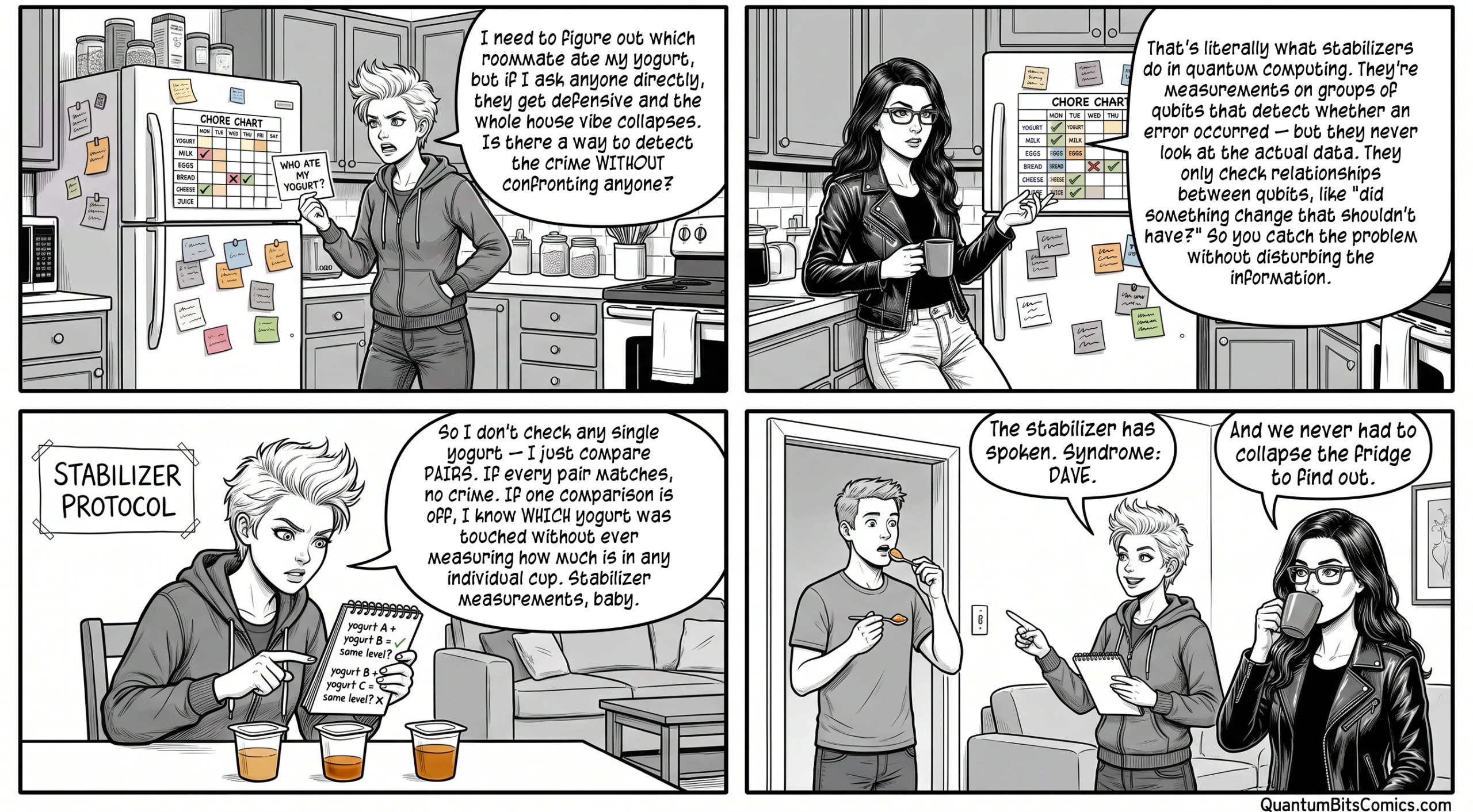
The fundamental paradox of quantum error correction is that you cannot look at your data. Measuring a quantum state forces it to collapse into classical bits, destroying any delicate superposition. Furthermore, the laws of physics forbid copying unknown quantum information to keep a safe backup. To build a reliable quantum computer, engineers had to find a way to detect and fix errors without ever looking directly at the information they were trying to protect.

The solution is a mathematical and physical technique called a stabilizer measurement. Instead of asking a specific qubit what state it is in, a quantum computer asks a group of qubits if any of them have changed relative to one another. It does this by temporarily entangling the data qubits with an extra helper qubit, often called an ancilla, and then measuring only that helper.

Measuring the helper qubit yields a piece of classical information called a syndrome. This syndrome reveals the shared properties, or parity, of the group. If the readout shows an unexpected change, the system knows an error occurred on one of the data qubits. Crucially, because the measurement only extracted information about the relationship between the qubits, the underlying quantum information remains intact and unobserved. The term stabilizer comes from the mathematics of this process: measuring these specific properties actively forces the quantum state to remain stable within a defined, protected space.

Running these stabilizer checks is the heartbeat of a fault-tolerant quantum computer. In architectures like the surface code, data qubits are constantly entangled with helper qubits in an endless grid, checking for both bit-flip and phase-flip errors. Performing these checks is a massive engineering challenge. The helper qubits must interact with the data qubits, be measured, and be reset fast enough to catch errors before they cascade, all without introducing new errors during the measurement process itself.

When a hardware platform successfully performs these continuous stabilizer measurements faster than errors naturally accumulate, it crosses a critical threshold. At that point, the system is no longer just manipulating fragile physical qubits. It is maintaining a protected logical qubit, turning error-prone hardware into a reliable foundation capable of sustaining long, complex calculations.

Subscribe on Substack at https://qubitguy.substack.com/
Quantum Middleware

A quantum comic strip about quantum middleware

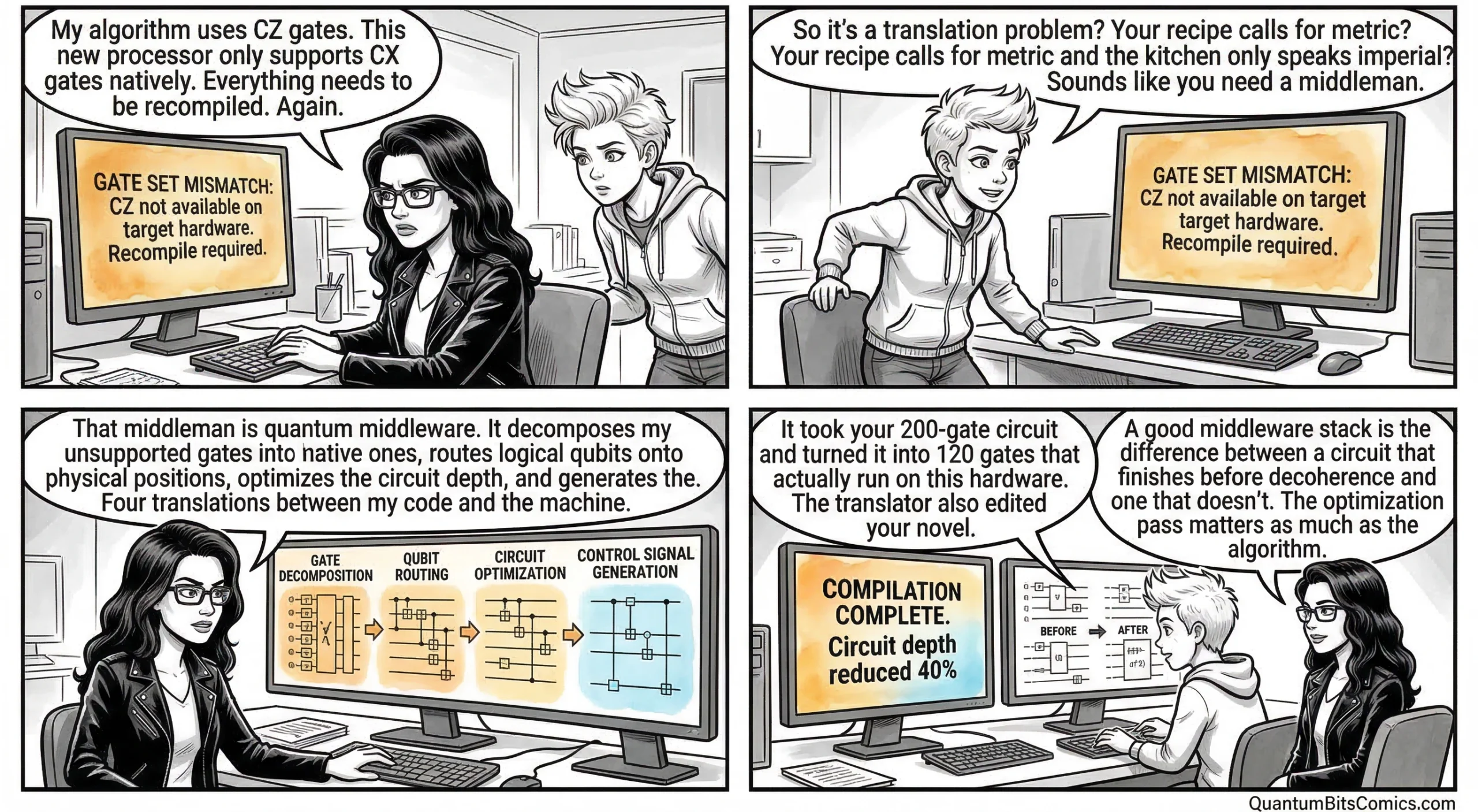
A quantum developer writing code today faces a fragmented hardware landscape. Different quantum processors support different native gate sets, different qubit connectivity, and different error characteristics. Code written for one machine may not run on another. Quantum middleware is the abstraction layer that sits between the developer and this hardware diversity.

The core function of middleware is hardware abstraction. A developer writes an algorithm once using a high-level framework like Qiskit, Cirq, or PennyLane. The middleware translates that algorithm into the specific instructions required by whichever backend will execute it, whether that is a superconducting processor, a trapped-ion system, a neutral-atom machine, or a classical simulator. The developer does not need to know the details of the target hardware.

Middleware also manages job orchestration. When a user submits a quantum program to a cloud platform, middleware handles queuing, scheduling, and resource allocation. It decides when the job runs, on which processor, and how to return results. For hybrid algorithms that require repeated quantum-classical iterations, middleware coordinates the handoff between the quantum processor and the classical optimizer, managing latency and data flow across the loop.

Some middleware platforms add a layer of intelligence to backend selection. Given a circuit’s structure, depth, and connectivity requirements, the middleware can route the job to the hardware best suited to execute it. As the number of available quantum processors grows and their capabilities diverge, this matchmaking function becomes increasingly valuable.

Middleware is where the quantum computing ecosystem becomes usable at scale. Without it, every developer would need to be a hardware specialist. With it, quantum computing begins to look like a callable resource within a broader computational workflow, which is what adoption ultimately requires.

Subscribe on Substack at https://qubitguy.substack.com/
Quantum Compiler

A quantum comic strip about quantum compiler

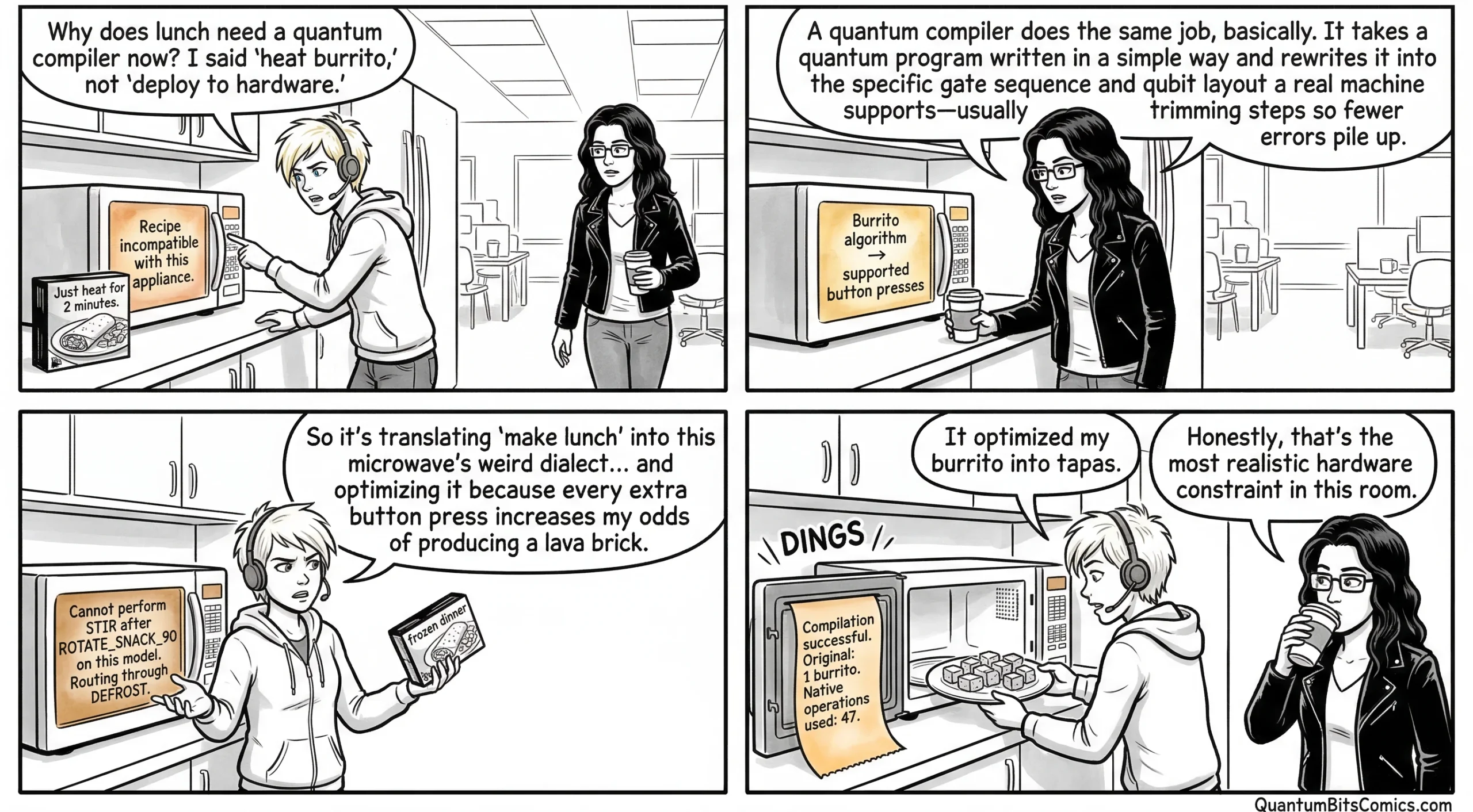
A quantum compiler translates a quantum algorithm, expressed as a sequence of abstract gates, into a form that specific quantum hardware can execute. This translation involves several steps, each addressing a different mismatch between what the algorithm assumes and what the hardware provides.

The first step is gate decomposition. An algorithm might call for a Toffoli gate (a three-qubit controlled operation), but the hardware only supports single-qubit rotations and two-qubit CZ gates natively. The compiler breaks the Toffoli into a sequence of supported operations that produce the same mathematical result.

The second step is qubit mapping and routing. The algorithm assumes any qubit can interact with any other. Some hardware platforms have a fixed connectivity graph where each physical qubit can only interact directly with its neighbors, requiring the compiler to insert swap operations. Others, including neutral-atom systems, offer reconfigurable connectivity that reduces or eliminates this routing overhead.

The third step is optimization. The naive translation from steps one and two typically produces a circuit that is longer than necessary. The compiler applies passes that cancel redundant gates, merge consecutive rotations, and reorder operations to reduce circuit depth. Since every additional gate introduces noise and every additional time step allows more decoherence, shorter circuits produce better results.

The quality of the compiler directly affects whether a computation succeeds or fails. A good compiler can reduce circuit depth by 30-50%, which on current hardware can mean the difference between a meaningful result and noise. As processors scale and algorithms grow more complex, compiler optimization will become increasingly critical.

Subscribe on Substack at https://qubitguy.substack.com/
Optical Tweezers

A quantum comic strip about optical tweezers

Neutral-atom quantum computers use individual uncharged atoms as qubits. Because these atoms carry no net electric charge, they do not repel each other, allowing researchers to pack large numbers of qubits into dense, configurable arrays.

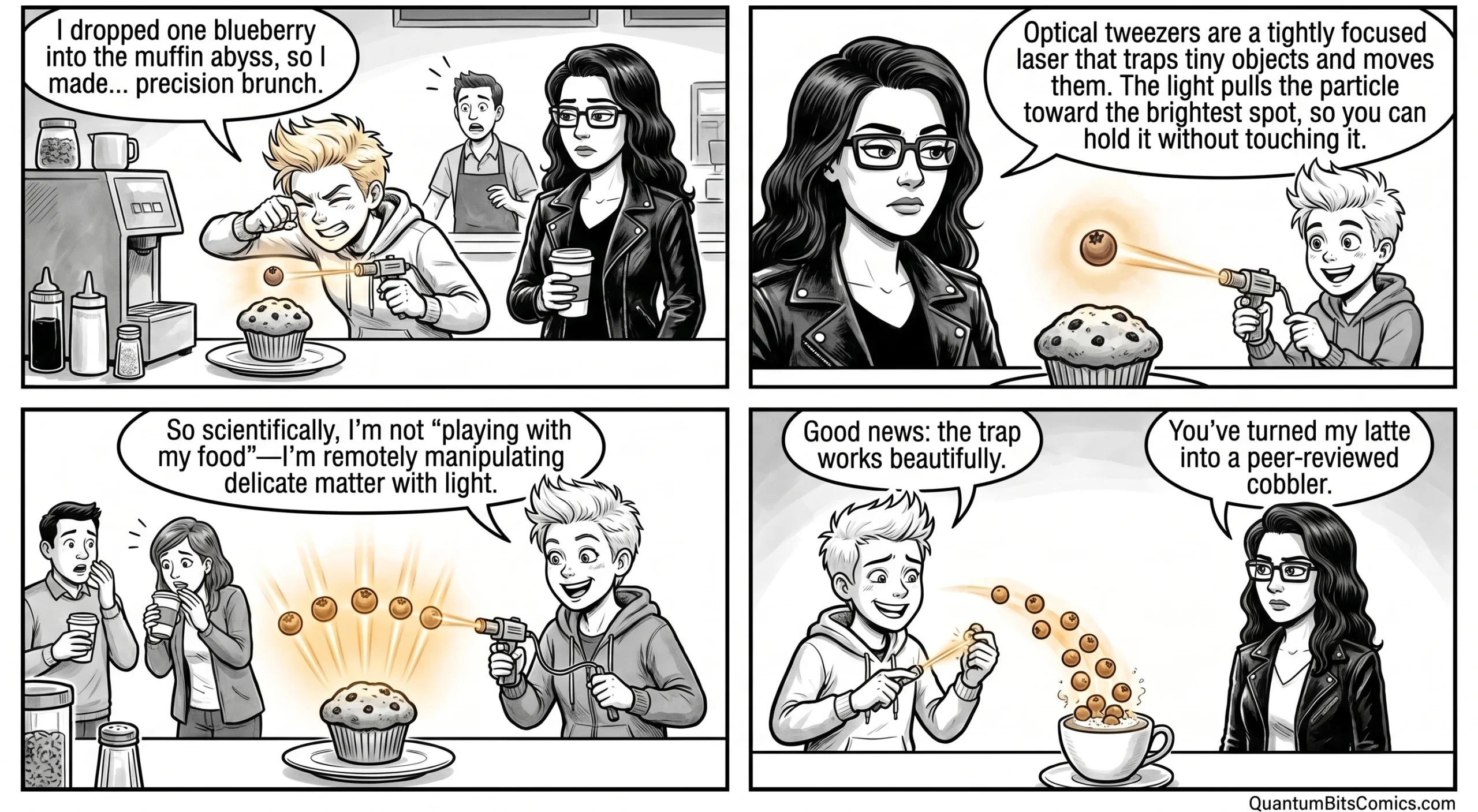
Individual atoms are trapped using tightly focused laser beams called optical tweezers. Each beam creates a potential well that holds a single atom in place. By controlling the positions of these beams, researchers can arrange atoms into two-dimensional grids, or three-dimensional structures, and reconfigure the layout between or even during computations. This geometric flexibility is a significant advantage over platforms where qubit positions are fixed at fabrication.

Quantum information is encoded in the internal energy states of each atom. Precisely timed laser pulses drive transitions between these states, implementing single-qubit gate operations.

Neutral-atom systems require laser cooling to bring atoms to microkelvin temperatures, cold enough that thermal motion does not disrupt trapping or gate operations. However, they do not require the millikelvin dilution refrigerators that superconducting platforms depend on, which simplifies the overall infrastructure.

The primary engineering challenges include maintaining trap stability over the duration of a computation, achieving high-fidelity two-qubit gates consistently across large arrays, and managing the optical systems needed to independently control thousands of atoms. Recent experiments have demonstrated arrays of over a thousand atoms and implemented quantum error-correction protocols, establishing neutral atoms as one of the leading platforms for scalable quantum computing. Companies including QuEra are actively developing this technology toward fault-tolerant systems.

Subscribe on Substack at https://qubitguy.substack.com/