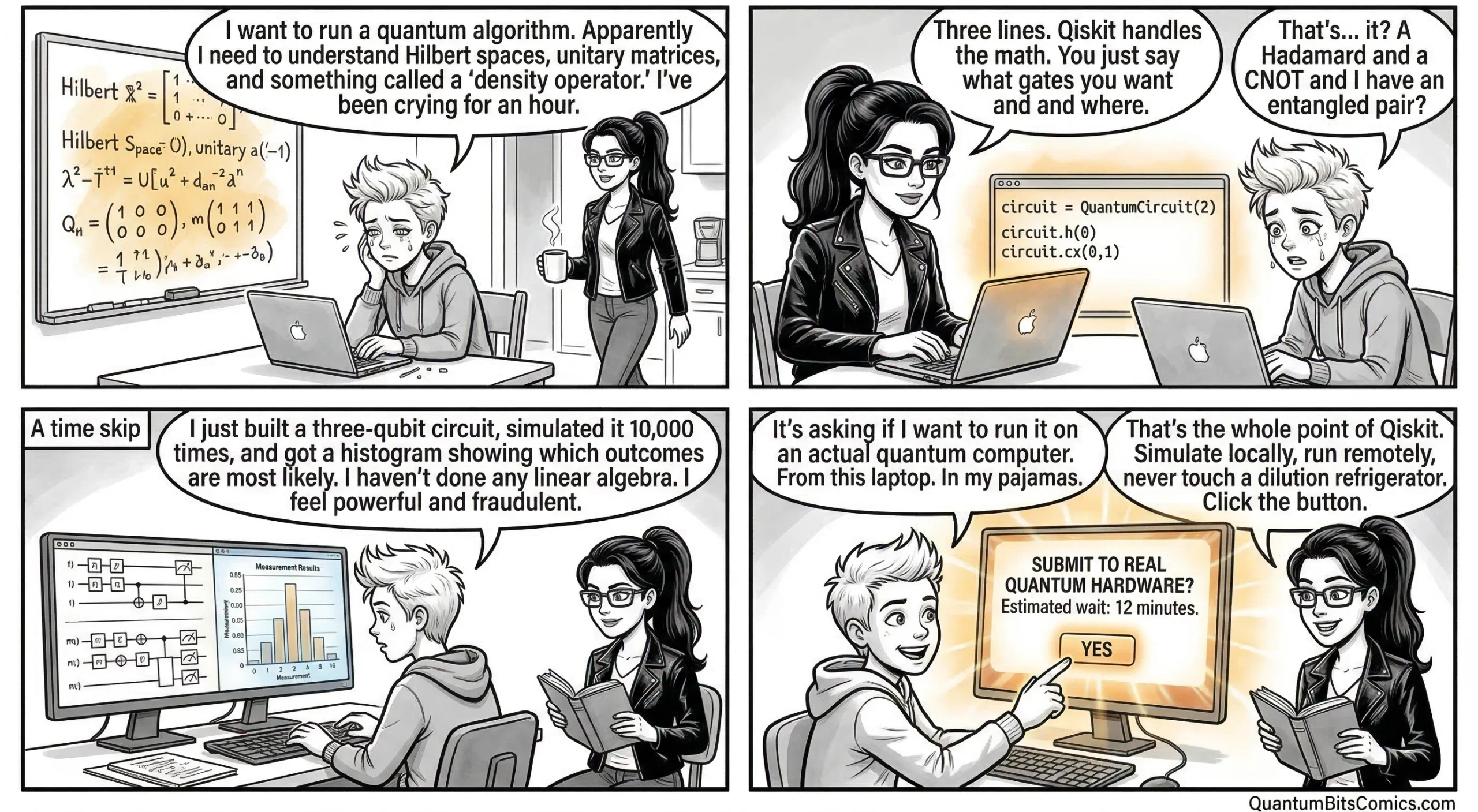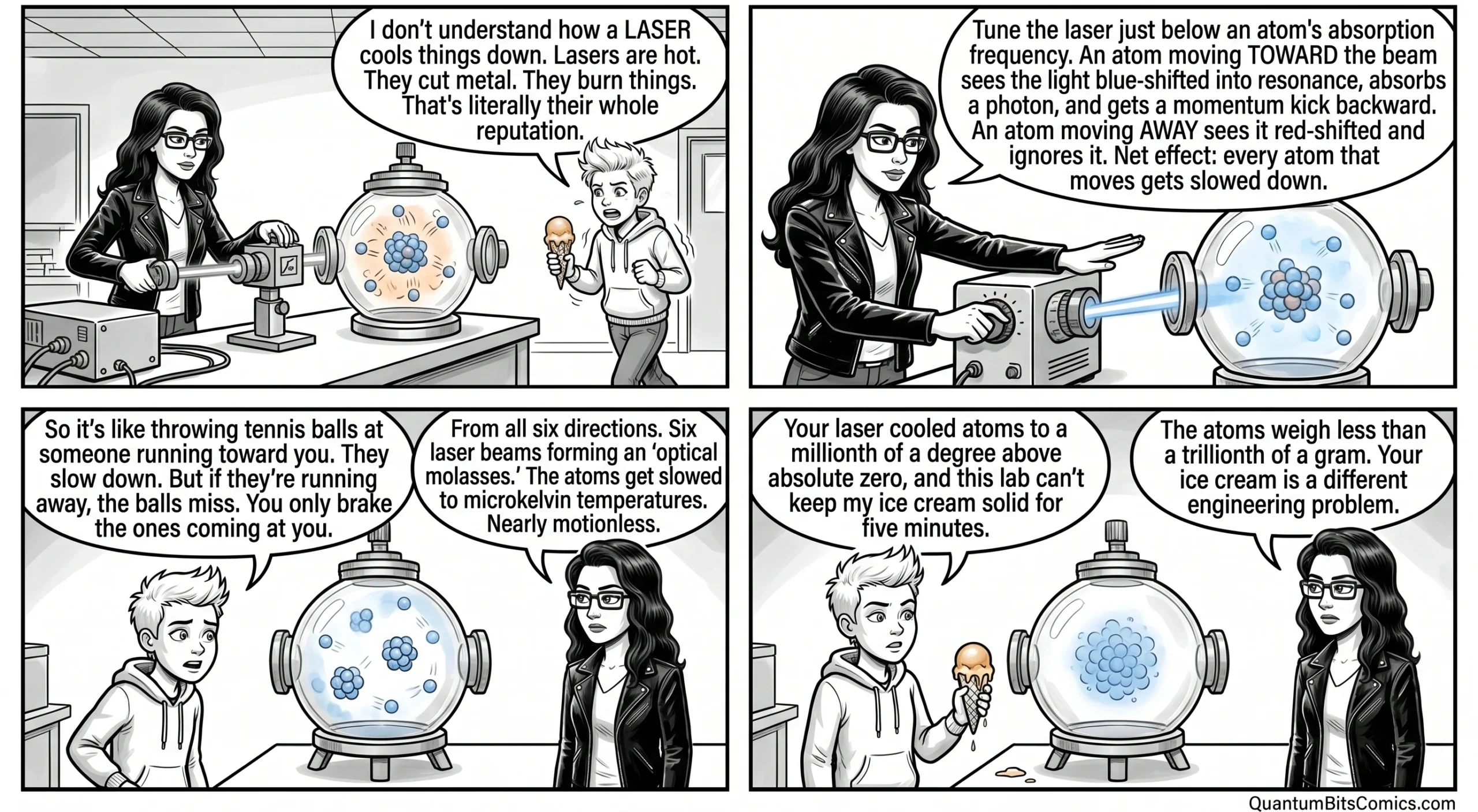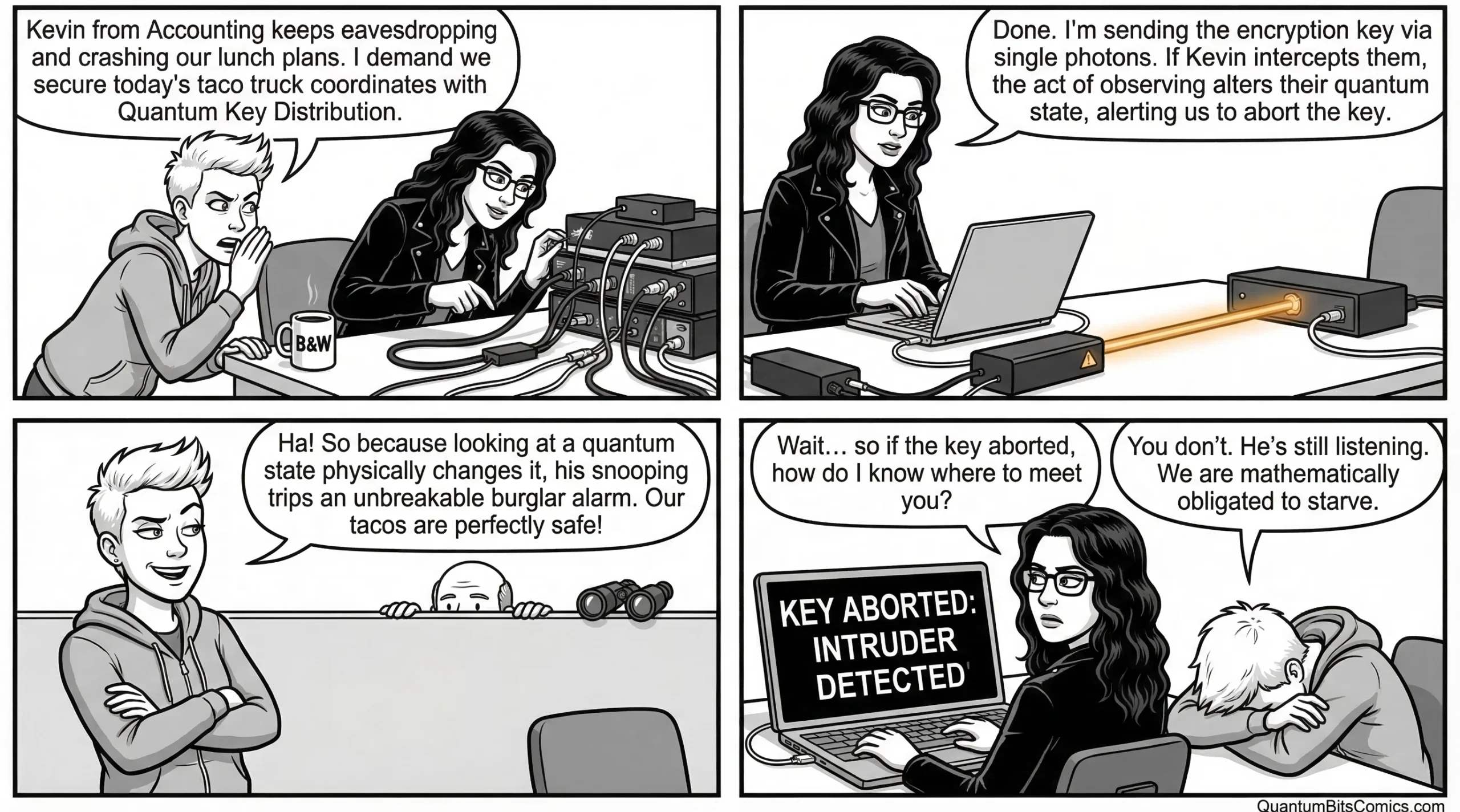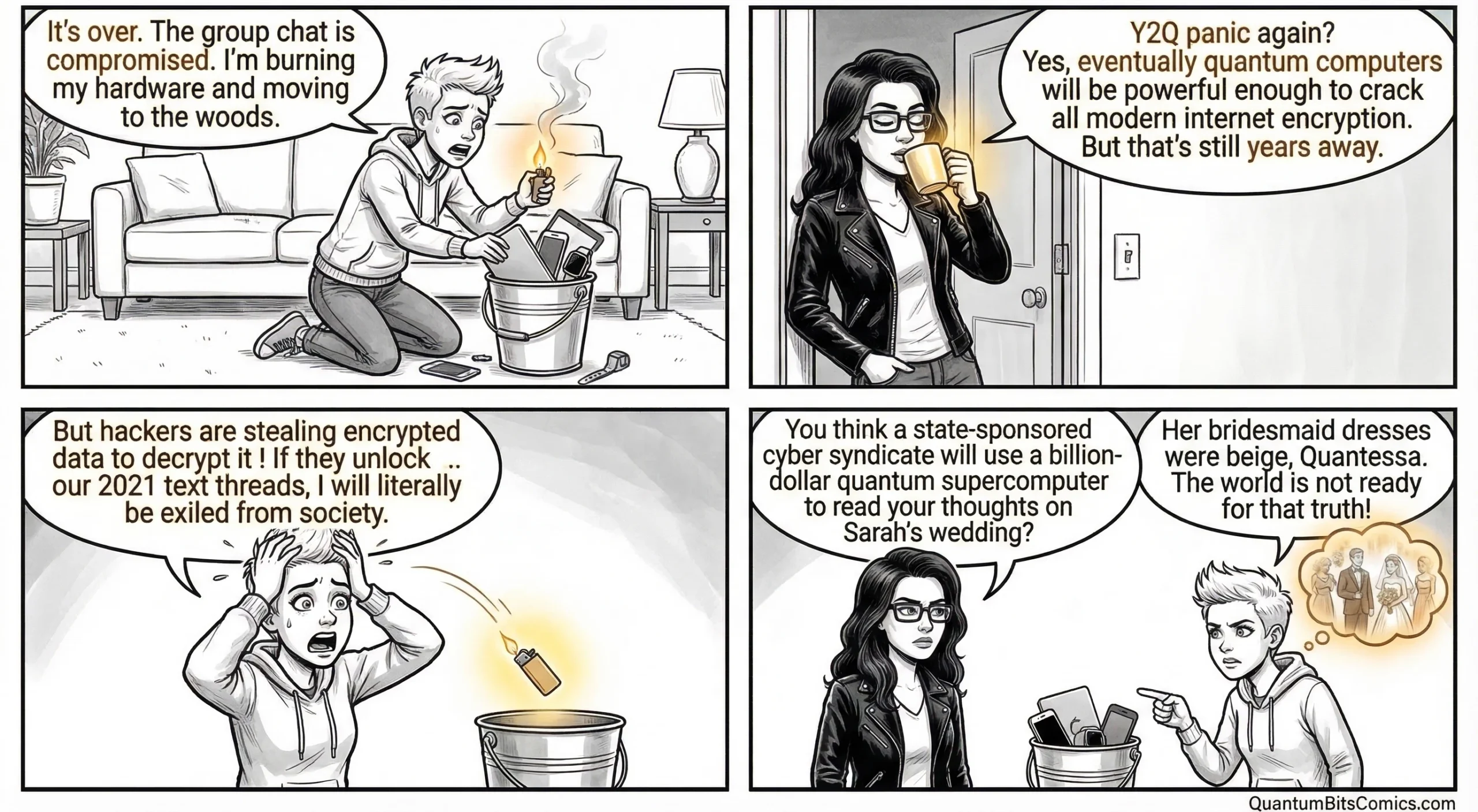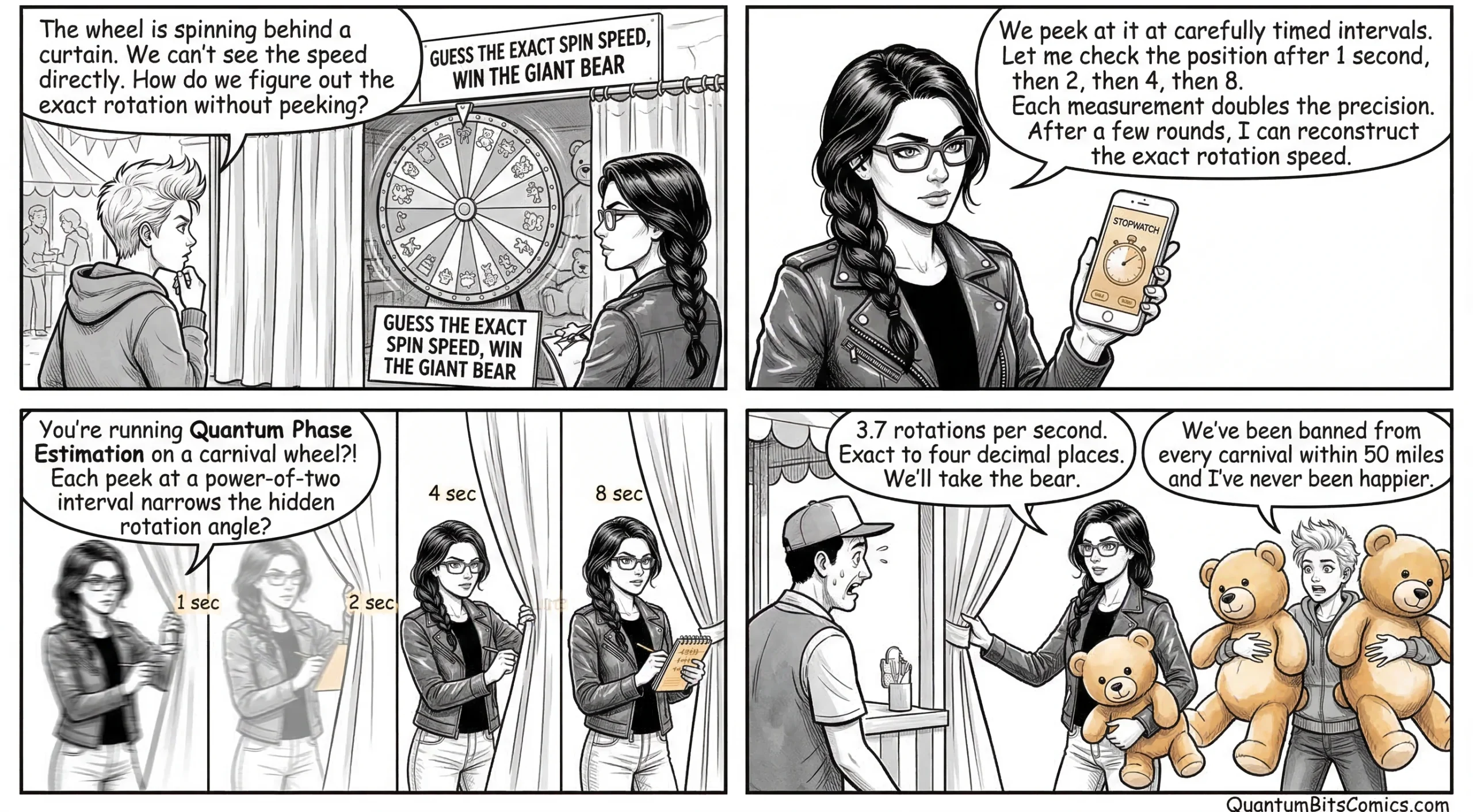
Quantum Bits is intended to introduce quantum computing terms in a fun and accessible way. It is a personal project of Yuval Boger, whose day job is Chief Commercial Officer at QuEra Computing. You might also know Yuval from his Superposition Guy's Podcast series (listen here)

Subscribe on Substack at https://qubitguy.substack.com/ to get both comics and podcasts.


Latest Posts

Entanglement

Entanglement is not just what happens when you pull your charging cables from your bag and find they are deeply connected. Some physicists would call that “string theory.” Quantessa explains what entanglement means in the quantum world.

A quantum comic strip about entanglement

In 1935, Einstein, Podolsky, and Rosen published a paper arguing that quantum mechanics must be incomplete. Their objection centered on a phenomenon that Einstein called “spooky action at a distance.” Today we call it entanglement, and it has become one of the most powerful tools in quantum computing.

When two qubits become entangled, their quantum states are no longer independent. Measuring one qubit instantly tells you something definite about the other, regardless of the distance between them. For example, in one type of entangled state called a Bell state, the qubits are perfectly anti-correlated: if you measure the first as 0, the second will definitely be 1, and vice versa. Other Bell states and entangled states produce different correlations: the qubits might always match instead, or their relationship might be more complex.

This is not the same as flipping two coins that were secretly programmed to match. In the 1960s, physicist John Bell established a mathematical limit on how strongly correlated two particles can be if their outcomes are predetermined. Entangled particles exceed that limit. Experiments have confirmed this repeatedly. The correlations are genuinely quantum, with no classical explanation.

For quantum computing, entanglement transforms a collection of qubits into something more powerful than the sum of its parts. It is what makes the state space of n qubits grow as 2^n rather than simply n. Without it, qubits would be independent coin flips offering no advantage over classical bits. With it, quantum algorithms can set up interference patterns across that exponentially large space, amplifying correct answers and suppressing wrong ones. This is what enables many quantum algorithms to outperform their classical counterparts.

Maintaining entanglement is difficult. Any interaction with the environment can cause decoherence, breaking the delicate quantum correlations between qubits. The practical challenge of preserving entangled states long enough to complete a computation is one of the defining problems in quantum engineering today.

Subscribe on Substack at https://qubitguy.substack.com/
World Quantum Day

Comic about world quantum day

You probably know about Pi Day on March 14th. We use the first three digits of pi to celebrate math. World Quantum Day works the exact same way. Scientists observe it on April 14th to honor a fundamental rule of nature called Planck’s constant. If you write this tiny number out in certain scientific units, it starts with 4.14. This number proves that energy does not flow in a smooth, continuous stream. Instead, energy arrives in small, separate packets called quanta. Think of it like walking up a wooden staircase instead of sliding up a smooth ramp. You can only place your foot on a specific stair, never float in the empty space between them. Everything in quantum computing relies on this staircase rule.

We celebrate this date to help everyone understand these invisible rules of nature. Right now, quantum computers are still fragile and mostly sit inside quiet research labs. They cannot run complex programs or solve major global problems today. However, researchers are building better machines piece by piece. World Quantum Day reminds us that we need fresh ideas from people outside the traditional physics world. It is an open invitation to learn how the universe actually operates at its smallest level. We need curious students to step up and help turn these basic rules into the useful computing tools of tomorrow.

Quantum Error Correction

A simplistic view of the progression of quantum computers has three stages, each with a question:

Stage 1: Can quantum computers be built at all, regardless of the quantity and quality of qubits?

Stage 2: Can errors be detected and corrected?

Stage 3: Can quantum computers scale to a sufficiently large number of high-quality qubits?

Error correction is the key question in stage 2. Quantessa explains:

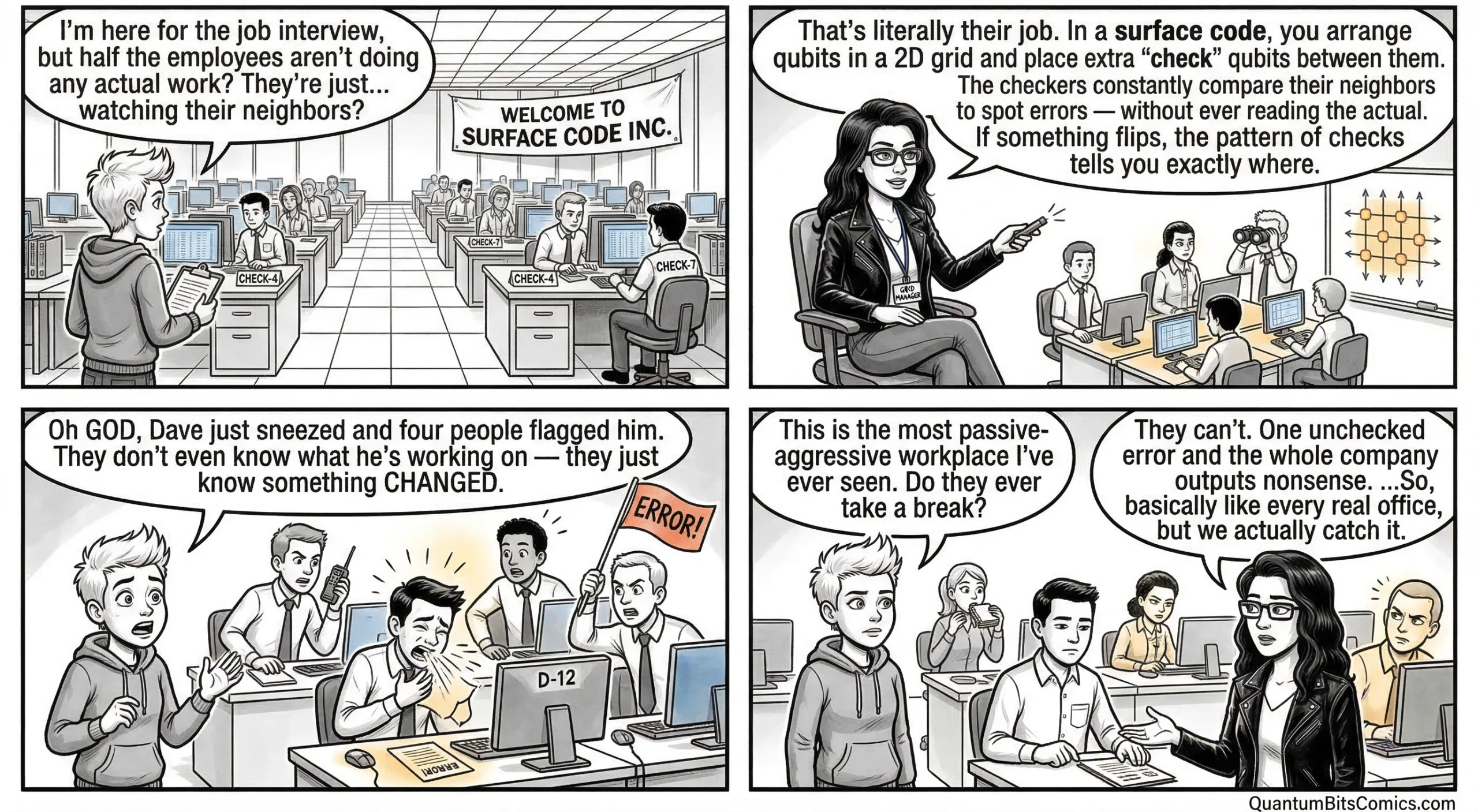
Quantum computers are extremely sensitive. The qubits that store information can be thrown off by the tiniest disturbance: a stray vibration, a small temperature fluctuation, even leftover electromagnetic noise. When a qubit picks up an error, the computation goes wrong. And unlike a classical computer, you can’t just check a qubit’s value to see if it’s correct, because measuring it destroys the superposition you’re trying to protect.

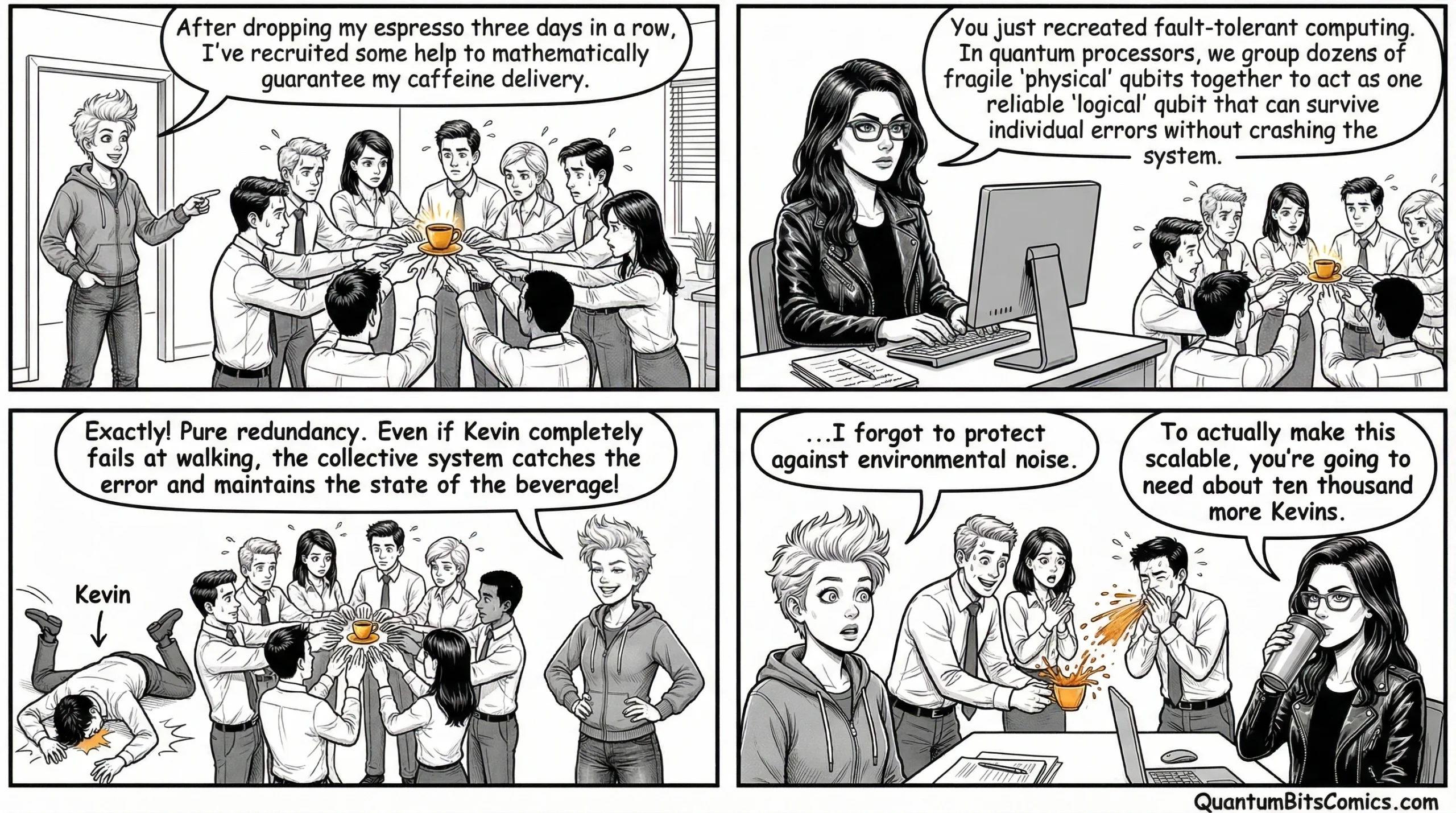
Quantum error correction is a clever workaround. Instead of storing one piece of information in one qubit, you spread it across a group of qubits. These extra qubits don’t hold their own data; they work together so the system can detect when something has gone wrong without directly looking at the protected information. Think of it like a group project where five people each know part of the plan. If one person gets confused, the others can compare notes and figure out what changed, then fix it, all without revealing the full plan to an outsider. The “logical qubit,” the reliable unit of information, emerges from the teamwork of many “physical qubits.” This is one of the biggest engineering challenges in quantum computing today. Building machines with enough high-quality physical qubits to make error correction work at scale is what separates experimental quantum devices from the fault-tolerant quantum computers that will eventually tackle real-world problems.

Looking for a more detailed description? Find it at quera.com/glossary

Grover’s Algorithm

Grover's Algorithm

Some say that there are just two quantum algorithms today: Grover’s and Shor’s. While Shor’s gets all the headlines, Grover’s stands out because of its elegant simplicity. See a beautiful video explaining its operation here, created by 3Blue1Brown.

By way of history, Lov Grover published his search algorithm in 1996, and it remains one of the foundational results in quantum computing. The problem it solves is simple: given an unsorted collection of items and a way to check whether any given item is the one you want, find the correct item. A classical computer must check items one at a time. Grover’s algorithm finds the answer using roughly the square root of the attempts a classical approach would need.

Think of searching for a specific card in a shuffled deck. A classical computer needs, on average, 26 checks for a 52-card deck. Grover’s algorithm finds the same card in about 7 checks, roughly the square root of 52.

The algorithm begins by creating a superposition that assigns equal amplitude to every possible answer. It then repeatedly applies two operations. First, an oracle marks the correct answer by flipping its quantum phase, turning its amplitude negative while leaving all other amplitudes unchanged. Second, a diffusion operator compares every amplitude to the overall average and reflects them around it. Because the correct answer’s amplitude was flipped negative, this reflection pushes it sharply upward while suppressing the incorrect answers. This is quantum interference in action: the mathematical structure of waves causes wrong answers to cancel out while the right answer reinforces with each iteration.

After about seven iterations for our 52-card example, the correct answer’s amplitude dominates, and a measurement will return it with high probability. If the problem has multiple correct answers, the algorithm still works and actually converges faster, since more marked states means more amplitude to reinforce.

Two important limitations apply. The square root speedup is provably the best possible for unstructured search, making it a polynomial rather than exponential advantage. And the algorithm requires an oracle that can recognize correct answers, meaning you must be able to verify a solution even if you cannot find one directly.

While running Grover’s algorithm on large problems requires more capable quantum hardware than exists today, its underlying technique of amplitude amplification has become a building block inside many other quantum algorithms, from optimization to cryptography.

Subscribe on Substack at qubitguy.substack.com
Looking for a more detailed description? Find it at quera.com/glossary

Neutral Atoms and Quantum Computing

In a week when Google announced it is starting a neutral-atom group, Atomique had two burning questions:

  1. What about IBM? After all, Amazon, Microsoft and Google all have a neutral-atom strategy.
  2. What are neutral atoms anyway?

Quantuessa will answer the second question.

BTW, I sometimes get asked how I came to join QuEra and work on neutral atoms. About four years ago, I met Nate Gemelke at a UMD event. Nate is co-founder and now Chief Technology Strategist at QuEra. He explained that QuEra makes “analog Hamiltonian simulators”. I understood each word separately, but wasn’t sure about the whole sentence. Later, when I was looking for my next quantum adventure, I recalled that conversation and thought: QuEra seems to have really nice and smart people, and very cool technology, but there must be a better way to market this to the world. So I offered my services.

But back to our regularly scheduled programming: What are neutral atoms, and how are they related to quantum computers?

There are several ways to build a quantum computer, and they differ in what physical object serves as the qubit. Some approaches use tiny currents in superconducting circuits. Others trap individual charged atoms, called ions, using electric fields. Neutral atom quantum computers use a different approach: they hold individual atoms that carry no electric charge, suspended in place by focused laser beams called optical tweezers.

Because these atoms are neutral, they don’t repel or attract each other the way charged particles do, which makes them naturally well-isolated from unwanted interference. The laser tweezers can arrange atoms into precise patterns, hundreds or even thousands at a time, and rearrange them on the fly. To make two qubits interact (which is essential for computation), the atoms are briefly excited into a high-energy state called a Rydberg state, where they temporarily influence each other across short distances. When the operation is done, they settle back down. This gives neutral atom systems a combination of advantages: large numbers of qubits, flexible connectivity between them, and the ability to operate at relatively modest infrastructure requirements compared to approaches that need extreme cooling to near absolute zero. Neutral atom quantum computing is still maturing, but it has emerged as one of the leading approaches for building the large-scale, error-corrected machines that will eventually tackle problems beyond the reach of classical computers.

Looking for a more detailed description? Find it at quera.com/glossary

Quantum Hype

Imagine walking through an auto show and seeing a sleek, glowing concept car. The builder promises it will soon fly you to work while you sleep. That sounds amazing, but the cars actually driving outside are still running on gas and struggling with traffic. Quantum computing faces a similar gap between grand promises and daily reality. This gap is called quantum hype. You often read headlines claiming these new machines will instantly cure diseases or break all internet security tomorrow. The truth is much slower. Scientists are still struggling to build machines that can perform basic tasks without making constant errors.

Currently, these computers are incredibly sensitive. A slight change in room temperature can ruin a calculation. We do not have machines that can replace your regular laptop. Instead of a magical problem solver, a quantum computer today is more like a delicate science experiment. Researchers spend most of their time just figuring out how to keep the machine stable. Cutting through this exaggeration matters because real scientific progress requires patience. If people expect miracles by next year, they might abandon the technology when those miracles fail to arrive. By focusing on actual engineering hurdles instead of science fiction, scientists can secure the steady support they need. This long-term work might eventually help us build reliable computers to design better batteries or discover new medicines.

Quantum Superposition

In everyday life, things have definite states. A coin on a table is either heads or tails. But at the quantum scale, particles don’t work that way. A quantum particle like an atom or an electron can be prepared so that its state isn’t determined yet. It has a set of probabilities for different outcomes, and only when you measure it does it land on a specific result. This is superposition: not “being in two states at once,” but existing in a state where the outcome is genuinely undetermined, with precise mathematical probabilities for each possibility.

What makes this useful, rather than just weird, is that quantum computers can manipulate these probabilities. A quantum algorithm carefully adjusts the probabilities across many qubits so that when measurement finally happens, the right answer is likely and the wrong answers mostly cancel out. It’s a bit like tuning a musical instrument so the note you want rings loud and the noise fades away. This ability to work with probabilities before measurement, rather than with fixed values, is what gives quantum computing its potential advantage for problems like molecular simulation, optimization, and cryptography. Superposition isn’t magic; it’s a precisely controllable physical property, and learning to harness it is what the entire field of quantum computing is built on.

Looking for a more detailed description? Find it at quera.com/glossary

Schrödinger’s Cat

In 1935, physicist Erwin Schrödinger proposed a thought experiment to show how strange quantum mechanics really is. Imagine you put a cat in a sealed box with a tiny bit of radioactive material, a detector, and a vial of poison. If the detector senses a radioactive decay (which is a random quantum event), the vial breaks and the cat dies. If it doesn’t, the cat lives. According to quantum mechanics, until you open the box, the radioactive atom hasn’t decayed or not decayed; it’s in a probabilistic state where both outcomes have some likelihood. That means, following the math strictly, the cat’s fate is tied to that quantum uncertainty.

Schrödinger wasn’t saying cats are actually alive and dead at the same time. His point was the opposite: something seems wrong when you extend quantum rules from tiny particles to everyday objects like cats. At the atomic scale, particles genuinely behave probabilistically, and experiments confirm this. But somewhere between an atom and a cat, those quantum probabilities resolve into the definite reality we experience. Figuring out exactly how and why that transition happens is still one of the open questions in physics. The thought experiment was never meant to be taken literally; it was Schrödinger’s way of saying “this can’t be the whole story,” and physicists are still working on the rest of it.

Looking for a more detailed description? Find it at quera.com/glossary

Qubit – A Quantum Bit

A regular computer stores everything as bits, and each bit is either a 0 or a 1. Think of it like a light switch: off or on, nothing in between. A qubit (short for “quantum bit”) is the quantum computing version, but it works differently. A qubit can be set up so that when you measure it, there’s some probability of getting a 0 and some probability of getting a 1. You can tune those probabilities precisely. It’s not that the qubit is “both at once” in some magical way; it’s that the outcome is genuinely uncertain until measurement, and that uncertainty is a resource you can manipulate.

The power comes when qubits work together. The probabilities of different qubits become correlated through a property called entanglement, meaning the measurement outcomes are linked in ways that classical bits can’t replicate. Quantum algorithms exploit these correlations to make correct answers more probable and wrong answers less probable, so that when you finally measure, you’re likely to get something useful. This gives quantum computers an edge for certain problems, like simulating molecular behavior for drug discovery or optimizing complex logistics. We’re still in the early stages of building reliable, large-scale quantum computers, but the qubit is the fundamental building block that makes all of it possible.

Looking for a more detailed description? Find it at quera.com/glossary

What is “Quantum Advantage”?

Quantum advantage is the point where a quantum computer can solve a specific problem faster or better than even the most powerful traditional (classical) computers in the world.

This doesn’t mean quantum computers are faster at everything. They won’t load your web browser quicker or run video games better. But for certain hard problems, like simulating how molecules behave to design new drugs, or optimizing complex logistics routes, they can potentially do in minutes or hours what a classical supercomputer would need thousands or even millions of years to finish. Quantum advantage is the milestone where that speedup stops being theoretical and starts being real and useful for practical problems people actually care about.

Looking for a more detailed description? Find it at quera.com/glossary