
A fault-tolerant quantum computer cannot reach its full potential using only the easiest operations. Most error-correction codes naturally support a set of operations known as Clifford gates. These are relatively straightforward to protect from noise, but there is a catch: according to the Gottesman-Knill theorem, a circuit built exclusively from Clifford gates can be perfectly simulated by a standard classical computer. To perform calculations a classical machine cannot match, a quantum computer needs a non-Clifford operation, such as a T gate.
Executing a protected T gate directly is nearly impossible in most standard codes. Instead, researchers use a special resource called a magic state, a carefully prepared quantum state that is consumed during the computation. By combining it with standard Clifford gates and measurements, the computer can mathematically force a T gate into existence. Because the state is destroyed in the process, complex algorithms require a massive, continuous supply.
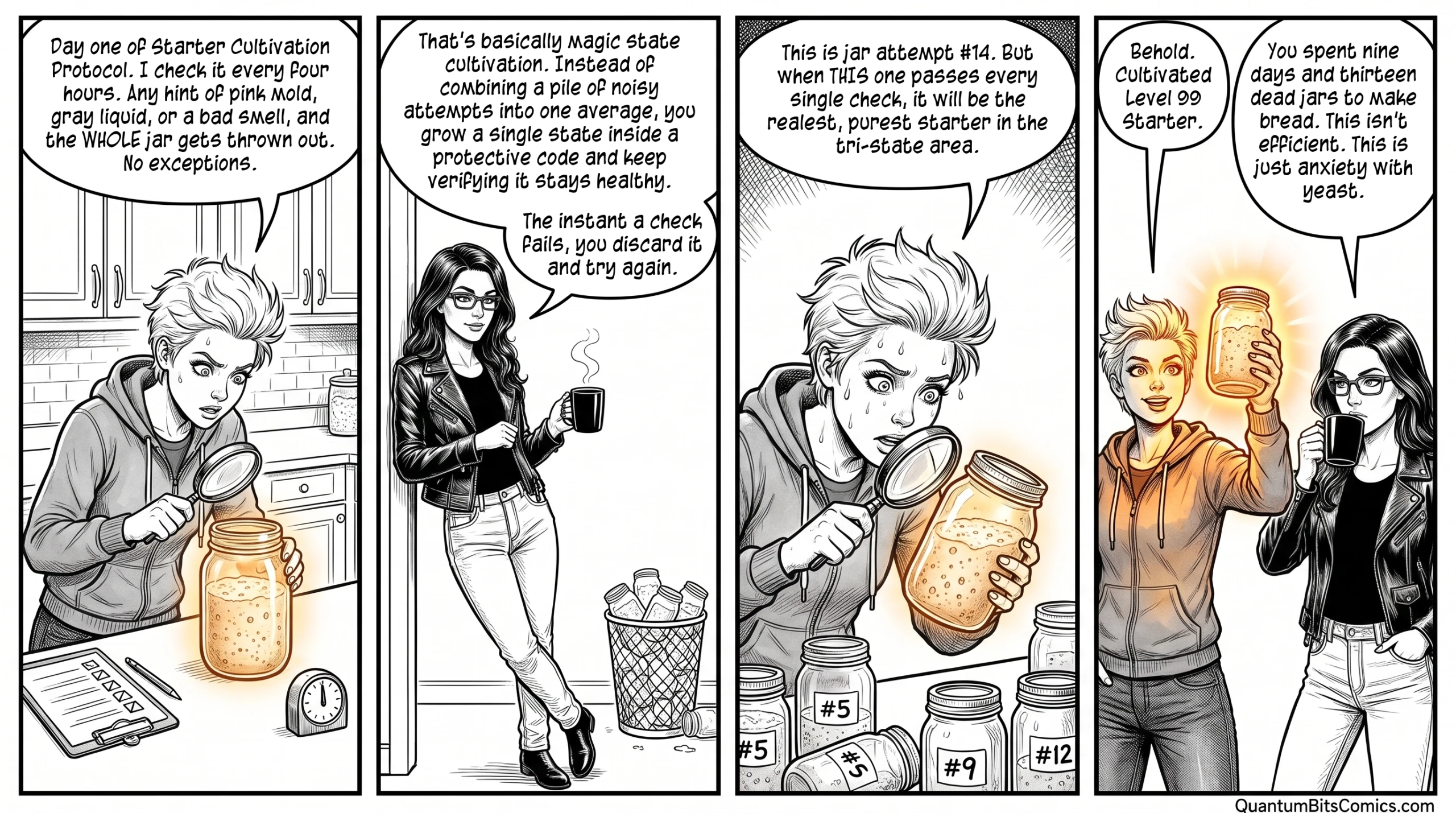
The challenge is that magic states are fragile and hard to create with high fidelity. Historically, the solution was magic state distillation, which takes many low-quality, noisy states and squeezes them into a single accurate one. Distillation works, but it is extremely inefficient. In a large-scale algorithm, distilling enough magic states could consume over ninety percent of the computer’s hardware, leaving few qubits for the actual computation.
Magic state cultivation offers a more efficient path. Rather than mass-producing noisy states and discarding most of them, cultivation focuses on preparing high-fidelity magic states from the very beginning. By using specialized encoding techniques or specific hardware properties, engineers can prepare these states with far fewer initial errors, drastically reducing the hardware overhead needed to power complex algorithms.
Solving the magic state problem is a strictly necessary step for practical fault tolerance. Without an efficient way to generate these non-Clifford resources, quantum computers will stay bottlenecked by the sheer size required for error correction. Cultivation provides a realistic strategy for scaling, ensuring future machines have the resources to execute advanced algorithms.
Subscribe on Substack at https://qubitguy.substack.com/