The surface code is the most widely studied quantum error correction scheme, and for good reason: it has a high error threshold (approximately 1% for standard noise models), meaning it can tolerate relatively noisy physical qubits compared to other codes. Its structure maps naturally onto the two-dimensional grid layouts that many quantum hardware platforms already use.
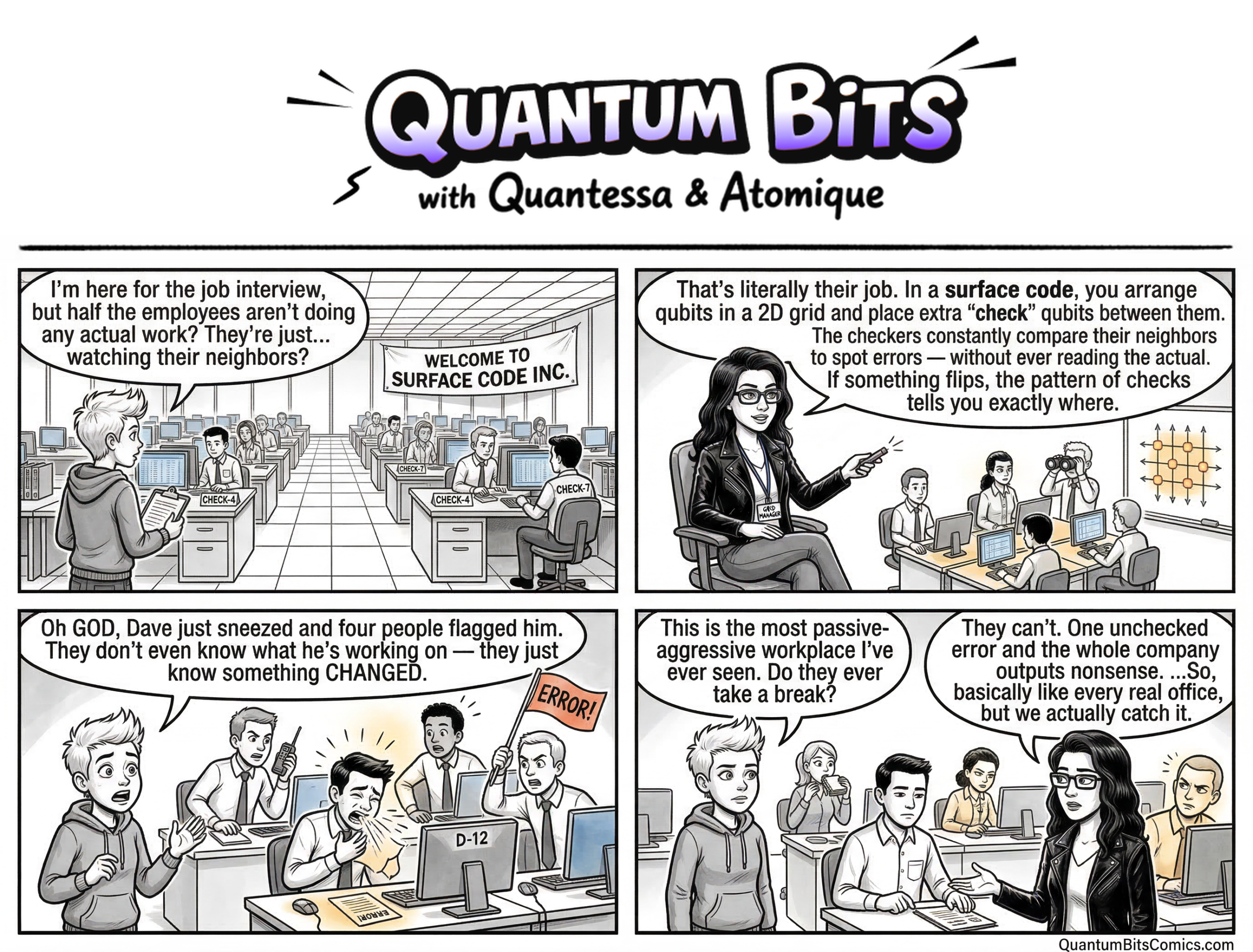
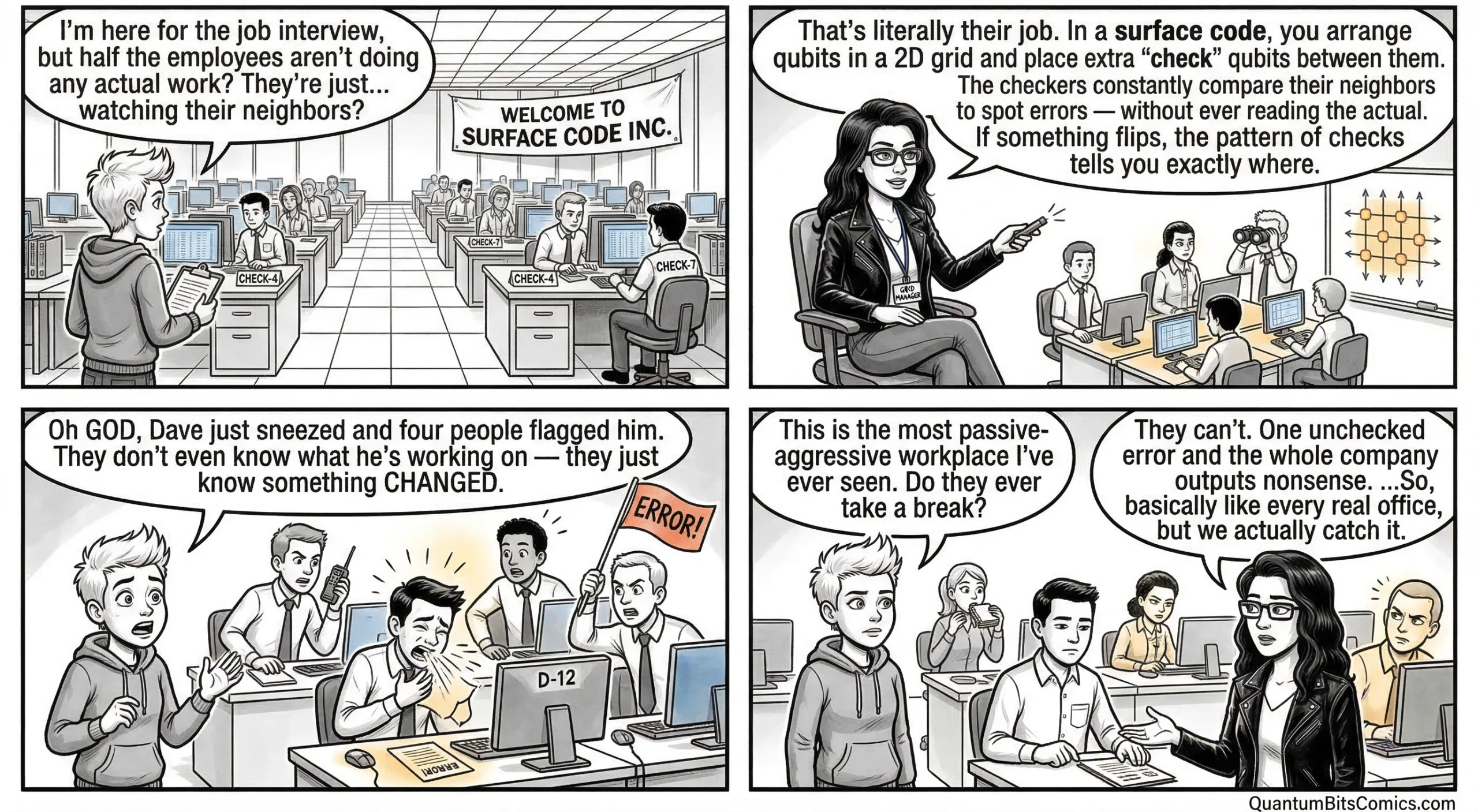
The basic idea: arrange physical qubits in a two-dimensional grid. Some qubits store the actual computation (data qubits). Others exist solely to detect errors (ancilla qubits, sometimes called “syndrome” qubits). Each ancilla qubit interacts only with its immediate neighbors, measuring a collective property that reveals whether a nearby error has occurred, without revealing the actual quantum information being protected.
This indirect detection is essential. Quantum mechanics forbids copying an unknown quantum state (the no-cloning theorem), and directly measuring a data qubit would destroy its quantum information. The ancilla qubits sidestep this by checking for consistency between neighbors rather than reading the data itself.
When an error does occur, it shows up as a pattern of unexpected measurements across multiple ancilla qubits. A classical decoding algorithm analyzes this pattern and determines the most likely error, allowing the system to correct it. The process runs continuously during computation.
A key parameter is the code distance, which determines how many errors the code can correct. A distance-d surface code can correct up to (d-1)/2 errors. Increasing the code distance requires a larger grid of physical qubits, which is the fundamental source of the surface code’s overhead.
That overhead is substantial. Current estimates suggest that producing one high-quality logical qubit requires roughly 1,000 or more physical qubits at today’s typical error rates, though this number drops as hardware improves. This is why scaling up quantum hardware matters so much.
Subscribe on Substack at https://qubitguy.substack.com/