A fault-tolerant quantum computer is a machine that can perform arbitrarily long calculations even though its underlying components are unreliable. In a classical computer, transistors rarely fail, but quantum bits are entirely different. Regardless of the underlying hardware platform, physical qubits lose their quantum states quickly due to environmental noise and imperfect control pulses. Without a way to manage these errors, quantum calculations degrade into useless noise after just a few steps.
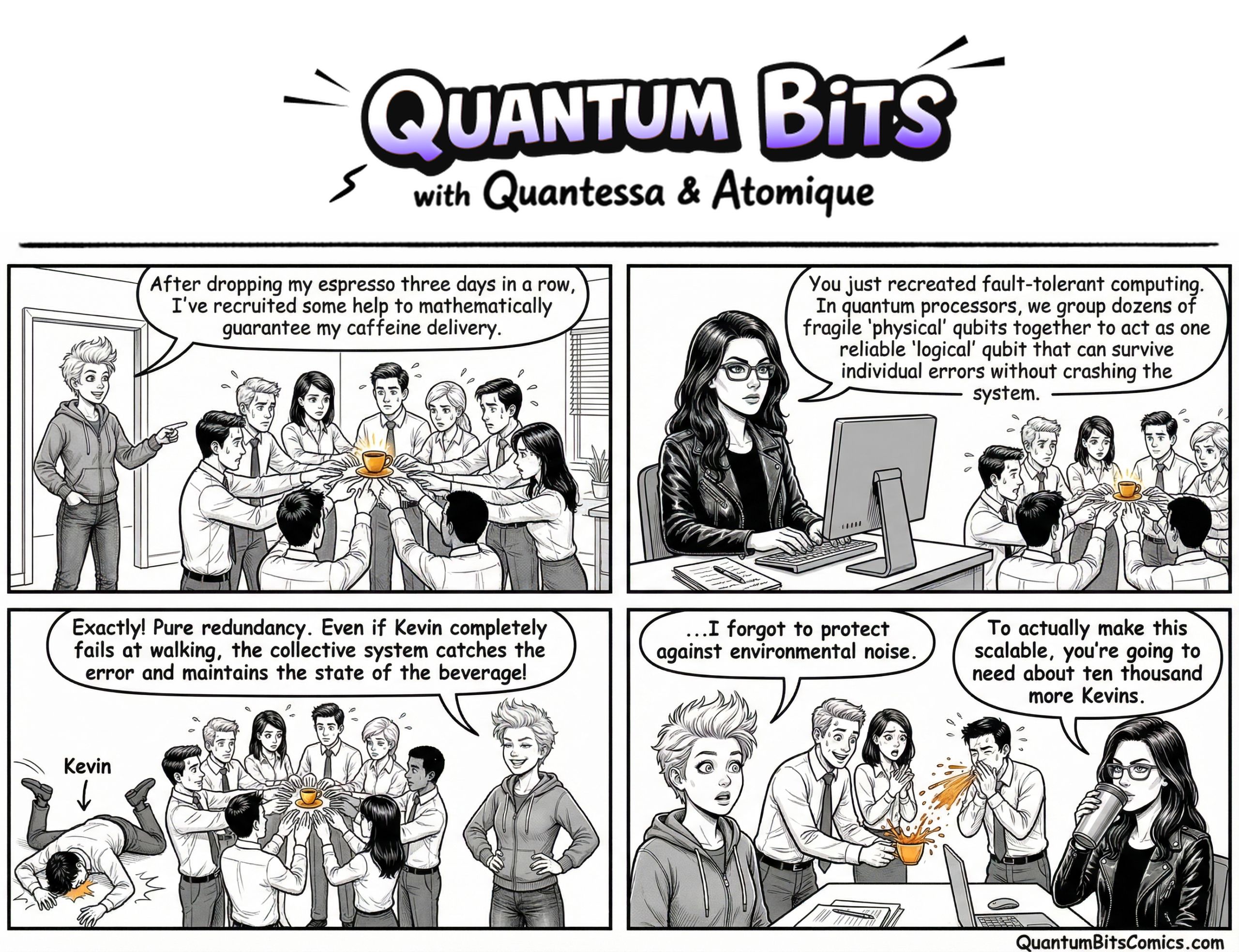
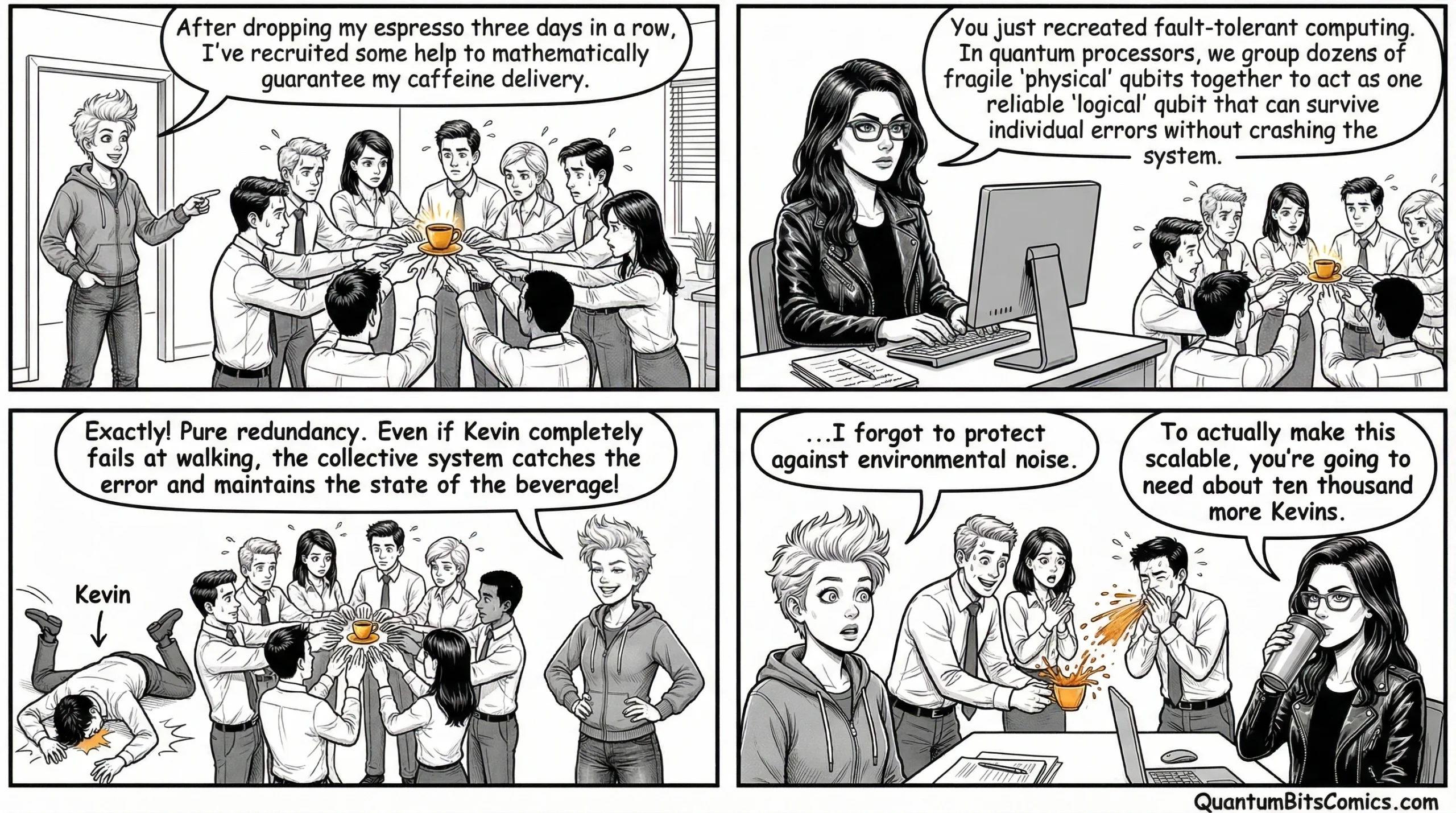
To achieve fault tolerance, physicists build protected units of information called logical qubits. A logical qubit is not a single physical object. It is a shared, entangled state distributed across tens, hundreds, or thousands of physical qubits. This distributed approach is necessary because the no-cloning theorem, a fundamental rule of quantum mechanics, forbids making a backup copy of an unknown quantum state. Instead, information is woven into the collective properties of a group. Through careful parity measurements that check relationships between qubits without reading their individual states, the system can detect and correct the errors.
Detecting an error is only part of the process. The operations used to check for errors can themselves introduce new errors. A system is fault-tolerant only if the error-correcting steps remove errors faster than they create them. This requirement defines the error threshold. If the physical hardware has an error rate below this specific mathematical limit, adding more physical qubits to each logical qubit will lower the overall logical error rate. If the hardware errors are above the threshold, adding more qubits simply creates a larger, messier problem.
The hardware industry is currently navigating the transition from noisy systems to early fault-tolerant machines. Researchers have successfully demonstrated the basic principles of logical qubits across multiple hardware platforms. Scaling these demonstrations to the millions of physical qubits needed for practical fault-tolerant computing remains the field’s central engineering challenge.
Subscribe on Substack at https://qubitguy.substack.com/