In a week when Google announced it is starting a neutral-atom group, Atomique had two burning questions:
- What about IBM? After all, Amazon, Microsoft and Google all have a neutral-atom strategy.
- What are neutral atoms anyway?
Quantuessa will answer the second question.
BTW, I sometimes get asked how I came to join QuEra and work on neutral atoms. About four years ago, I met Nate Gemelke at a UMD event. Nate is co-founder and now Chief Technology Strategist at QuEra. He explained that QuEra makes “analog Hamiltonian simulators”. I understood each word separately, but wasn’t sure about the whole sentence. Later, when I was looking for my next quantum adventure, I recalled that conversation and thought: QuEra seems to have really nice and smart people, and very cool technology, but there must be a better way to market this to the world. So I offered my services.
But back to our regularly scheduled programming: What are neutral atoms, and how are they related to quantum computers?
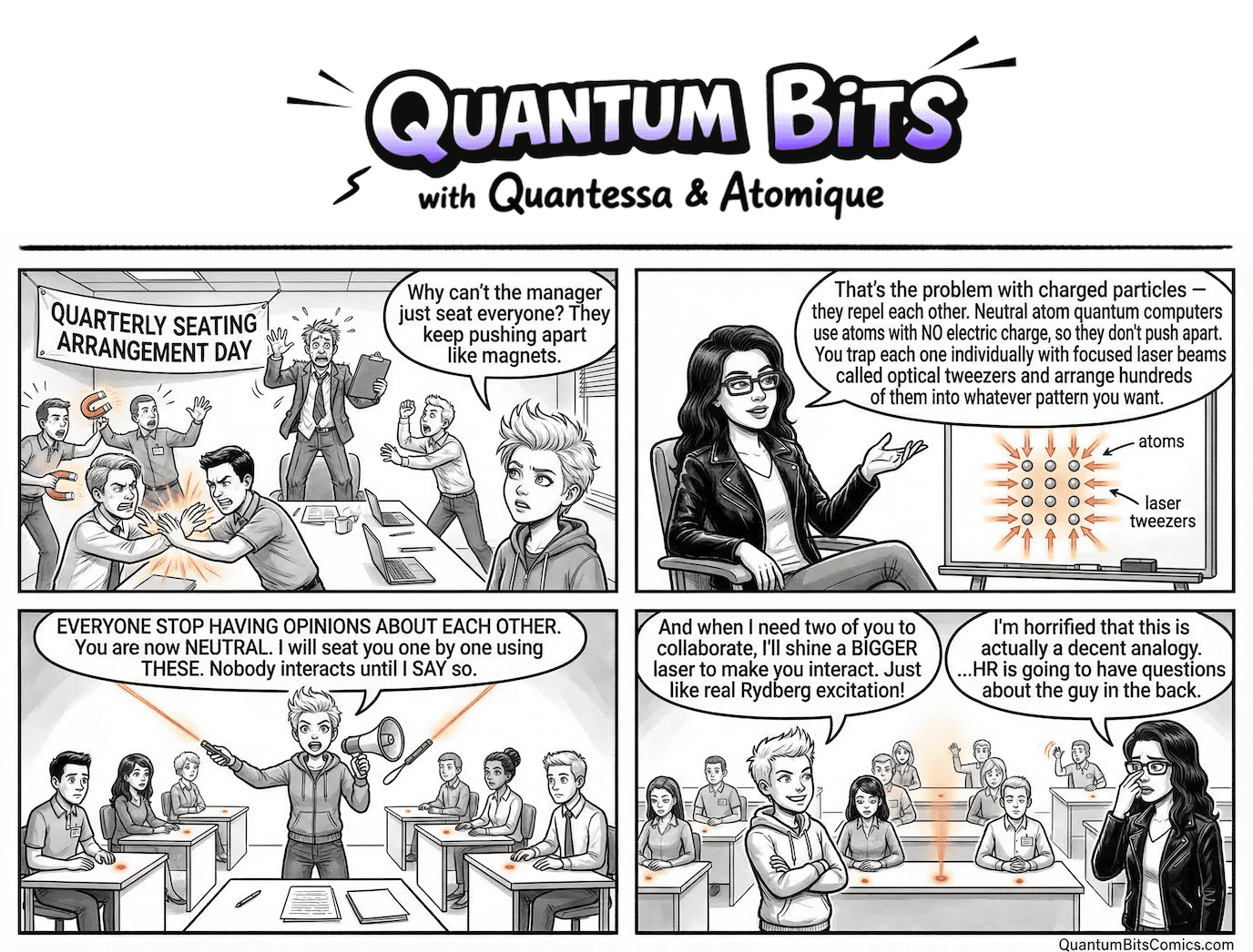
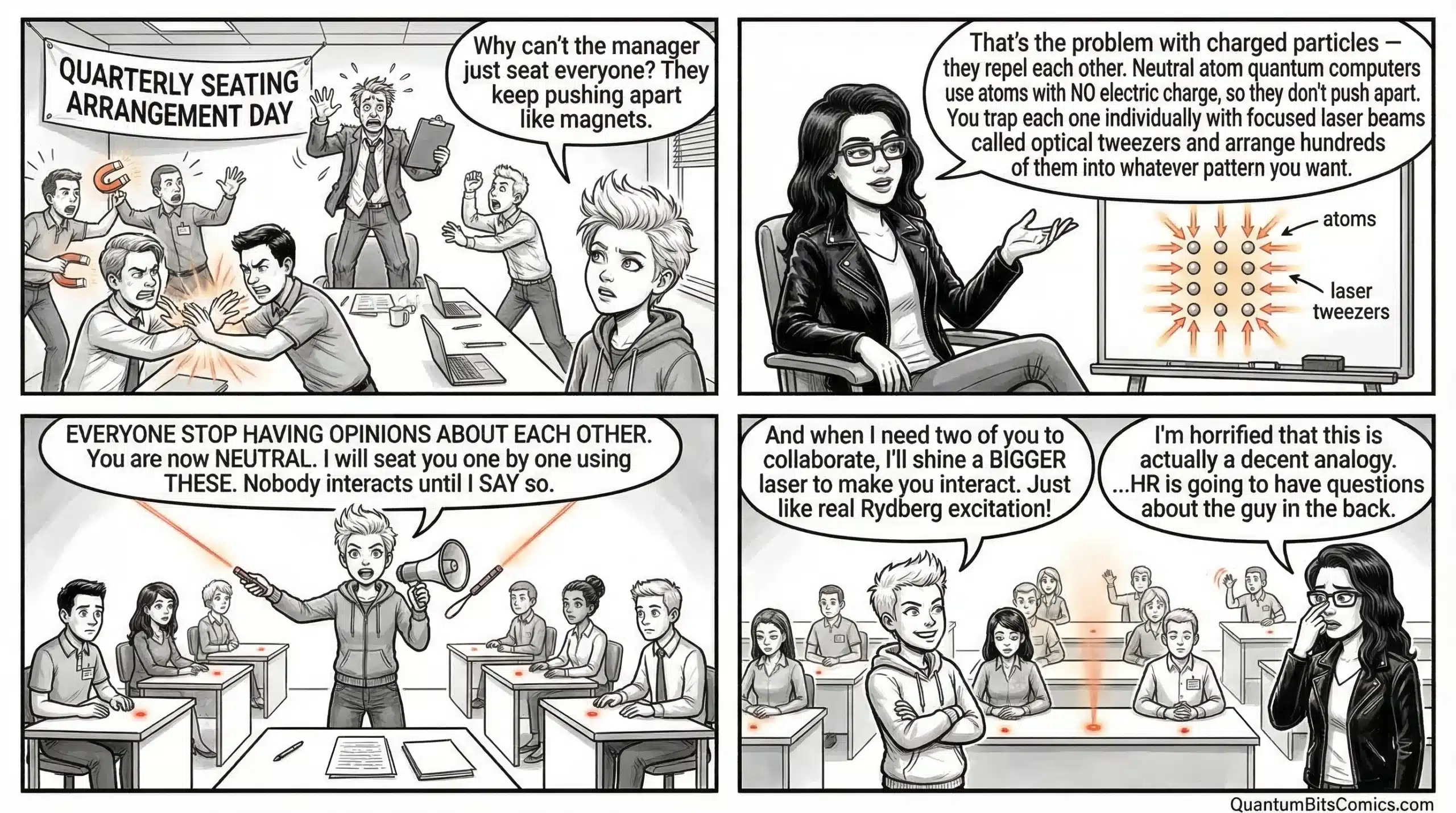
There are several ways to build a quantum computer, and they differ in what physical object serves as the qubit. Some approaches use tiny currents in superconducting circuits. Others trap individual charged atoms, called ions, using electric fields. Neutral atom quantum computers use a different approach: they hold individual atoms that carry no electric charge, suspended in place by focused laser beams called optical tweezers.
Because these atoms are neutral, they don’t repel or attract each other the way charged particles do, which makes them naturally well-isolated from unwanted interference. The laser tweezers can arrange atoms into precise patterns, hundreds or even thousands at a time, and rearrange them on the fly. To make two qubits interact (which is essential for computation), the atoms are briefly excited into a high-energy state called a Rydberg state, where they temporarily influence each other across short distances. When the operation is done, they settle back down. This gives neutral atom systems a combination of advantages: large numbers of qubits, flexible connectivity between them, and the ability to operate at relatively modest infrastructure requirements compared to approaches that need extreme cooling to near absolute zero. Neutral atom quantum computing is still maturing, but it has emerged as one of the leading approaches for building the large-scale, error-corrected machines that will eventually tackle problems beyond the reach of classical computers.
Looking for a more detailed description? Find it at quera.com/glossary