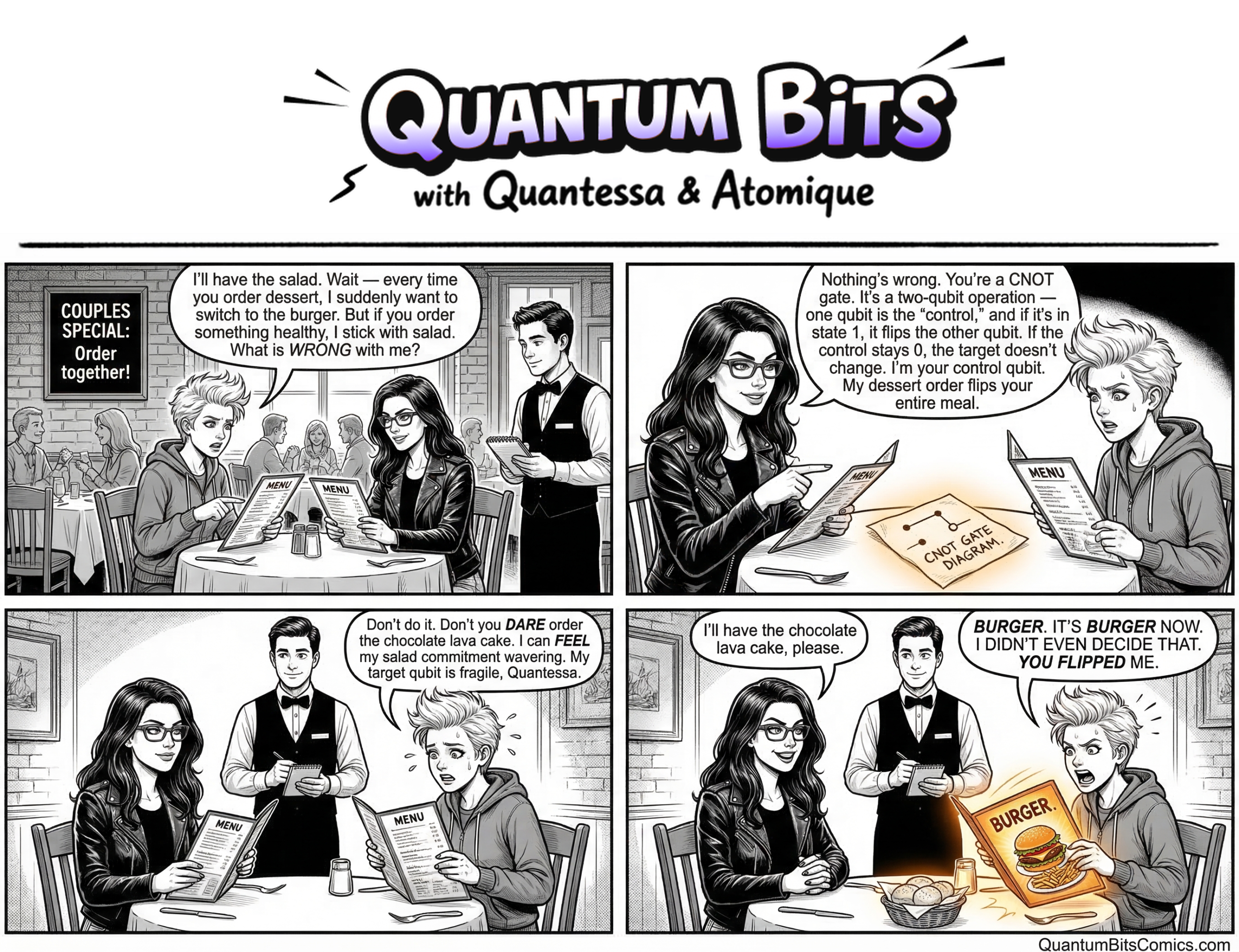

The CNOT (Controlled-NOT) gate is the standard two-qubit gate in quantum computing. It takes two qubits as input: a control qubit and a target qubit. If the control qubit is in state 1, the target qubit is flipped (0 becomes 1, 1 becomes 0). If the control is in state 0, the target is left unchanged. This conditional behavior is what makes it useful.
The CNOT gate becomes powerful when the control qubit is in superposition. If the control is in an equal superposition of 0 and 1, the CNOT creates entanglement between the two qubits. The resulting state cannot be described as two independent qubits; their fates are now linked. This ability to generate entanglement from superposition is why the CNOT gate (together with single-qubit rotations) forms a universal gate set: any quantum computation can be decomposed into a sequence of these operations. The CNOT is self-inverse: applying it twice returns both qubits to their original states.
In circuit diagrams, the CNOT is drawn as a dot on the control qubit’s wire connected by a vertical line to a circled plus symbol on the target qubit’s wire. Reading quantum circuit diagrams is a core skill, and the CNOT symbol appears in virtually every circuit of any complexity.
Different hardware platforms implement the CNOT differently. Superconducting systems use microwave pulses that couple two transmon qubits through a shared resonator. Trapped-ion systems use laser-driven interactions mediated by the ions’ shared motional modes. Neutral-atom systems often implement the closely related CZ (controlled-Z) gate natively using Rydberg interactions, then convert to CNOT through additional single-qubit rotations. The mathematical effect is the same; the physics varies.
The CNOT gate’s error rate is one of the most critical metrics in quantum hardware. Two-qubit gates are typically far noisier than single-qubit gates, often by an order of magnitude or more, making them the primary bottleneck for circuit depth and algorithm complexity. Improving two-qubit gate fidelity is one of the highest-impact engineering targets in the field.
Subscribe on Substack at https://qubitguy.substack.com/