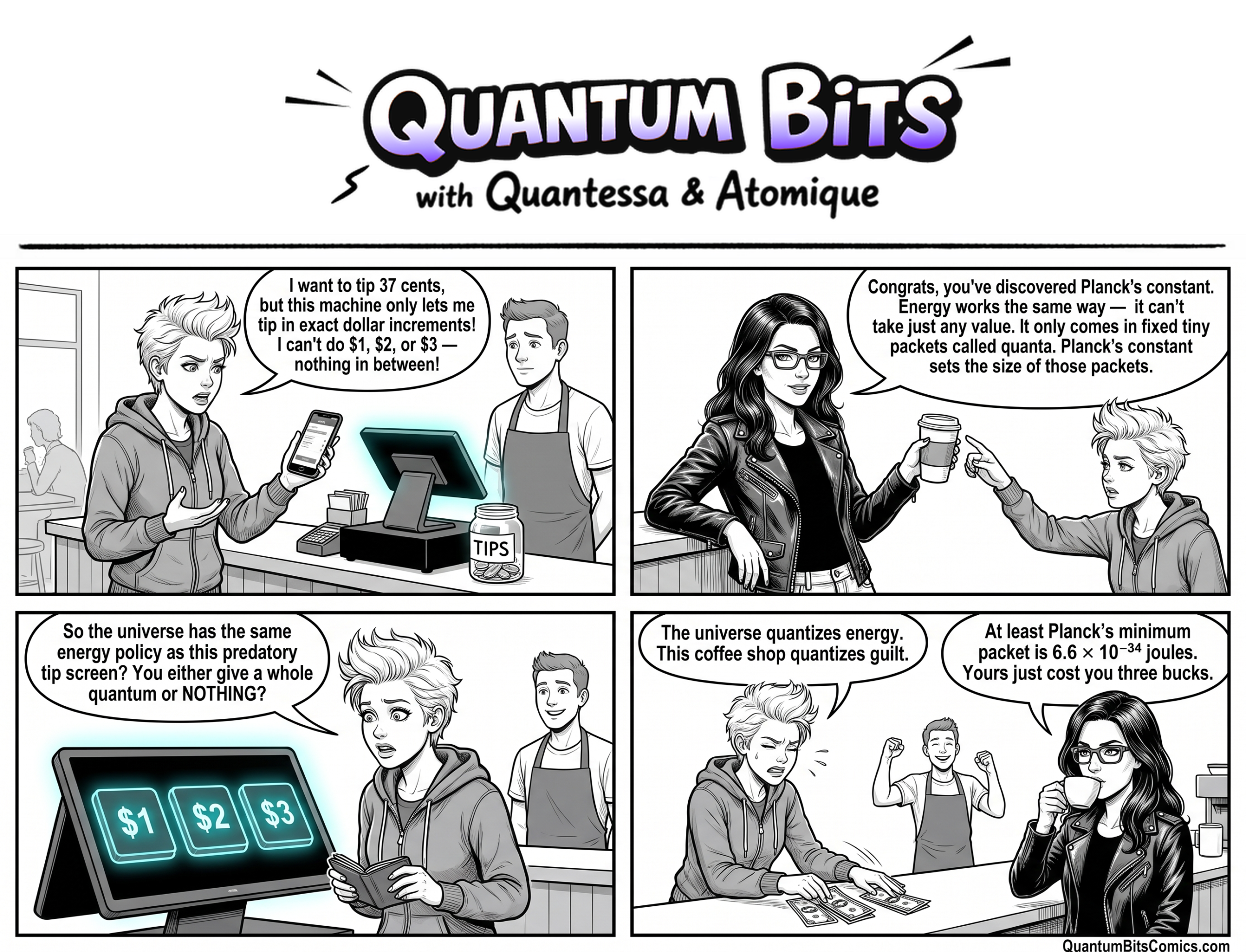
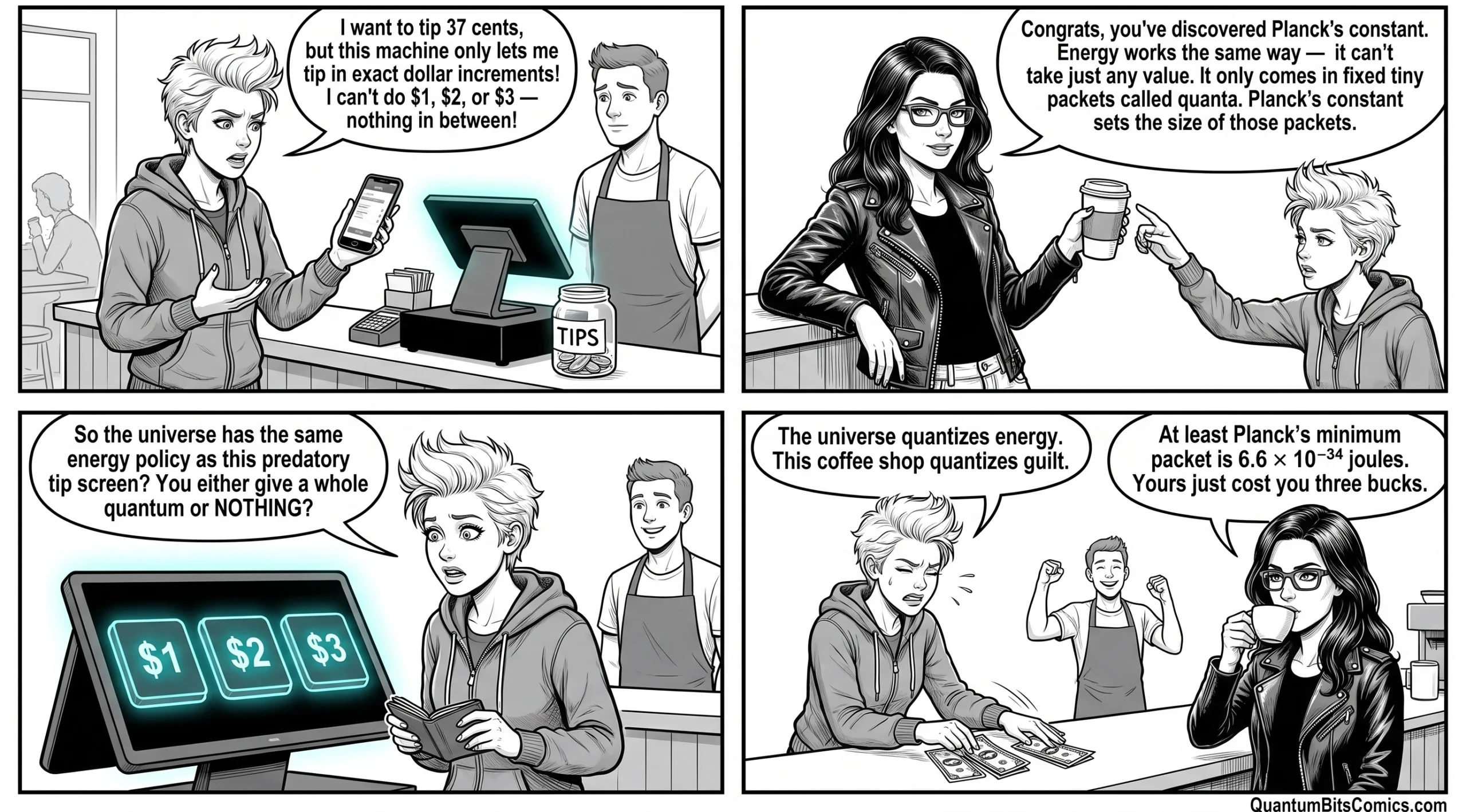
In 1900, physicist Max Planck was trying to explain how hot objects emit light. Classical physics could not reproduce the observed spectrum, so Planck introduced a radical idea: matter could emit or absorb energy only in distinct amounts linked to the frequency of the radiation. The constant connecting energy and frequency became known as Planck’s constant. A few years later, Albert Einstein extended the idea by proposing that light itself comes in individual packets, now called photons.
Planck’s constant is extraordinarily small in everyday units. Written as a decimal in joule-seconds, it begins with a decimal point followed by thirty-three zeros before the first nonzero digit. Its small value helps explain why quantum behavior is difficult to notice in daily life. A kettle, a flashlight, or a moving baseball involves immense numbers of quantum events whose individual effects blend together. At the scale of atoms and electrons, however, energy often comes in clearly separated levels. Planck’s constant sets the basic scale of this quantum behavior, although the spacing between levels depends on the physical system.
Quantum computers deliberately operate in this microscopic realm. A qubit’s zero and one correspond to two quantum states, often separated by a small energy gap. Engineers control superconducting qubits with carefully shaped microwave pulses and manipulate atomic qubits with laser light. The frequency, strength, phase, and duration of each pulse determine how the qubit changes. Small inaccuracies do not necessarily make an operation fail completely, but they introduce errors that can accumulate during a computation.
Keeping qubits stable is therefore a major engineering challenge. In superconducting processors, ordinary thermal energy can excite the qubits and disturb their delicate quantum states. Dilution refrigerators cool these devices to temperatures only a few thousandths of a degree above absolute zero, while shielding and filtering reduce unwanted electromagnetic noise. Neutral-atom computers take a different approach: lasers cool and trap the atoms, while an ultra-high vacuum prevents disruptive collisions. Different quantum technologies have different requirements, but they share the same goal—isolating quantum states long enough to control them accurately and perform a computation.
Subscribe on Substack at https://qubitguy.substack.com/