
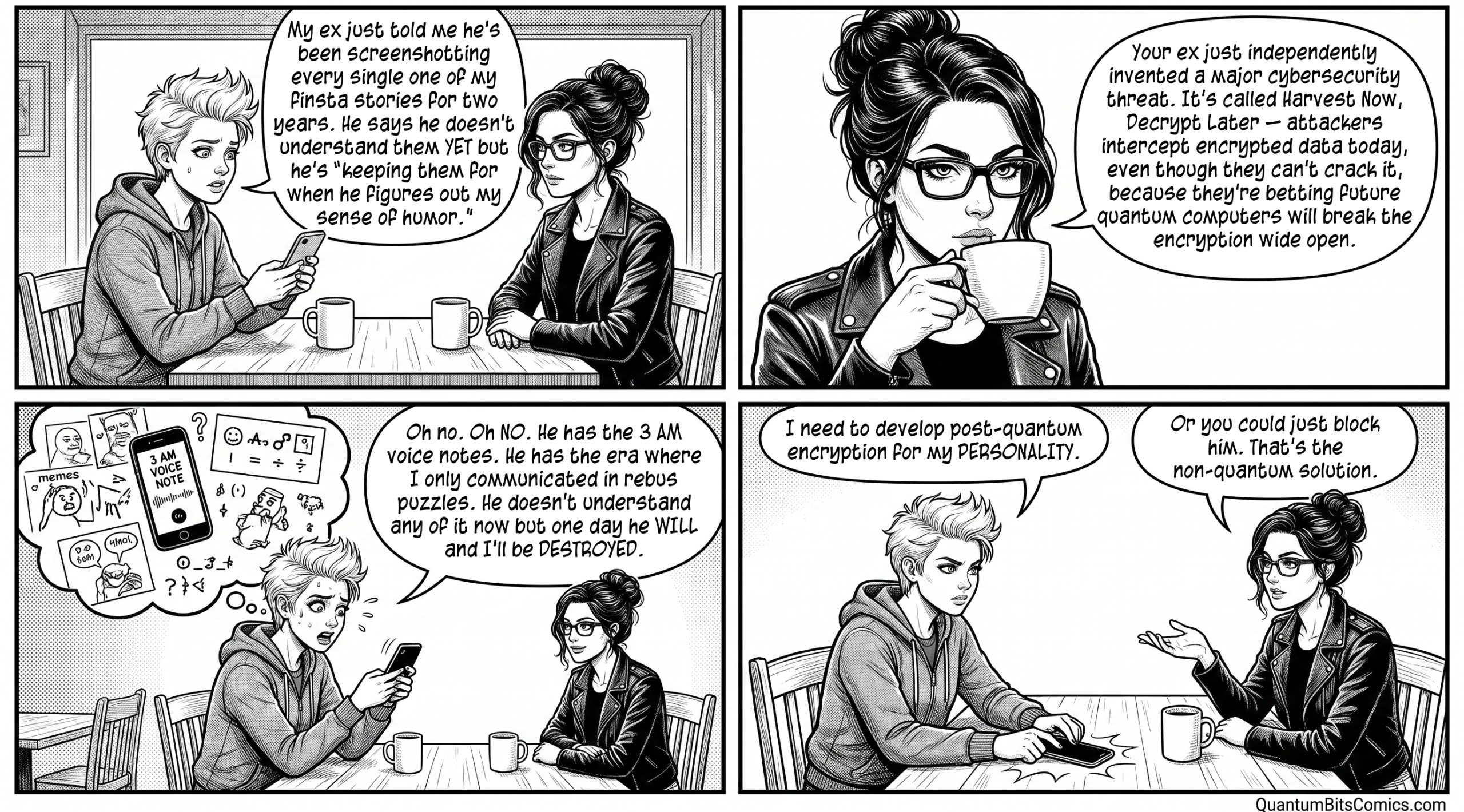
Most internet security today rests on a single mathematical assumption: that factoring large numbers is prohibitively difficult. Whenever you send a secure message, check your bank balance, or transmit sensitive data, public-key cryptography shields it. But this shield has an expiration date. In a threat model called Harvest Now, Decrypt Later, adversaries intercept and store encrypted communications today. They cannot read the files yet. They are simply stockpiling them until a powerful enough quantum computer comes online to pick the locks.
The vulnerability traces to a 1994 breakthrough. Mathematician Peter Shor proved that a quantum computer could factor massive numbers efficiently, breaking the foundation of encryption protocols like RSA. Shor’s algorithm does not try all possible keys at once. Instead, it uses quantum interference to amplify the correct answer while canceling out the wrong ones, revealing the hidden structure inside a cryptographic key in hours rather than the millennia a classical supercomputer would need.
Fortunately, the hardware to run Shor’s algorithm does not yet exist. Today’s quantum computers are small and error-prone. Breaking commercial encryption will require a fault-tolerant machine with millions of physical qubits working in tandem to correct errors and sustain the calculation. Companies and labs are building toward this, but a machine of that scale remains years away.
The danger of harvesting is that this timeline may not matter. Data storage is cheap. State-sponsored hackers and corporate spies can siphon encrypted intellectual property, military secrets, and diplomatic cables straight from global networks. If that information still holds value in ten or twenty years, the eventual decryption becomes a devastating intelligence victory. The data is compromised the moment it is intercepted, even if the payoff is delayed.
To counter this, the cybersecurity industry is already overhauling how the internet protects information. Researchers have developed post-quantum cryptography, which relies on different mathematical problems that remain hard for both classical and quantum computers. Organizations are now racing to adopt these new standards before adversaries can build the machines capable of breaking the old locks.
Subscribe on Substack at https://qubitguy.substack.com/