The fundamental paradox of quantum error correction is that you cannot look at your data. Measuring a quantum state forces it to collapse into classical bits, destroying any delicate superposition. Furthermore, the laws of physics forbid copying unknown quantum information to keep a safe backup. To build a reliable quantum computer, engineers had to find a way to detect and fix errors without ever looking directly at the information they were trying to protect.
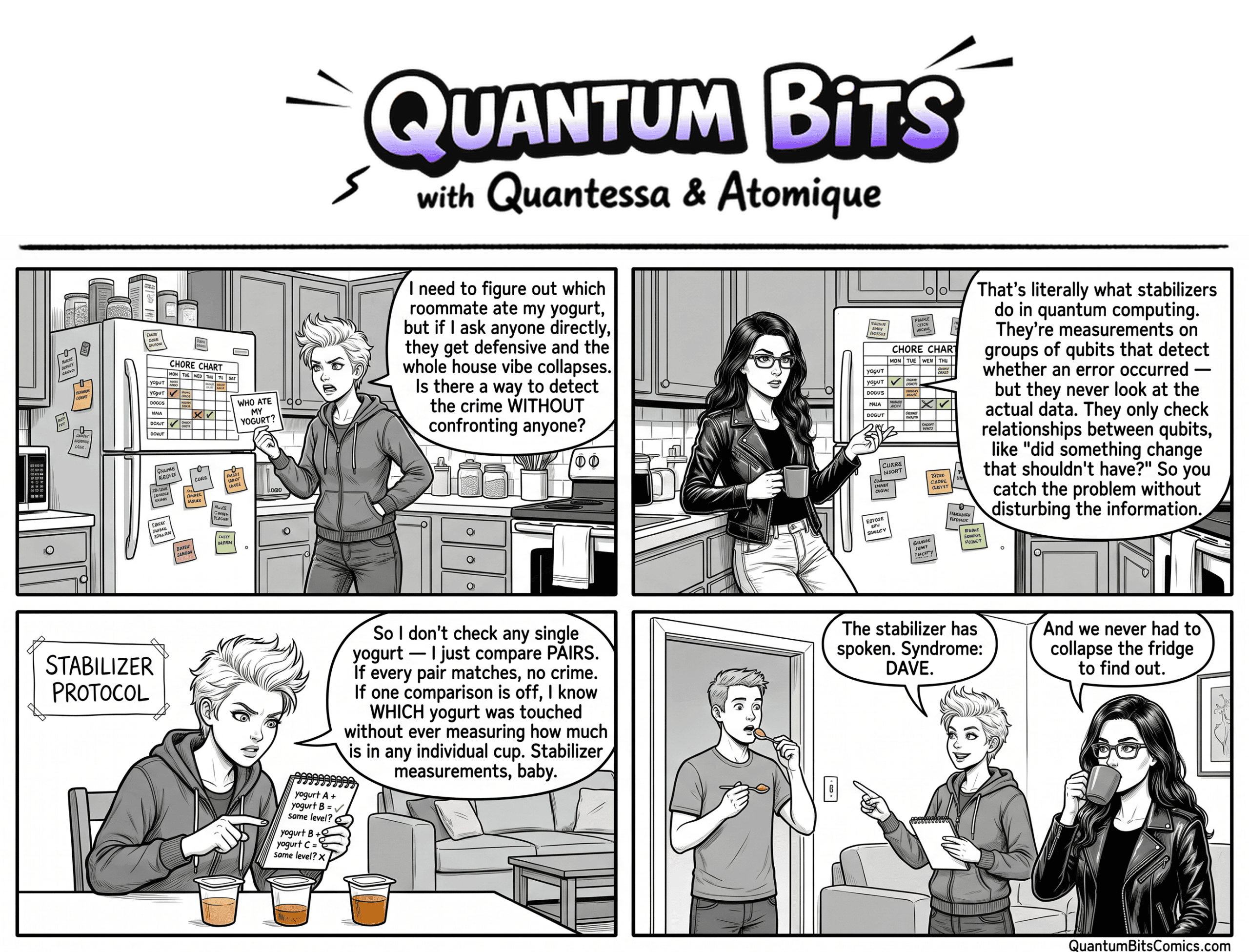
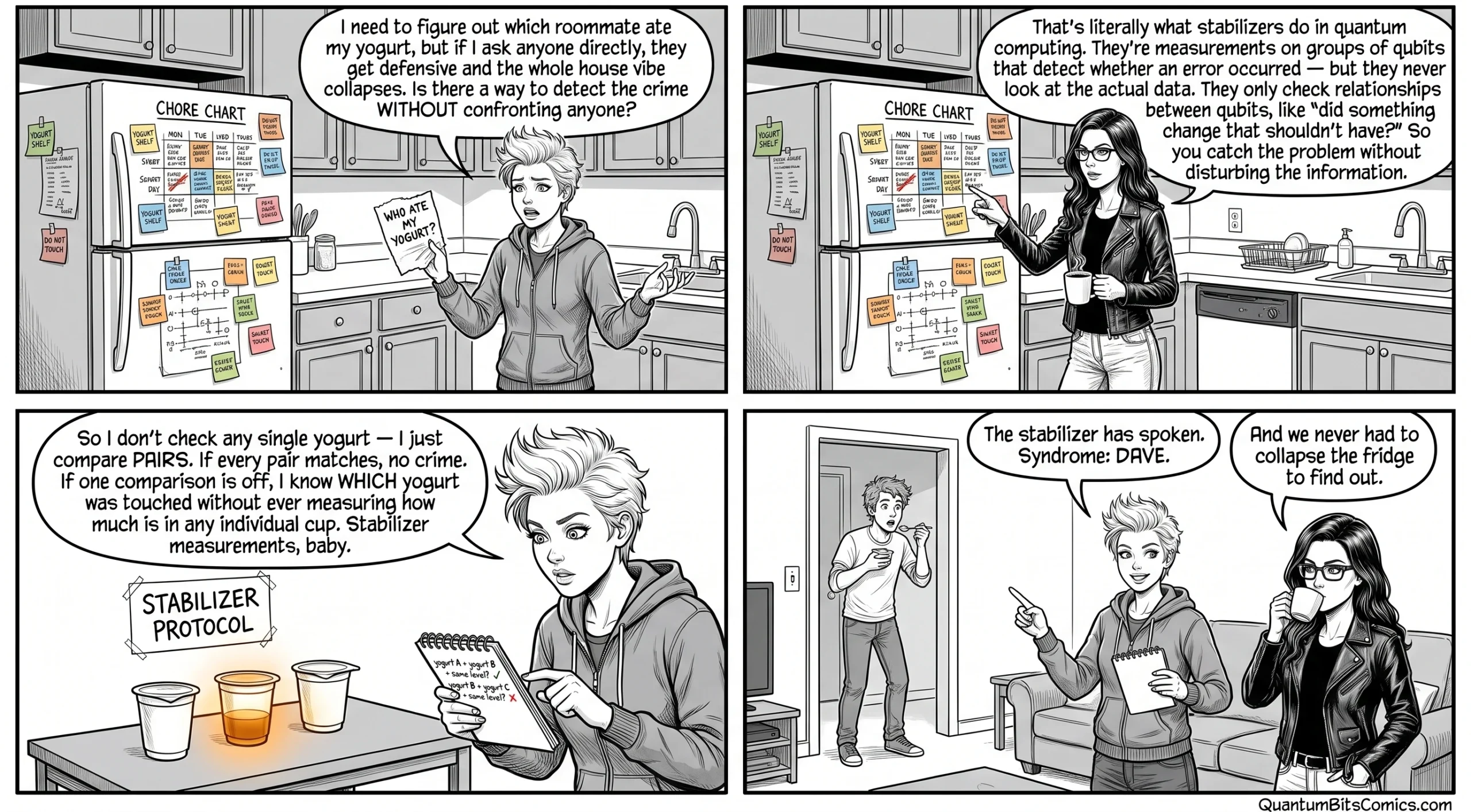
The solution is a mathematical and physical technique called a stabilizer measurement. Instead of asking a specific qubit what state it is in, a quantum computer asks a group of qubits if any of them have changed relative to one another. It does this by temporarily entangling the data qubits with an extra helper qubit, often called an ancilla, and then measuring only that helper.
Measuring the helper qubit yields a piece of classical information called a syndrome. This syndrome reveals the shared properties, or parity, of the group. If the readout shows an unexpected change, the system knows an error occurred on one of the data qubits. Crucially, because the measurement only extracted information about the relationship between the qubits, the underlying quantum information remains intact and unobserved. The term stabilizer comes from the mathematics of this process: measuring these specific properties actively forces the quantum state to remain stable within a defined, protected space.
Running these stabilizer checks is the heartbeat of a fault-tolerant quantum computer. In architectures like the surface code, data qubits are constantly entangled with helper qubits in an endless grid, checking for both bit-flip and phase-flip errors. Performing these checks is a massive engineering challenge. The helper qubits must interact with the data qubits, be measured, and be reset fast enough to catch errors before they cascade, all without introducing new errors during the measurement process itself.
When a hardware platform successfully performs these continuous stabilizer measurements faster than errors naturally accumulate, it crosses a critical threshold. At that point, the system is no longer just manipulating fragile physical qubits. It is maintaining a protected logical qubit, turning error-prone hardware into a reliable foundation capable of sustaining long, complex calculations.
Subscribe on Substack at https://qubitguy.substack.com/