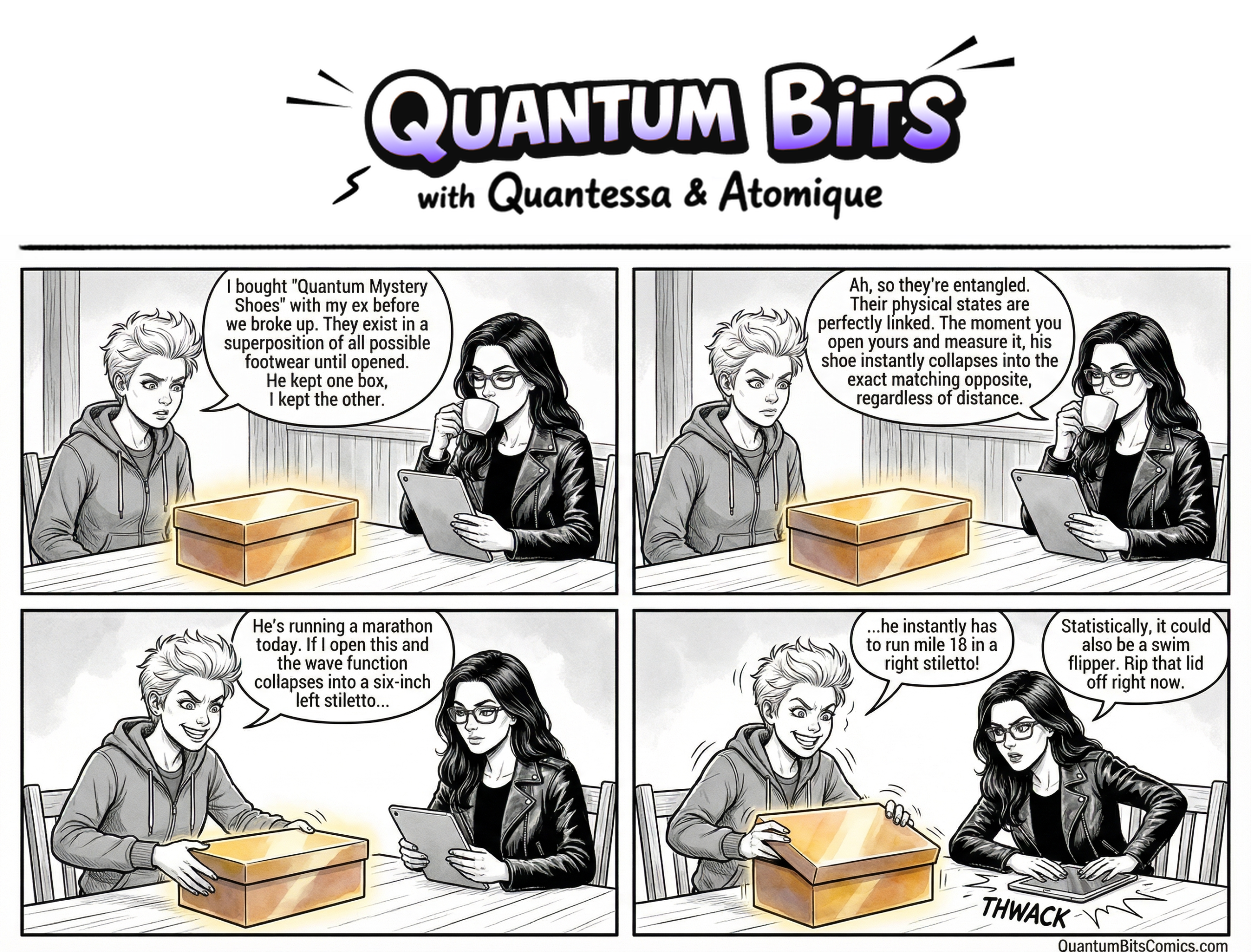
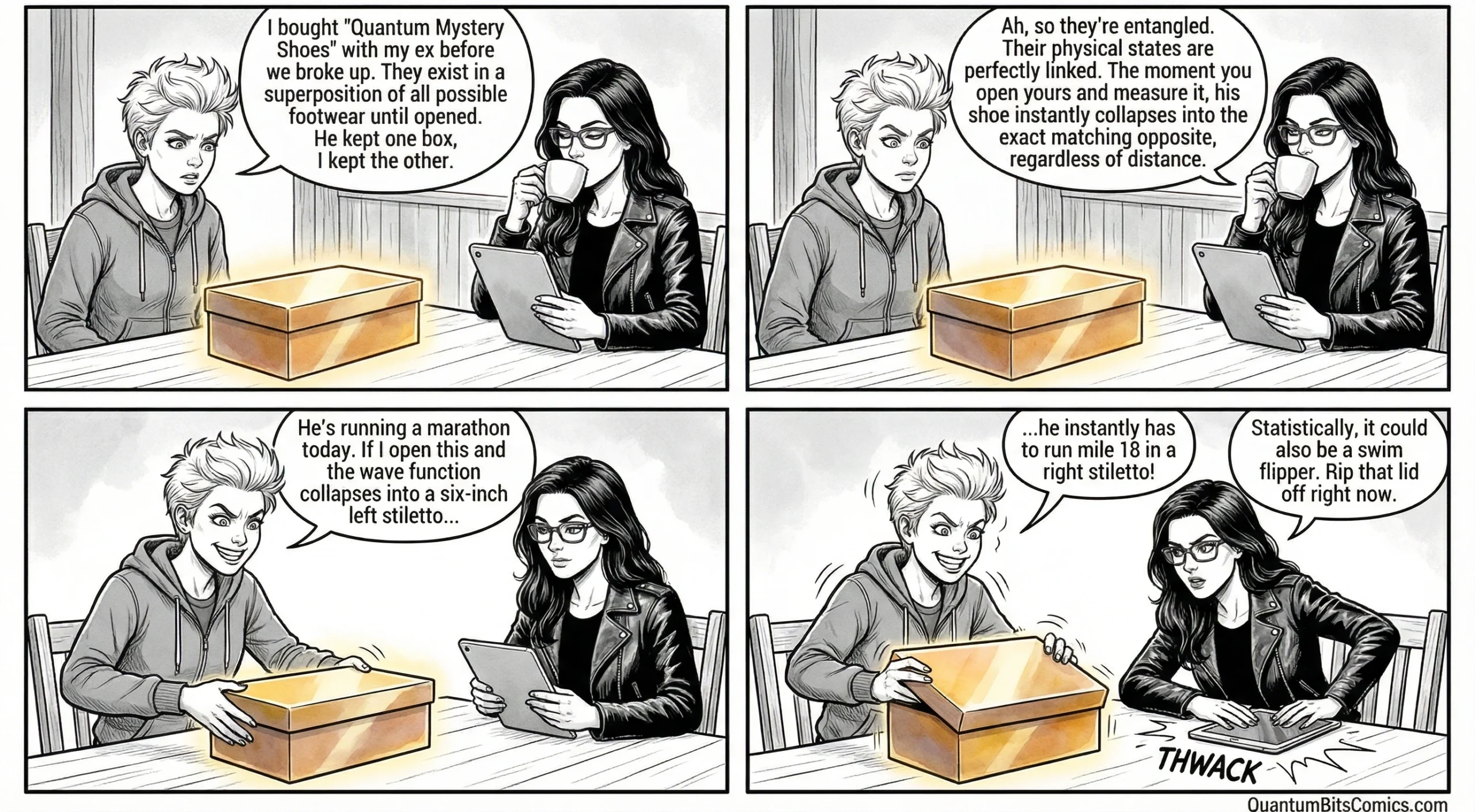
Entanglement is not just what happens when you pull your charging cables from your bag and find they are deeply connected. Some physicists would call that “string theory.” Quantessa explains what entanglement means in the quantum world.
In 1935, Einstein, Podolsky, and Rosen published a paper arguing that quantum mechanics must be incomplete. Their objection centered on a phenomenon that Einstein called “spooky action at a distance.” Today we call it entanglement, and it has become one of the most powerful tools in quantum computing.
When two qubits become entangled, their quantum states are no longer independent. Measuring one qubit instantly tells you something definite about the other, regardless of the distance between them. For example, in one type of entangled state called a Bell state, the qubits are perfectly anti-correlated: if you measure the first as 0, the second will definitely be 1, and vice versa. Other Bell states and entangled states produce different correlations: the qubits might always match instead, or their relationship might be more complex.
This is not the same as flipping two coins that were secretly programmed to match. In the 1960s, physicist John Bell established a mathematical limit on how strongly correlated two particles can be if their outcomes are predetermined. Entangled particles exceed that limit. Experiments have confirmed this repeatedly. The correlations are genuinely quantum, with no classical explanation.
For quantum computing, entanglement transforms a collection of qubits into something more powerful than the sum of its parts. It is what makes the state space of n qubits grow as 2^n rather than simply n. Without it, qubits would be independent coin flips offering no advantage over classical bits. With it, quantum algorithms can set up interference patterns across that exponentially large space, amplifying correct answers and suppressing wrong ones. This is what enables many quantum algorithms to outperform their classical counterparts.
Maintaining entanglement is difficult. Any interaction with the environment can cause decoherence, breaking the delicate quantum correlations between qubits. The practical challenge of preserving entangled states long enough to complete a computation is one of the defining problems in quantum engineering today.
Subscribe on Substack at https://qubitguy.substack.com/