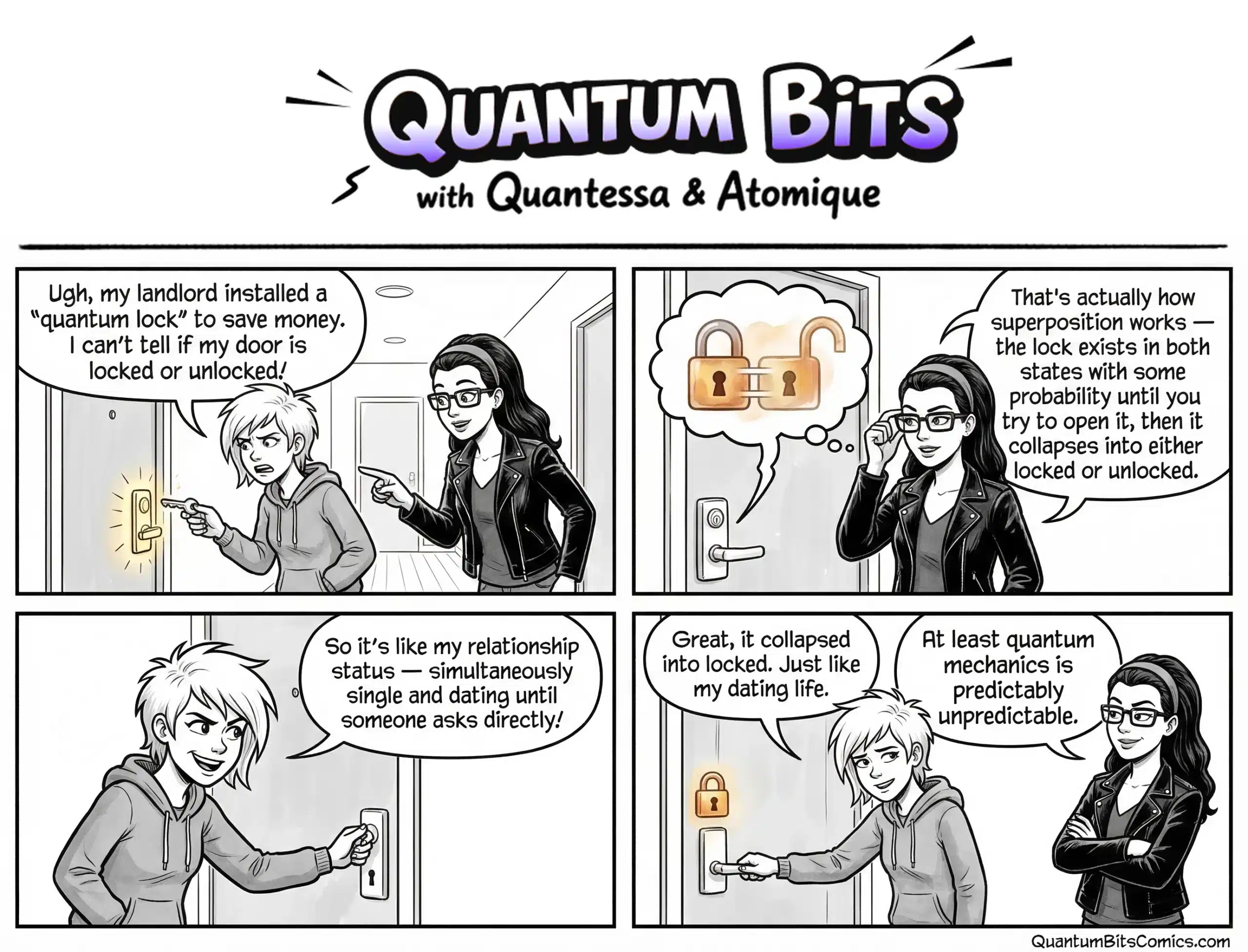

In everyday life, things have definite states. A coin on a table is either heads or tails. But at the quantum scale, particles don’t work that way. A quantum particle like an atom or an electron can be prepared so that its state isn’t determined yet. It has a set of probabilities for different outcomes, and only when you measure it does it land on a specific result. This is superposition: not “being in two states at once,” but existing in a state where the outcome is genuinely undetermined, with precise mathematical probabilities for each possibility.
What makes this useful, rather than just weird, is that quantum computers can manipulate these probabilities. A quantum algorithm carefully adjusts the probabilities across many qubits so that when measurement finally happens, the right answer is likely and the wrong answers mostly cancel out. It’s a bit like tuning a musical instrument so the note you want rings loud and the noise fades away. This ability to work with probabilities before measurement, rather than with fixed values, is what gives quantum computing its potential advantage for problems like molecular simulation, optimization, and cryptography. Superposition isn’t magic; it’s a precisely controllable physical property, and learning to harness it is what the entire field of quantum computing is built on.
Looking for a more detailed description? Find it at quera.com/glossary