
Buy the Books
Six books, two kinds. Quantum Bits explains quantum computing one term at a time, with Quantessa and Atomique as your guides. The Lost Manuscript of von Neumann tells a single story.


Which book is right for you?
Original, Neutral-Atom, HPC, Fault-Tolerant and Government are Quantum Bits editions; Lost Manuscript is the graphic novel.
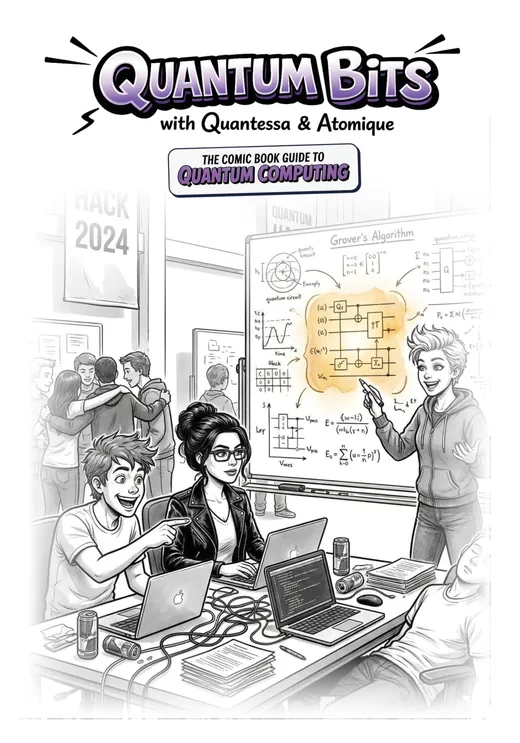 Quantum BitsOriginal Edition | 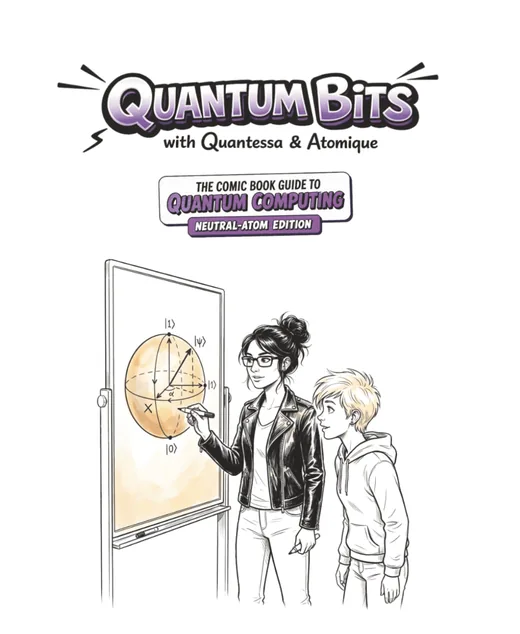 Quantum BitsNeutral-Atom Edition | 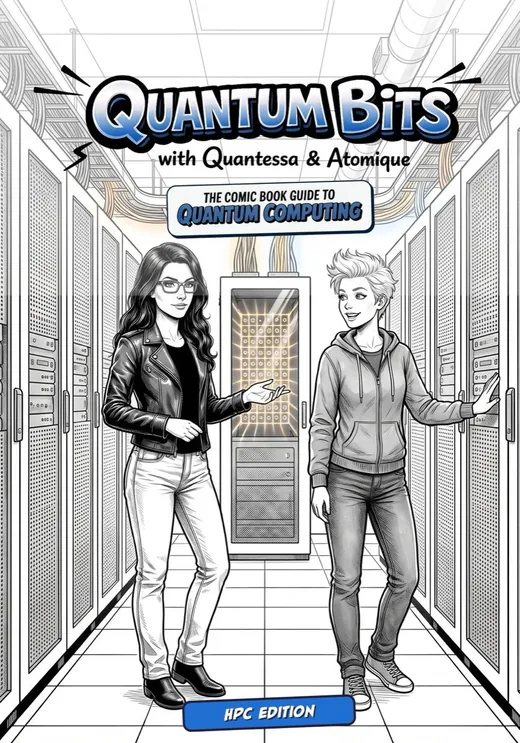 Quantum BitsHPC Edition | 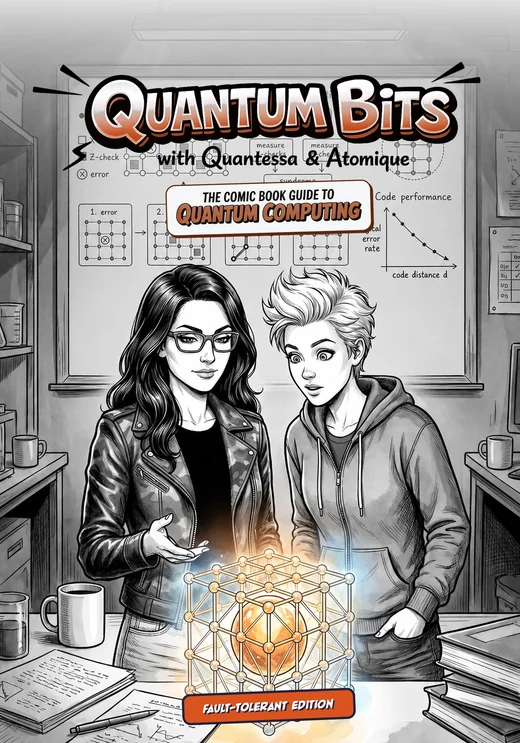 Quantum BitsFault-Tolerant Edition | 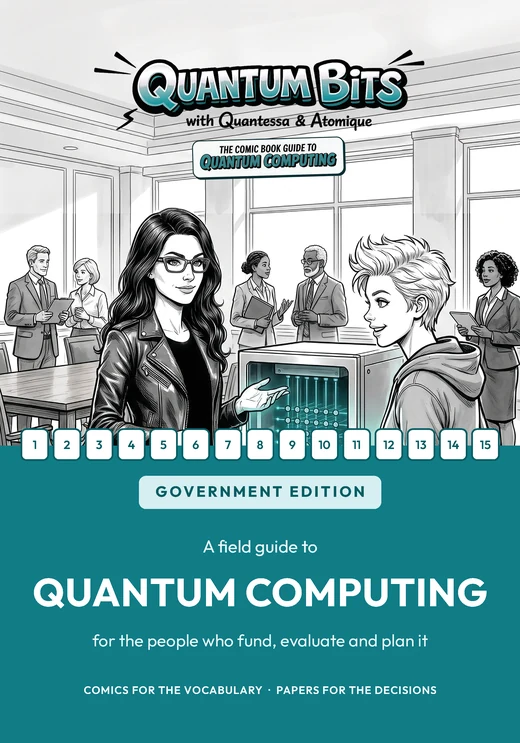 Quantum BitsGovernment Edition |  Graphic novelLost Manuscript | |
|---|---|---|---|---|---|---|
| What it is | Comic glossary of quantum computing | Short comic introduction to one technology | Comics plus a planning guide for quantum in HPC centers | Comic guide to error correction and fault tolerance | Comics plus 15 briefing papers for government decisions | Graphic novel: an alternate-history mystery |
| Who it’s for | Anyone who wants the broadest introduction, or a desk reference | Newcomers curious about neutral-atom quantum computers | Managers of supercomputing and research computing centers | Readers who want to know how quantum computers will become reliable | People who fund, evaluate and plan public quantum programs | Readers who enjoy history, mysteries and the big questions in physics |
| Length | 120+ terms, one comic each | About 35 comics | 44 comics plus reference sections | 66 comics, plus a primer and a glossary | 34 comics plus 15 papers | About 140 pages |
| How to read it | Dip in anywhere | Cover to cover in one sitting | Read through, then keep the reference pages at hand | Front to back; each part builds on the last | Comics for the vocabulary, then the papers for your decisions | Front to back, like a novel |
| Languages | English | English | English | English | English | English and French |
| Published | May 2026 | April 2026 | October 2026 | November 2026 | Coming soon | October 2026 |
| Get it | Buy on Amazon | Buy on Amazon | Buy on Amazon | Buy on Amazon | Coming soon | Buy on Amazon |
Quantum Bits – Original Edition
The first Quantum Bits book, and the broadest. It explains more than 120 quantum computing terms, from qubits, superposition and entanglement to algorithms, error correction and every major hardware approach: superconducting, trapped-ion, neutral-atom, photonic and more. Each concept gets its own comic strip and a plain-language explanation.
Best for: Anyone who wants the broadest introduction, or a desk reference for terms that come up in the news and in meetings.
Quantum Bits – Neutral-Atom Edition
A shorter, focused book. About 35 comics chosen for neutral-atom quantum computing: qubits and gates, how atoms are trapped and controlled with lasers, and the road to fault tolerance. It is a quick read with the same characters and the same jargon-free explanations.
Best for: Newcomers who want a short introduction built around one technology, and readers curious about how neutral-atom quantum computers work.
Quantum Bits – HPC Edition
For the people who run supercomputing centers. Quantum computers are moving into HPC centers, and the people who run those centers are being asked to host them, connect them and keep users happy. The comics cover what that takes: site requirements and calibration windows, procurement and acceptance tests, batch queues and middleware, the classical computing behind error correction, the workloads with real promise, and running quantum as a service.
More than comics. The book also includes:
- A five-minute primer on quantum computing for HPC managers
- A decision guide that points each common question, from first exploration to running a service, to the right comic or page
- A stage-by-stage plan for a first quantum pilot, with a worked example of a fault-tolerant chemistry project
- A worksheet for the full cost of a quantum program, beyond the purchase price or cloud bill
- How to choose between cloud, dedicated access and an on-site system, and when an installation is justified
- Who owns what: integration and support responsibilities between your team and your suppliers
- Where the classical work runs, how to match hardware capabilities to workloads, and how to keep results reproducible
- Notes and sources for time-sensitive claims, checked as of October 2026
Best for: Directors and managers of supercomputing centers, national-lab and university research computing, and enterprise HPC teams.
Quantum Bits – Fault-Tolerant Edition
Today’s quantum computers make mistakes. A qubit forgets its state, a gate misfires, a measurement misreads, and over a long calculation those errors pile up. This edition is about the fix: fault-tolerant quantum computing, the science of building a reliable machine out of unreliable parts.
It follows one thread from start to finish: why quantum information is so fragile, how error correction protects it, and what it takes to finish a long computation with an answer you can trust. Logical qubits, surface codes, syndromes and decoders, magic states and transversal gates each get their own comic and a plain-language explanation.
A short primer maps the road to fault tolerance. Then come eight parts:
- Part 1 · Qubits, and Why They Break
- Part 2 · Finding and Fixing Errors
- Part 3 · Codes and Other Ways to Protect Qubits
- Part 4 · Decoding: Making Sense of the Clues
- Part 5 · Computing Without Losing the Plot
- Part 6 · The Qubit Zoo: Hardware Platforms
- Part 7 · A Closer Look: Neutral Atoms
- Part 8 · Useful Quantum Computing: What Will It Take?
Best for: Executives, students and engineers who want the big picture of quantum error correction without the heavy math.
Quantum Bits – Government Edition
Quantum computing has reached the desks of the people who fund, evaluate and plan public programs. This edition is written for them, assumes no physics background, and comes in two parts: comics for the vocabulary, and papers for the decisions.
Part One has 34 Quantum Bits comics, from qubits and error correction to benchmarks, milestones, hosting, post-quantum cryptography and export controls. Each comes with a plain-language explanation and a pointer to the paper that goes deeper.
Part Two is the briefing: the fifteen papers of the series Quantum Computing for Government: Evidence and Decisions, sponsored by QuEra Computing and current as of November 2026. Each paper takes one decision and works through the evidence, keeping what has been demonstrated apart from what is projected. Each has a decision tool (a checklist, worksheet, matrix or register), a closing checklist, a technical note with the numbers behind it, and references labeled peer-reviewed, preprint, government or vendor publication. The back of the book collects all fifteen checklists, with reading paths by role and an index.
The fifteen papers in Part Two:
- What Is Demonstrated, What Is Projected, and What Remains Uncertain How to sort quantum announcements into results, projections and open questions, and why government has reasons to engage now.
- Beyond Qubit Counts: How to Evaluate Quantum Computing Progress What makes a new result credible and relevant to a mission, beyond a qubit count or a claim of beating a supercomputer.
- From Physical Qubits to Fault-Tolerant Computing How error correction combines many error-prone qubits into one reliable logical qubit, and how far that has come.
- Quantum Hardware Choices: Understanding the Trade-offs The competing ways to build a quantum computer, what the evidence shows for each, and why there is no winner yet.
- Quantum Computing in National HPC Infrastructure Quantum computers in supercomputing centers: which research needs them, buying access or hosting hardware, staffing, and judging value.
- Buying Progress: Designing Government Quantum Programs with Measurable Milestones How to fund and buy quantum progress against milestones that can be checked, when roadmaps describe targets rather than deliveries.
- Selecting Quantum Applications for Public Missions Which of the many proposed uses deserve a pilot, and how mission owners can choose them.
- Building National Quantum Capability Through Collaboration What to build at home, what to obtain through partners, and how to tell whether public money is producing lasting capability.
- Quantum Computing and AI: Evaluating the Evidence The three different claims behind “quantum AI”, and how to judge a proposal by which one it makes.
- Quantum Computing and Cybersecurity: Planning Under Uncertainty Planning the move to post-quantum cryptography without knowing when a code-breaking quantum computer might arrive.
- What to Expect from the First Fault-Tolerant Quantum Computers What the error-corrected machines targeted for 2027 to 2029 are likely to offer, and what agencies should ask of them.
- Hosting a Quantum Computer: Power, Facilities, and Siting Whether a particular room can support a particular machine, and how to read the published power and facility figures.
- Budgeting for Quantum Computing: The Full Cost of a Public Program The costs beyond the hardware contract or access fee: facilities, integration, staff, independent testing, upgrades and retirement.
- Building Quantum Expertise Inside Government Why agencies need people of their own who can tell a strong claim from a weak one, and how to build that expertise.
- Quantum Supply Chains and Export Controls: Managing Critical Dependencies The lasers, optics, cooling, chips and control electronics behind a program, and the dependencies and export controls that come with them.
Best for: Budget analysts, program managers, legislative and agency staff, national laboratory leaders and state economic development officials.
The Lost Manuscript of von Neumann
A graphic novel by Lionel Martellini and Yuval Boger, and a separate book rather than a Quantum Bits edition. In our world, von Neumann’s 1932 masterwork unified quantum physics. In this alternate history it vanishes, and two investigators in pre-war Europe set out to find it.
Along the way they put Einstein, Bohr, Heisenberg and Schrödinger in front of a tribunal and rebuild a forgotten idea: potentiality. It uses real mathematics, real historical figures and the real dispute over what quantum mechanics means.

As an Amazon Associate, we earn from qualifying purchases. Purchases made through the Amazon links on this page may earn us a small commission at no extra cost to you.
Coming soon
More editions are on the way, each one a selection of comics for a particular audience or topic. Subscribe on Substack, or contact us to hear when they come out.
Tell me whenNeed a book for your own audience?
Custom editions for your organization, conference or classroom, possibly in another language.
See custom editions →