Quantum Bits is intended to introduce quantum computing terms in a fun and accessible way. It is a personal project of Yuval Boger, whose day job is Chief Commercial Officer at QuEra Computing. You might also know Yuval from his Superposition Guy's Podcast series (listen here)


Latest Posts

Quantum Hype

Quantum Hype — Quantum Bits Comic Strip

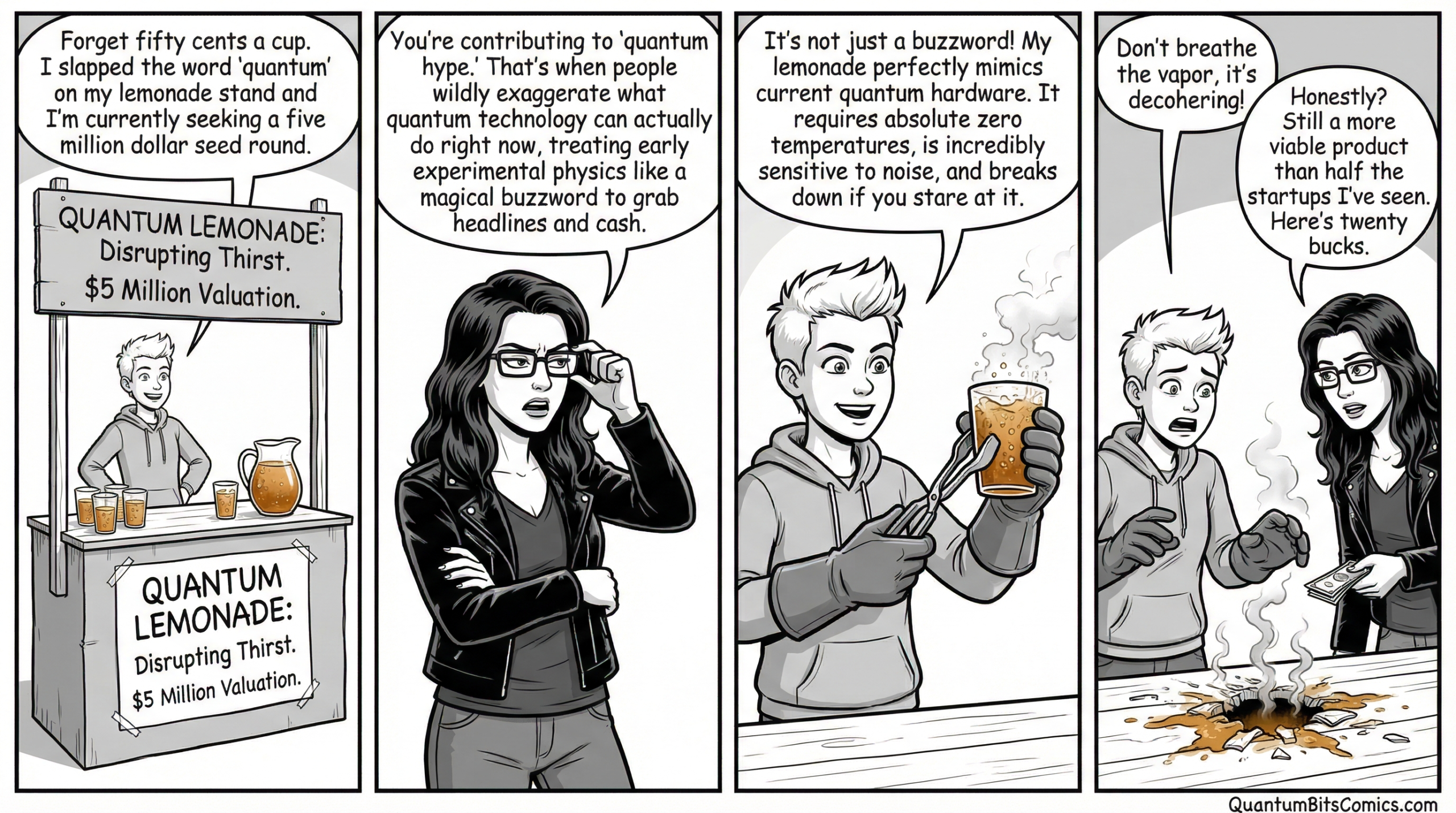
Imagine walking through an auto show and seeing a sleek, glowing concept car. The builder promises it will soon fly you to work while you sleep. That sounds amazing, but the cars actually driving outside are still running on gas and struggling with traffic. Quantum computing faces a similar gap between grand promises and daily reality. This gap is called quantum hype. You often read headlines claiming these new machines will instantly cure diseases or break all internet security tomorrow. The truth is much slower. Scientists are still struggling to build machines that can perform basic tasks without making constant errors.

Currently, these computers are incredibly sensitive. A slight change in room temperature can ruin a calculation. We do not have machines that can replace your regular laptop. Instead of a magical problem solver, a quantum computer today is more like a delicate science experiment. Researchers spend most of their time just figuring out how to keep the machine stable. Cutting through this exaggeration matters because real scientific progress requires patience. If people expect miracles by next year, they might abandon the technology when those miracles fail to arrive. By focusing on actual engineering hurdles instead of science fiction, scientists can secure the steady support they need. This long-term work might eventually help us build reliable computers to design better batteries or discover new medicines.


Quantum Superposition

In everyday life, things have definite states. A coin on a table is either heads or tails. But at the quantum scale, particles don’t work that way. A quantum particle like an atom or an electron can be prepared so that its state isn’t determined yet. It has a set of probabilities for different outcomes, and only when you measure it does it land on a specific result. This is superposition: not “being in two states at once,” but existing in a state where the outcome is genuinely undetermined, with precise mathematical probabilities for each possibility.

What makes this useful, rather than just weird, is that quantum computers can manipulate these probabilities. A quantum algorithm carefully adjusts the probabilities across many qubits so that when measurement finally happens, the right answer is likely and the wrong answers mostly cancel out. It’s a bit like tuning a musical instrument so the note you want rings loud and the noise fades away. This ability to work with probabilities before measurement, rather than with fixed values, is what gives quantum computing its potential advantage for problems like molecular simulation, optimization, and cryptography. Superposition isn’t magic; it’s a precisely controllable physical property, and learning to harness it is what the entire field of quantum computing is built on.

Looking for a more detailed description? Find it at quera.com/glossary

Schrödinger’s Cat

In 1935, physicist Erwin Schrödinger proposed a thought experiment to show how strange quantum mechanics really is. Imagine you put a cat in a sealed box with a tiny bit of radioactive material, a detector, and a vial of poison. If the detector senses a radioactive decay (which is a random quantum event), the vial breaks and the cat dies. If it doesn’t, the cat lives. According to quantum mechanics, until you open the box, the radioactive atom hasn’t decayed or not decayed; it’s in a probabilistic state where both outcomes have some likelihood. That means, following the math strictly, the cat’s fate is tied to that quantum uncertainty.

Schrödinger wasn’t saying cats are actually alive and dead at the same time. His point was the opposite: something seems wrong when you extend quantum rules from tiny particles to everyday objects like cats. At the atomic scale, particles genuinely behave probabilistically, and experiments confirm this. But somewhere between an atom and a cat, those quantum probabilities resolve into the definite reality we experience. Figuring out exactly how and why that transition happens is still one of the open questions in physics. The thought experiment was never meant to be taken literally; it was Schrödinger’s way of saying “this can’t be the whole story,” and physicists are still working on the rest of it.

Looking for a more detailed description? Find it at quera.com/glossary

Qubit – A Quantum Bit

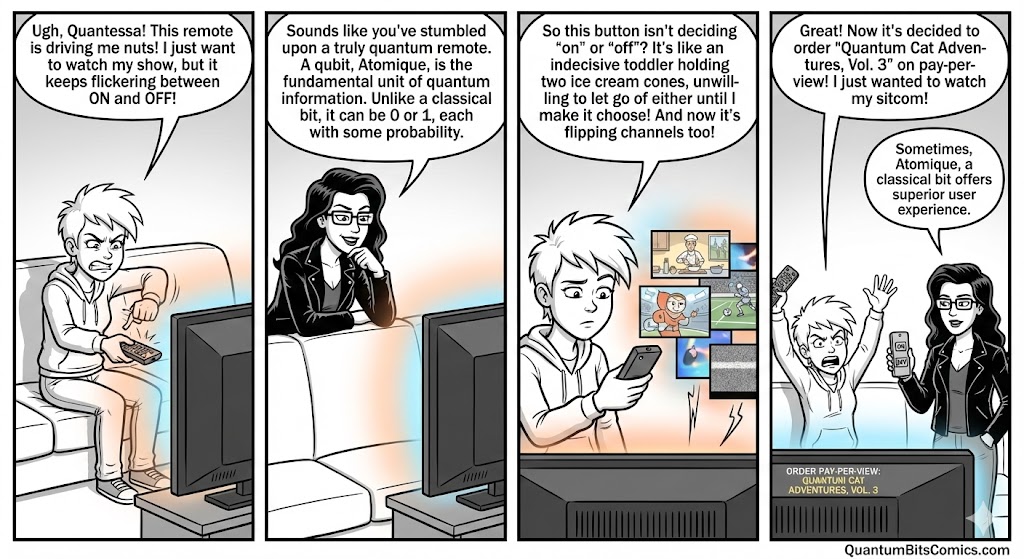
A regular computer stores everything as bits, and each bit is either a 0 or a 1. Think of it like a light switch: off or on, nothing in between. A qubit (short for “quantum bit”) is the quantum computing version, but it works differently. A qubit can be set up so that when you measure it, there’s some probability of getting a 0 and some probability of getting a 1. You can tune those probabilities precisely. It’s not that the qubit is “both at once” in some magical way; it’s that the outcome is genuinely uncertain until measurement, and that uncertainty is a resource you can manipulate.

The power comes when qubits work together. The probabilities of different qubits become correlated through a property called entanglement, meaning the measurement outcomes are linked in ways that classical bits can’t replicate. Quantum algorithms exploit these correlations to make correct answers more probable and wrong answers less probable, so that when you finally measure, you’re likely to get something useful. This gives quantum computers an edge for certain problems, like simulating molecular behavior for drug discovery or optimizing complex logistics. We’re still in the early stages of building reliable, large-scale quantum computers, but the qubit is the fundamental building block that makes all of it possible.

Looking for a more detailed description? Find it at quera.com/glossary

What is “Quantum Advantage”?

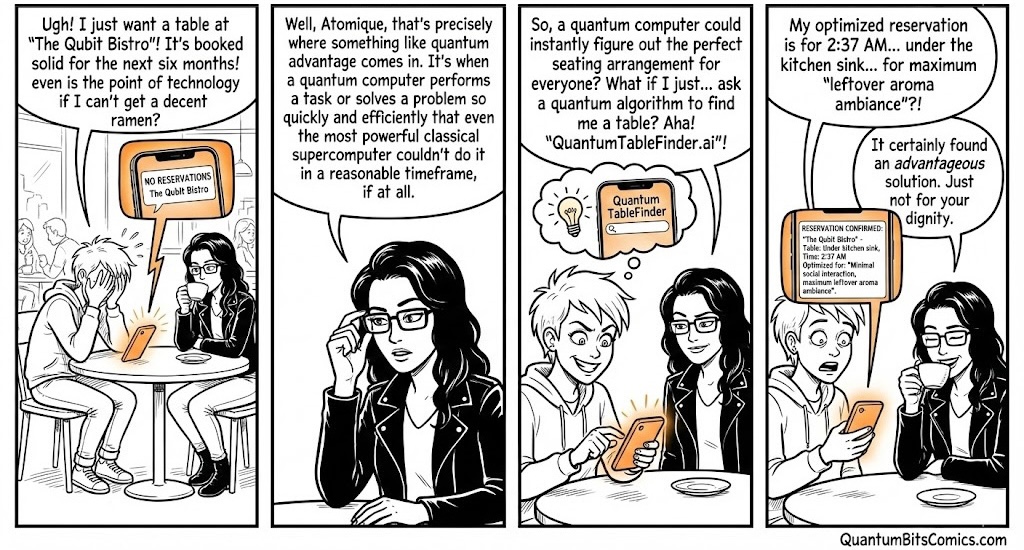
Quantum advantage is the point where a quantum computer can solve a specific problem faster or better than even the most powerful traditional (classical) computers in the world.

This doesn’t mean quantum computers are faster at everything. They won’t load your web browser quicker or run video games better. But for certain hard problems, like simulating how molecules behave to design new drugs, or optimizing complex logistics routes, they can potentially do in minutes or hours what a classical supercomputer would need thousands or even millions of years to finish. Quantum advantage is the milestone where that speedup stops being theoretical and starts being real and useful for practical problems people actually care about.

Looking for a more detailed description? Find it at quera.com/glossary

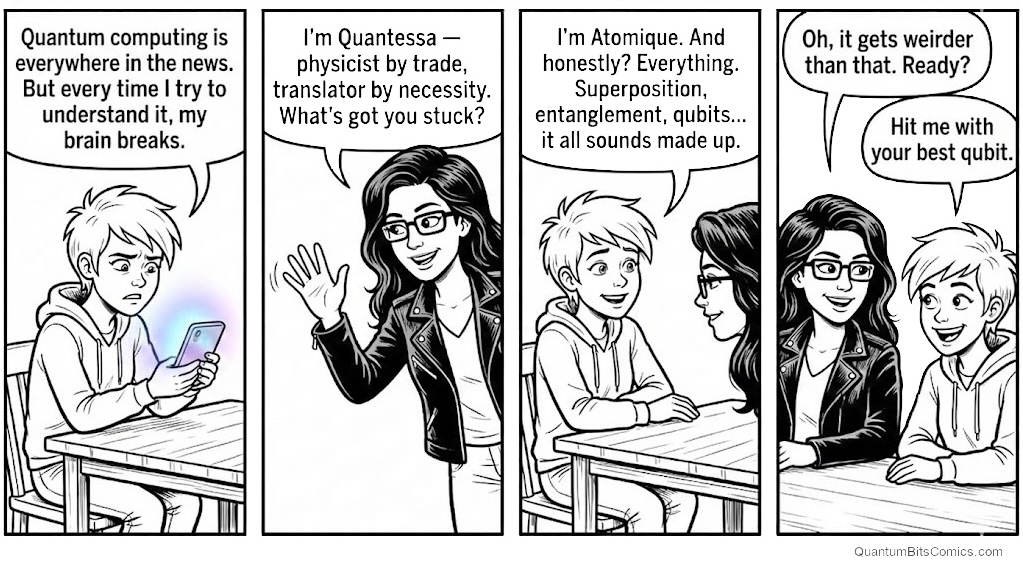
Introducing Quantessa and Atomique

Today I’m launching a personal project I’ve wanted to ship for a while — quantum comics.

Tomorrow, Sunday, and on future Sundays, I’ll post a new “Quantum Bits” strip featuring my two heroines, Quantessa and Atomique.

As a kid, I was always looking forward to the Sunday comics. Ripping open the newspaper, spreading the colorful pages across the floor — that was the highlight of the week. Peanuts, Garfield, Dennis the Menace, Doonesbury, Spider-Man — I devoured them all.

Years later, I was delighted to take my kids to the Charles M. Schulz Museum in Santa Rosa, California, celebrating the creator of Peanuts. Seeing his original strips up close reminded me how much a simple comic can spark curiosity and joy.

Sunday has been the day for comics since newspapers started printing them in the 1890s. Color printing, bigger pages, families with time to read — Sunday was made for comics. And for me, it was pure magic.

I think quantum computing deserves its own version of that magic.

Quantum can feel intimidating. Superposition, entanglement, error correction — these concepts matter, but they’re often buried in jargon or lost in hype. Quantum Bits is my attempt to change that. Each Sunday strip will take a quantum term or idea and trying to make it accessible, visual, and — I hope — fun.

No PhD required. Just Quantessa, Atomique, and a few laughs along the way.